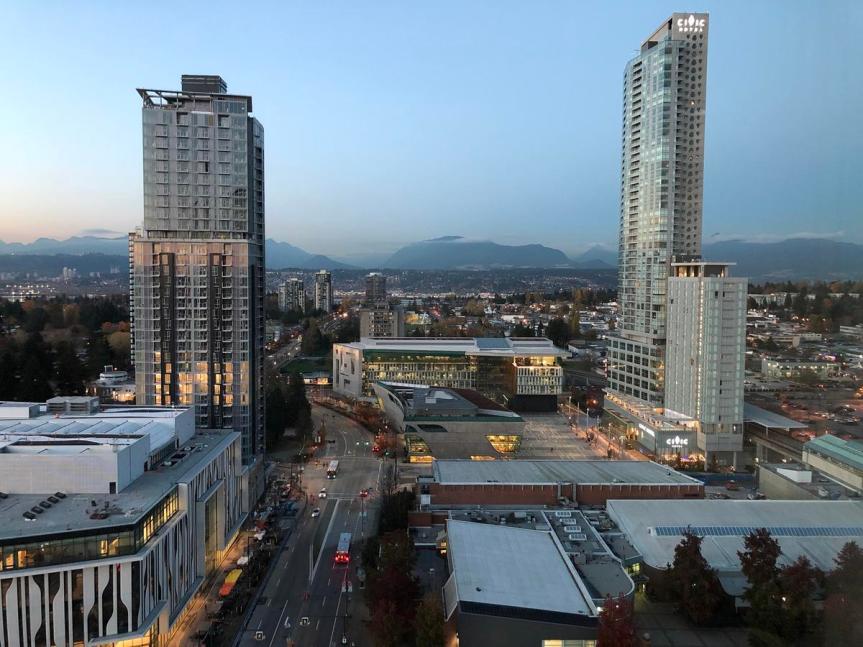
A date has finally been set for the official closure of the North Surrey Recreation Centre to make way for the site’s long anticipated redevelopment. In a notice posted on the recreation centre website, the facility is planned to close in 2 phases beginning with a decommissioning of the ice rinks in early September, and finally a closure of the remaining portions of the building on December 22. Ice rink programming will move to the new North Surrey Sport & Ice Complex, set to open on September 3 near Scott Road Station. Following that in January, Aquatics programs will move to Guildford Recreation Centre, fitness and multi-purpose activities to North Surrey Sport & Ice Complex, and preschool programs to Chuck Bailey Recreation Centre.
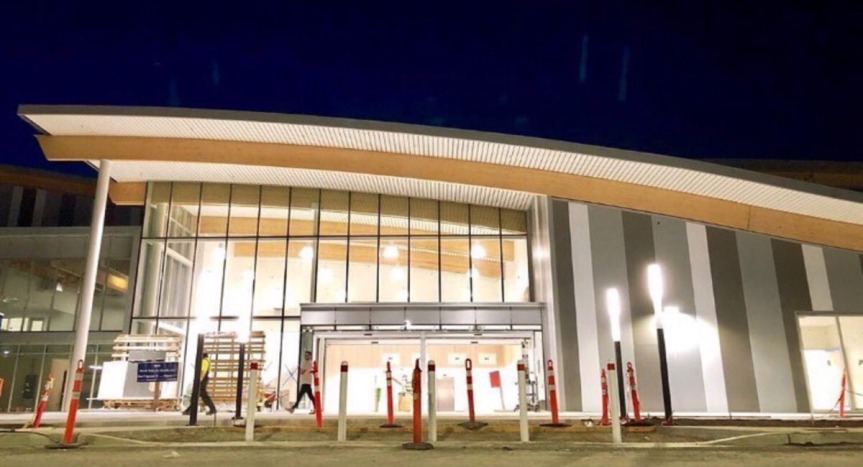 New North Surrey Sport & Ice Complex
While no timeline has been given for the site’s redevelopment following decommissioning, behind-the-scenes planning work has been underway for years, dating back to 2012. Since then, the City has been working with Simon Fraser University, TransLink, and various architects, planners, and consultants, on a master plan for what is known as the ‘Centre Block’ bounded by Central Avenue to the north, 102 Avenue to the south, University Drive to the west, and City Parkway to the east. Well-positioned adjacent to Surrey Central SkyTrain Station, the site forms a key link between Surrey City Hall / Civic Plaza to the north, and the Central City Complex and beyond to the south.
Back in 2013, Via Architecture prepared a ‘vision’ for what redevelopment could look like in the future. The concept envisioned a numerous mixed-use buildings for the site integrated with a transit-oriented plaza linking City Hall to Central City. The buildings would contain office, university, and retail space. The plan also envisioned:
- A new bus layover facility to be located on 133A St behind the new SFU Engineering building.
- A removal and re-configuring of the Surrey Central Bus Exchange – replacing the loop with a new street-oriented exchange along a realigned 102A Avenue and Central Avenue. The 2 streets would be integrated with a new Transit Plaza, designed to accommodate high pedestrian and bus passenger volumes.
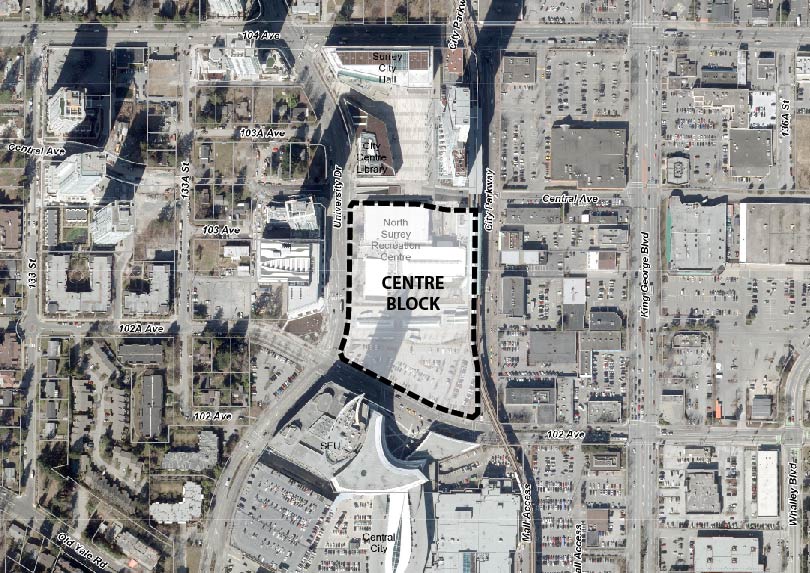 Centre Block location between Civic Plaza and Central City
 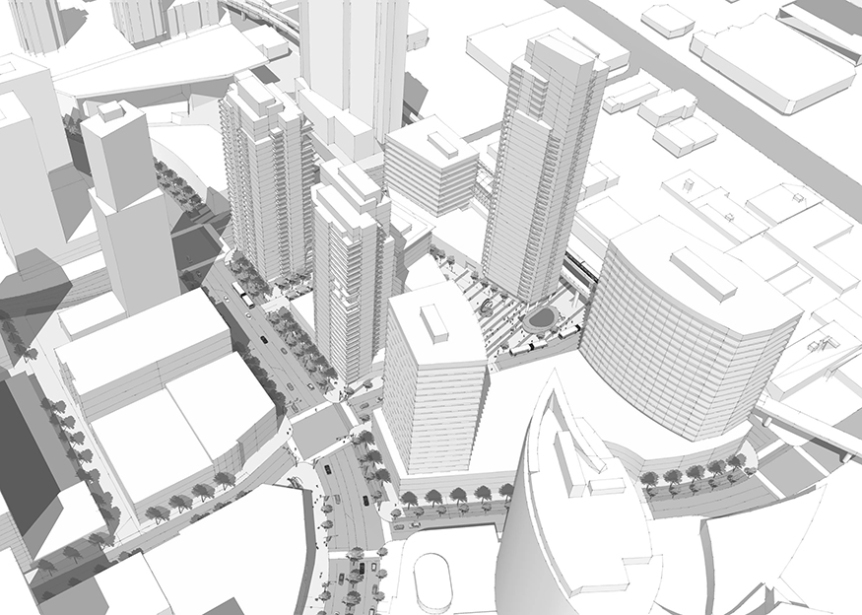 Early vision for the Centre Block prepared by Via Architecture in 2013
Since the early Via Architecture vision, a more recent planning process has been underway following a Surrey City Development Corp (SCDC) RFP was filled seeking a new firm to undertake detailed master planning work for the Centre Block site. While no plans have been publicly released yet, what is expected is a major overhaul of Surrey Central Station linked with a new transit-oriented plaza connecting Civic Plaza to Central City, and integrated with over 2 million square feet of new office, university, and retail space. With such a large scale, the plan is expected to be completed in phases, with various puzzle pieces and phasing needing to take place before other phases can begin. The first of those pieces is the decommissioning and demolition of the North Surrey Recreation Centre. The second will be the construction of the new bus layover facility on 133 Street, allowing for removal of the current Bus Loop, and re-alignment of 102A Avenue through it.
With the North Surrey Rec Centre decommissioning now in sight, the pieces are finally coming together to make the Centre Block redevelopment a reality. While the project is likely to take at least a decade to build-out, we could see the start of application activity related to it in the coming year.
For more on the North Surrey Recreation Centre closing:
https://www.surrey.ca/bylawsandcouncillibrary/CR_2019-R133.pdf
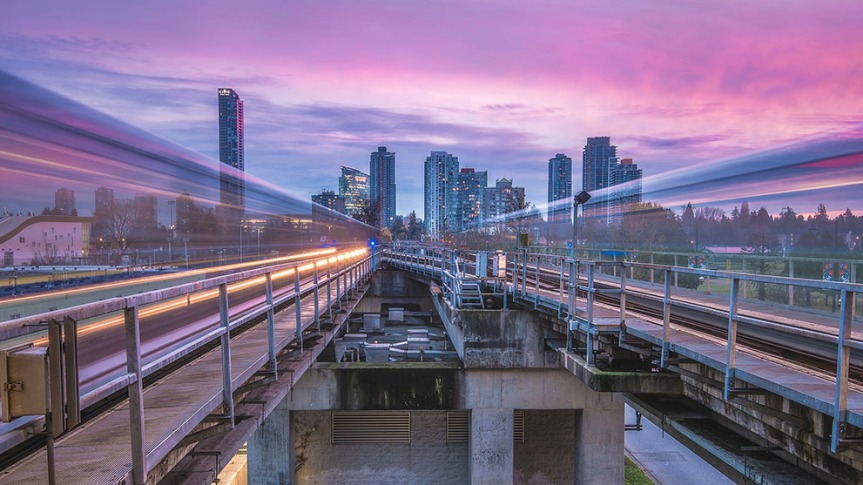
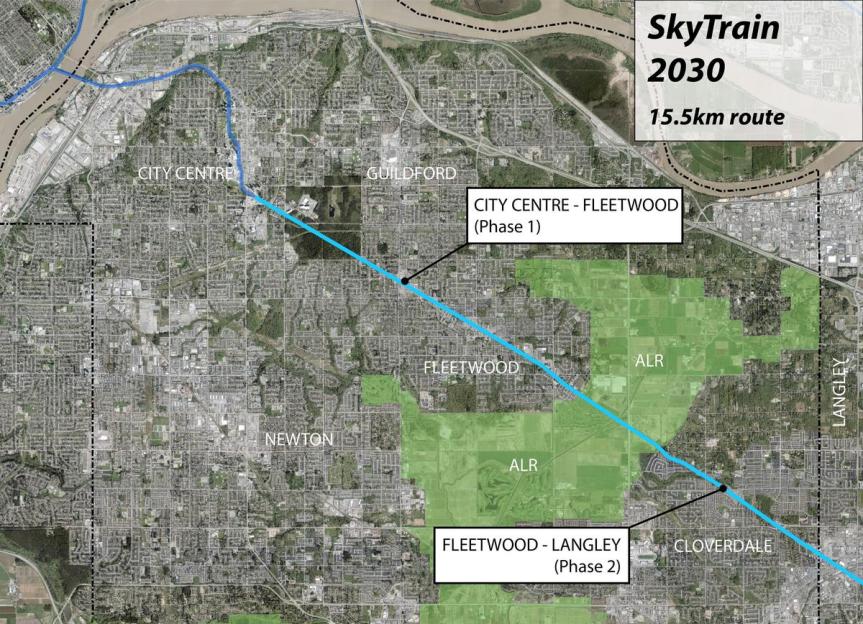
With yesterday’s Mayors Council vote in favour of finalizing the business case for the Surrey-Langley SkyTrain project, it is now certain that SkyTrain will be extended along Fraser Highway, but only as far as Fleetwood within the foreseeable future. As expected, the 1.65 billion in funding currently secured for rapid transit in Surrey will only allow for a 7km / 4 station extension of the Expo Line from King George Station to 166 Street, not to be in service until the end of 2025. With no funding secured, and no timeline in place for a phase 2 extension to Langley, it’s unlikely that SkyTrain will reach Langley before the 2030’s.
Given the decision to go ahead with SkyTrain on Fraser Highway, Surrey’s most urban corridors of 104 Ave and King George Blvd serving the 2 largest Town Centres of Guildford and Newton will likely now see no rapid transit for the next decade, due to the limited 3.55 billion funding envelope (with 1.9 billion yet to be secured) for rapid transit South of the Fraser. This funding envelope would have provided Surrey 27km of LRT across the city, including both the Guildford-City Centre-Newton ‘L’ line, and Fraser Hwy line to Langley. With SkyTrain, Surrey will just receive a single 16.5km line down Fraser Highway instead, along a corridor much more suburban in form, and with much less opportunity for land assembly to higher densities to support a SkyTrain line.
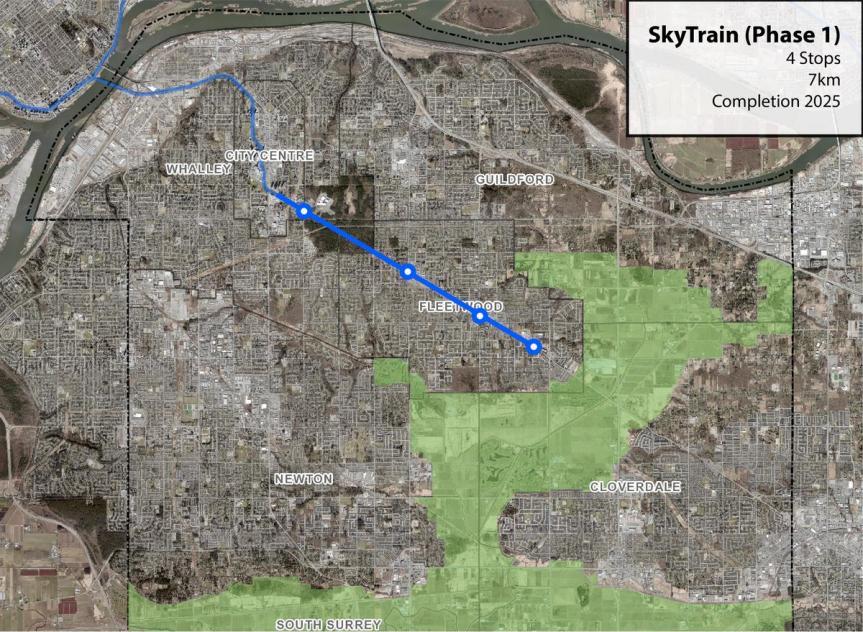
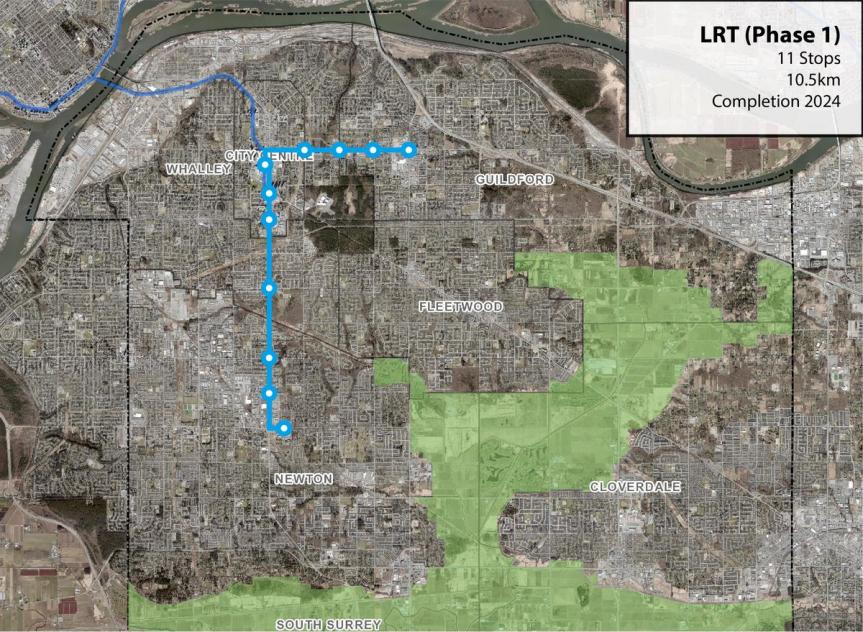
While rapid transit to Langley is definitely a good thing, the reality of the line not likely reaching Langley until the 2030’s, while rapid transit elsewhere in Surrey is stalled, is very unfortunate when Surrey could have had a full 19-Stop (27km) LRT system across the City inclusive of Langley within the same timeframe as an 8-Stop (16.5km) SkyTrain line. LRT additionally would have transformed, urbanized, and distinguished Surrey in ways that SkyTrain will not. LRT and trams are common fixtures and symbols of inner urban cores in major cities around the world, of which Metro Vancouver currently lacks. Cities such as Berlin, with robust multi-tiered rail transit networks, are embarking on major expansions of their LRT networks, on top of their existing metro rail networks. LRT would have urbanized and distinguished Surrey as a city on its own, as an inner core of the region. With SkyTrain, Surrey remains similar to Burnaby, a by-pass suburb along the line to Vancouver. This is not to mention, the negative effects of SkyTrain on the streetscape – obtrusive overhead guideways that cast shadows, are noisy, unsightly, and ultimately very suburban in nature, compared to urbanized street-integrated LRT which can transform a city and its streetscapes.
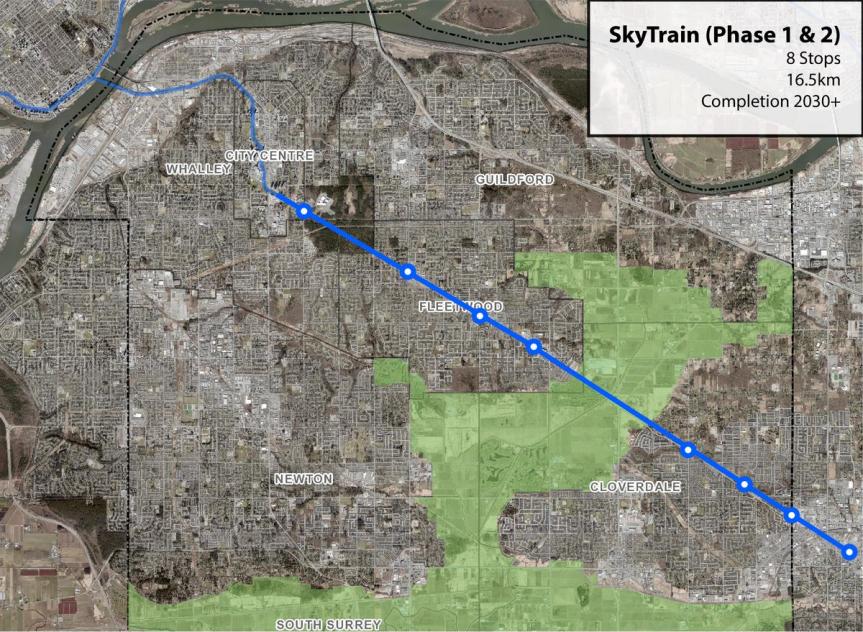 Eventual 8-Stop (16.5km) SkyTrain to Langley by 2030’s
 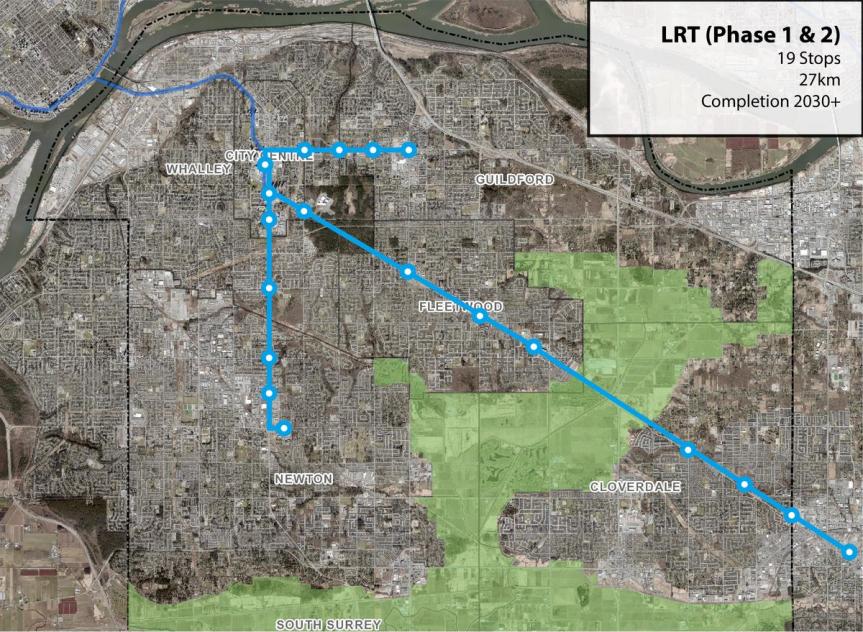 Cancelled 19-Stop (27km) LRT network that would have been completed within same time frame as SkyTrain
It’s hard to imagine rationalizing a 4-station SkyTrain extension to suburban Fleetwood over an 11-station LRT line servicing Surrey’s most urban corridors and largest Town Centres, but here we are. Ultimately once the line does reach Langley in the 2030’s it will help to move people through the region, benefit Surrey’s City Centre (although with less new stations), and those living near the line, but at the expense of what could have been a much more extensive rapid transit system, more urbanizing, distinguishing, and transformative for Surrey.
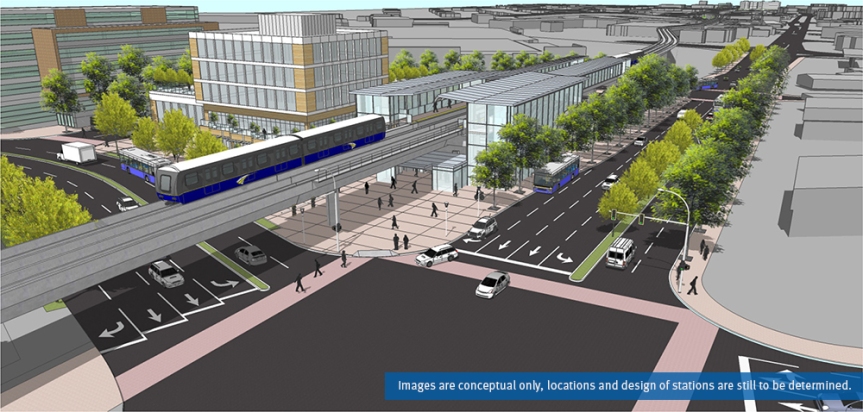
Public consultation is set to get underway this month for the proposed Surrey Langley SkyTrain (SLS) extension, as well as the future of rapid transit along 104 Avenue & King George Blvd.
In 2014, the regional Mayors Council identified Fraser Highway, King George Boulevard, and 104 Avenue as priority corridors for rapid transit South of the Fraser in the 10-Year Vision. Following a study looking at combinations of SkyTrain, LRT, and Bus Rapid Transit for the corridors, the Mayors Council decided on 27-km of urban-style LRT on dedicated track (separate from traffic) on each of the corridors to be built over 2 phases:
- Phase 1: Surrey-Newton-Guildford Line on 104 Avenue & King George Boulevard
- Phase 2: Surrey-Langley Line on Fraser Highway
With funding in place to cover the entire first phase, and construction set to begin this year – a last minute request was made in 2018 by Surrey’s new Council to the regional Mayors’ Council to suspend the Phase 1 Surrey-Newton-Guildford LRT line and re-direct funding to the Phase 2 Surrey-Langley line instead, while switching the technology of the Phase 2 line to SkyTrain. The Mayors’ Council voted to move forward with this request, and directed TransLink to begin planning work for SkyTrain on Fraser Highway while at the same time re-visit rapid transit plans for 104 Avenue and King George Boulevard corridors.
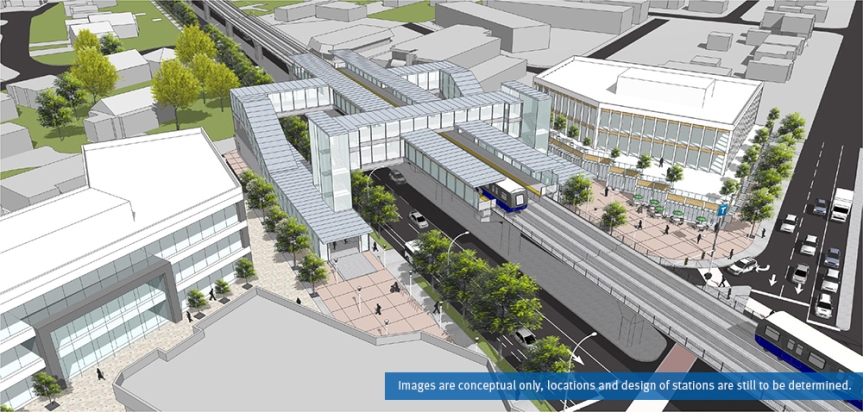
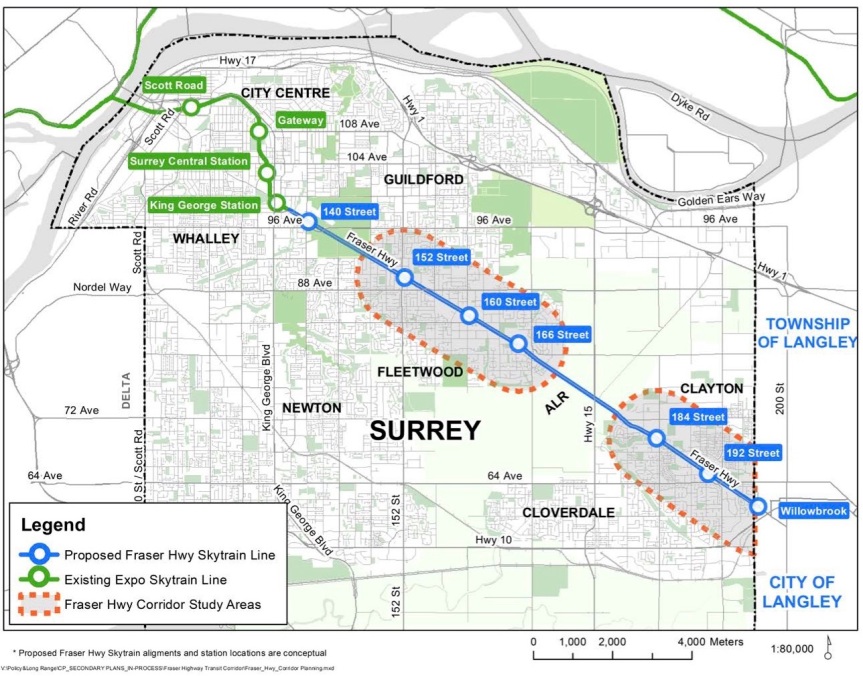 Proposed Surrey Langley SkyTrain route and conceptual stations
The switch of priorities to the Phase 2 Fraser Highway line and changing its technology to SkyTrain has had implications both in budget and timeline. The funding that was allocated for the full Phase 1 Surrey-Newton-Guildford LRT line has been identified as inadequate to fund the entire Fraser Highway SkyTrain extension to Langley. Pending a future round of funding (timeline unclear), the line may have to be phased, with the current funding getting the line potentially only as far as Fleetwood. Start of construction and delivery of new rapid transit South of the Fraser is also now delayed by approximately 2 years as a result of the switch.
Despite the funding and timeline uncertainties, planning work is nonetheless well underway for the new SLS line, which will need to involve a significant re-evaluation of land-use plans along the Fraser Highway corridor to support SkyTrain, completion of a number of supportive studies, and extensive Public Consultation. In a project update report to Surrey Council this week – a preliminary timeline was given for this work by TransLink, with start of service targeted for 2025.
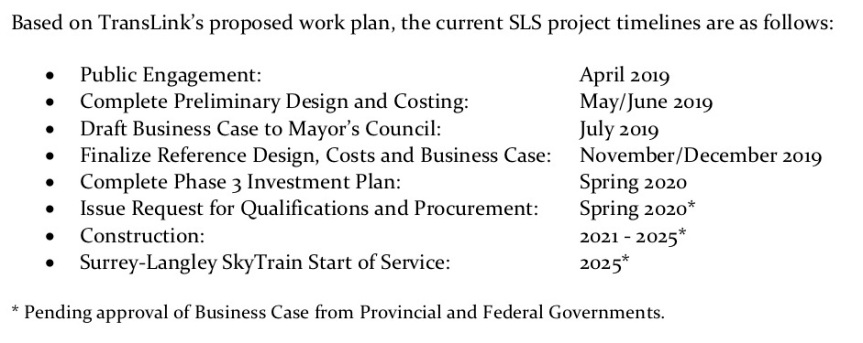
To run concurrently with the SLS planning and consultation work will be a planning process to ‘refresh’ the South Fraser Rapid Transit Strategy for delivering the Mayors’ Council fully envisioned 27km of Rapid Transit along each of the Fraser Hwy, King George Blvd, and 104 Ave corridors. This refresh will look to re-examine and engage the public on what rapid transit along the remaining corridors could look like, now that SkyTrain has been chosen as the technology for Fraser Hwy. The 2013 Rapid Transit Alternatives Study identified Bus Rapid Transit (BRT) for these corridors based on a scenario with SkyTrain on Fraser Hwy. With much LRT planning work having now been completed however, for the 104 Ave and King George Blvd corridors, it’s possible that LRT could still be an option for them rather than BRT, especially given Surrey’s long-term rapid transit vision for an extensive LRT network on major arterials across the City.
The first round of Public Consultation on the SLS line and South Fraser Rapid Transit refresh gets underway on April 11 in Langley, with open houses in Surrey on April 15, 16, and 17. TransLink has also recently launched an online survey where you can voice your feedback on the proposed SLS line. Open House times are set for the following dates and locations between 3-8pm:
- Thursday, April 11 – Langley City Hall
- Monday, April 15 – Surrey Sport & Leisure Complex (Fleetwood)
- Tuesday, April 16 – Surrey City Hall
- Wednesday, April 17 – Newton Seniors Centre
More info on the land-use planning review process for the Fraser Highway Corridor being undertaken by the City of Surrey can be found here: https://www.surrey.ca/bylawsandcouncillibrary/CR_2019-R059.pdf
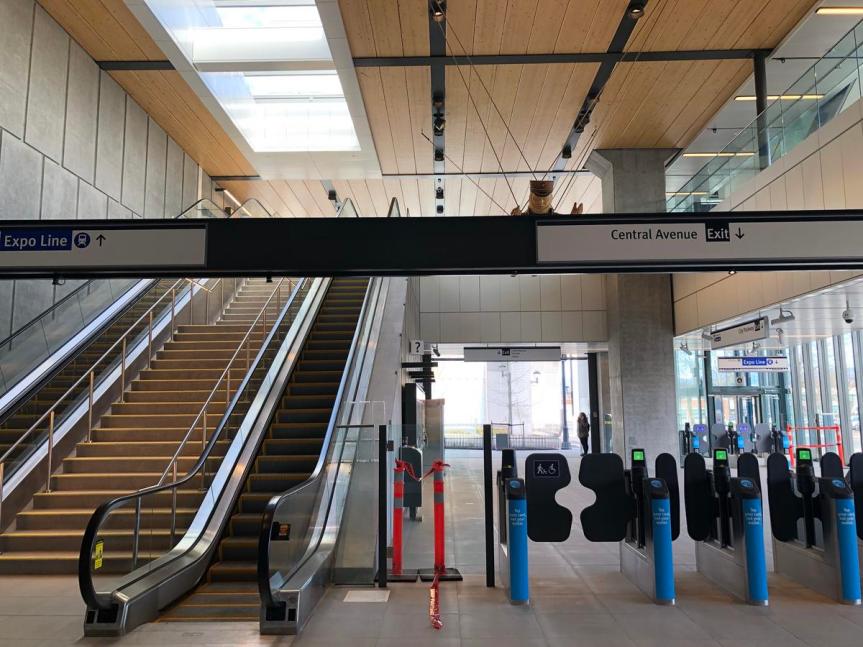
After nearly 2 years of construction, the Surrey Central Station north station house expansion officially opened to the public this weekend. Designed by OMB Architects, the new 2-storey station house is now the largest entrance at the station, fronting directly onto the corner of Central Avenue and City Parkway across from Civic Plaza.
The new station house features a contemporary, open, and airy design consisting of glass, concrete, and wood materials, as well as a prominent new First Nations art installation suspended from the ceiling – ‘The Sea Captain’ by Marianne Nicolson. A new retail unit has also been added to the station next to the entrance fronting Central Avenue, but has yet to be occupied by a tenant.
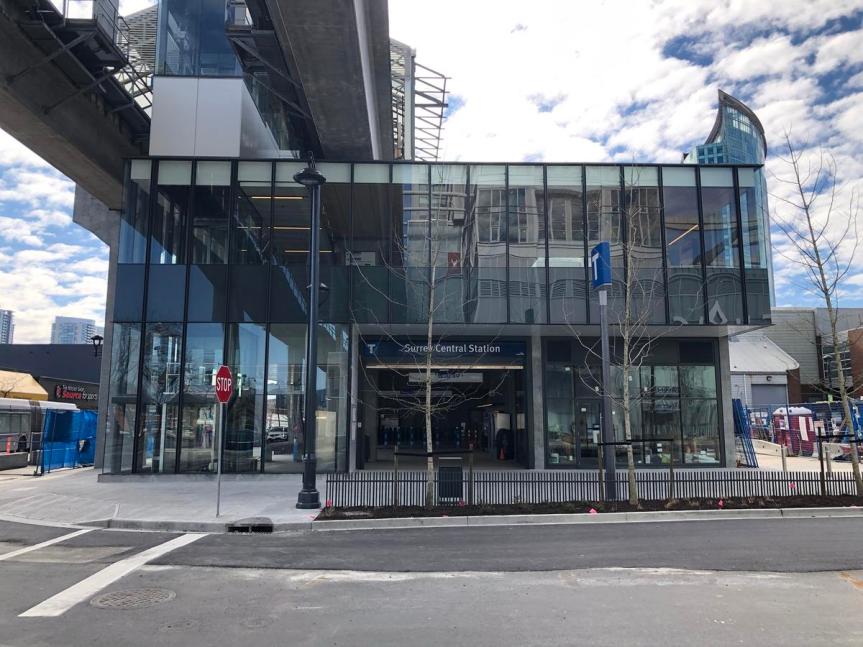 New entrance fronting Central Ave
 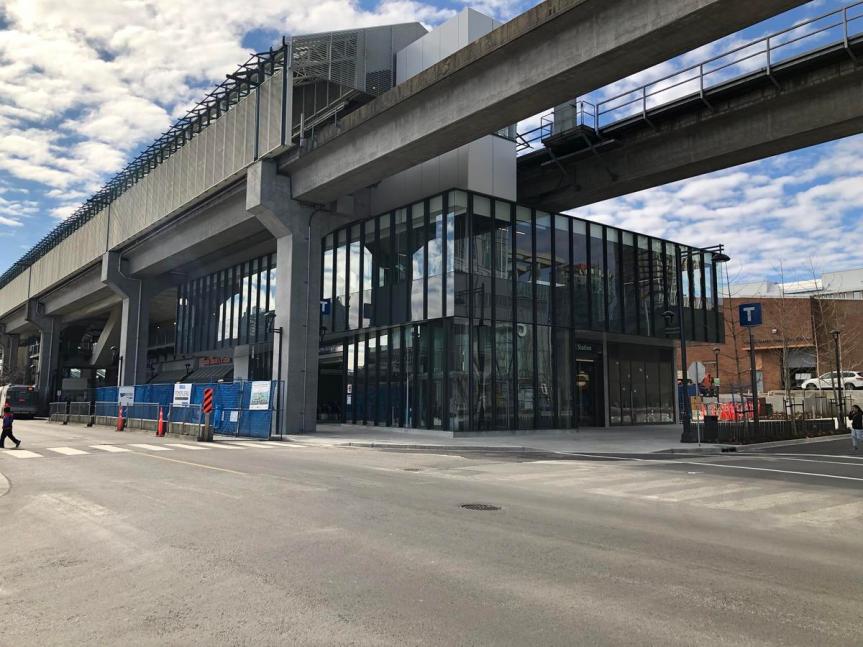 Corner of Central Ave & City Parkway
 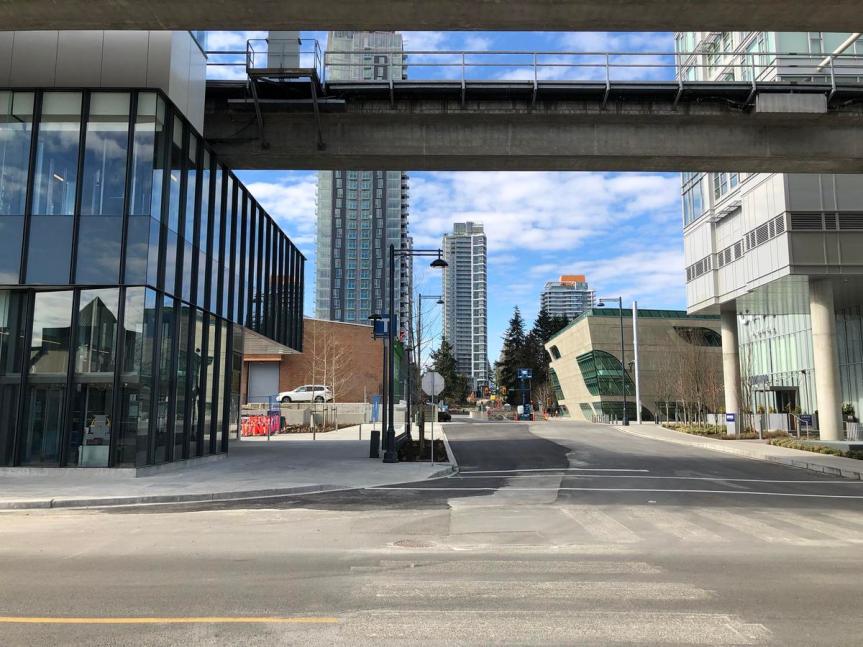 Looking west down Central Avenue
 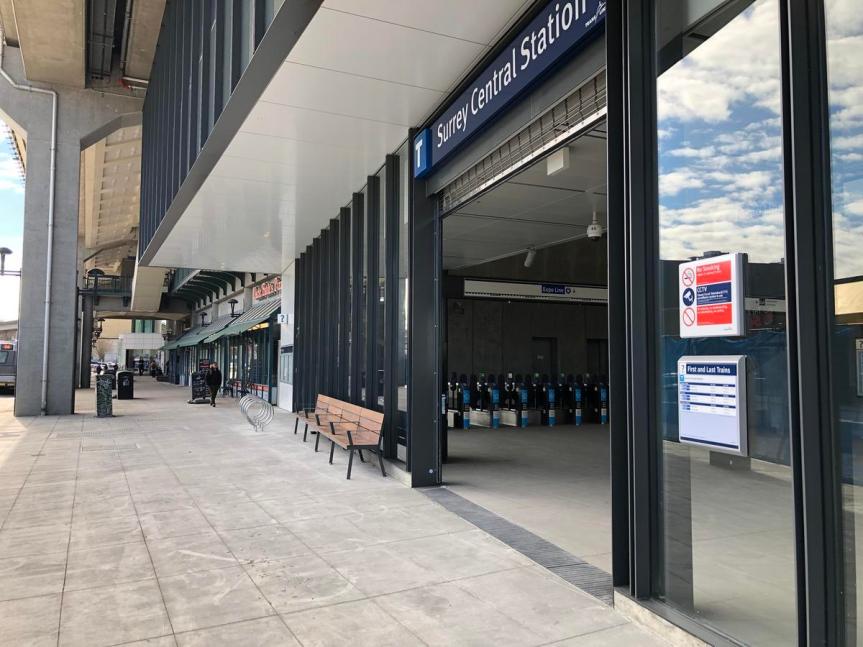 New entrance on City Parkway
 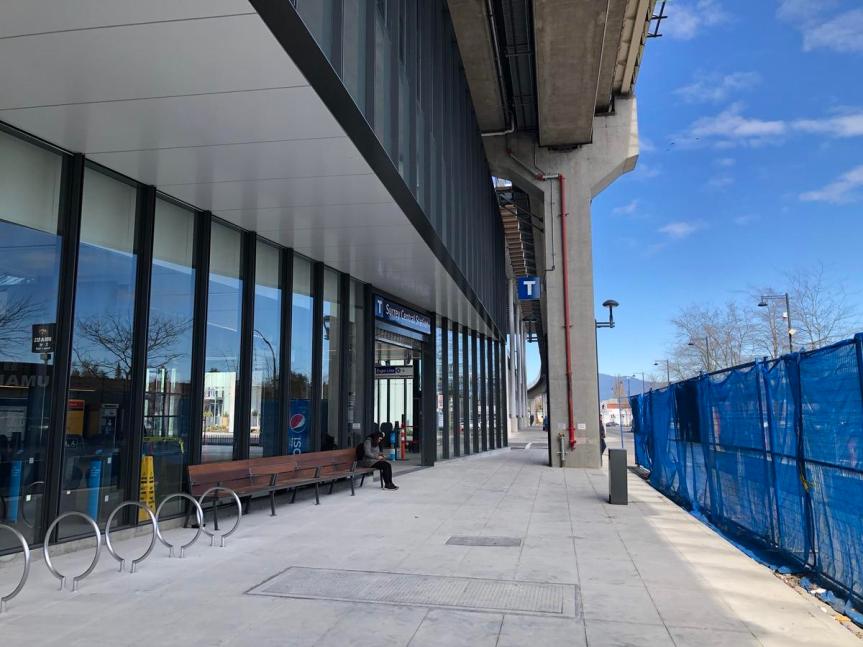 New entrance with bike racks and benches on City Parkway
 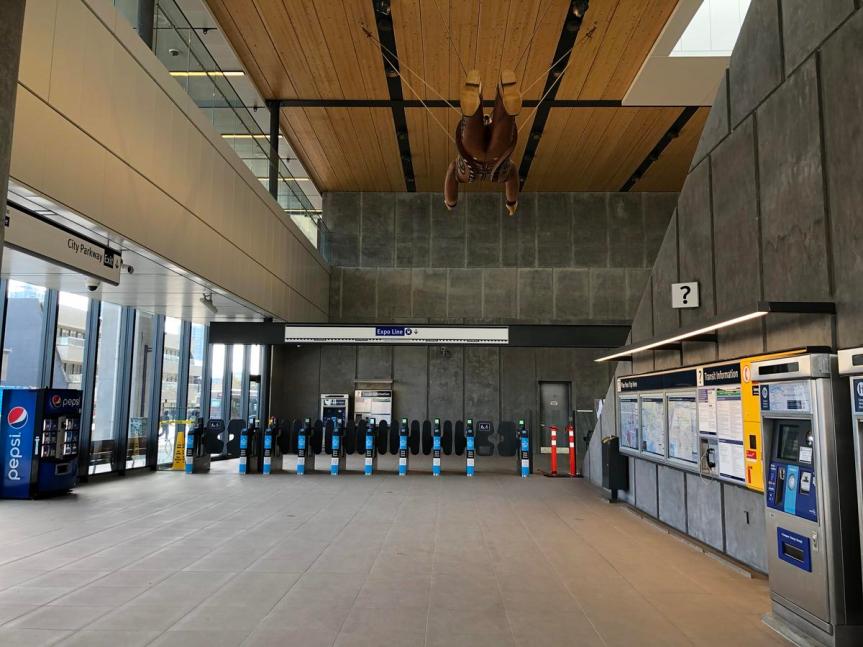 New ticket and fare gate concourse
 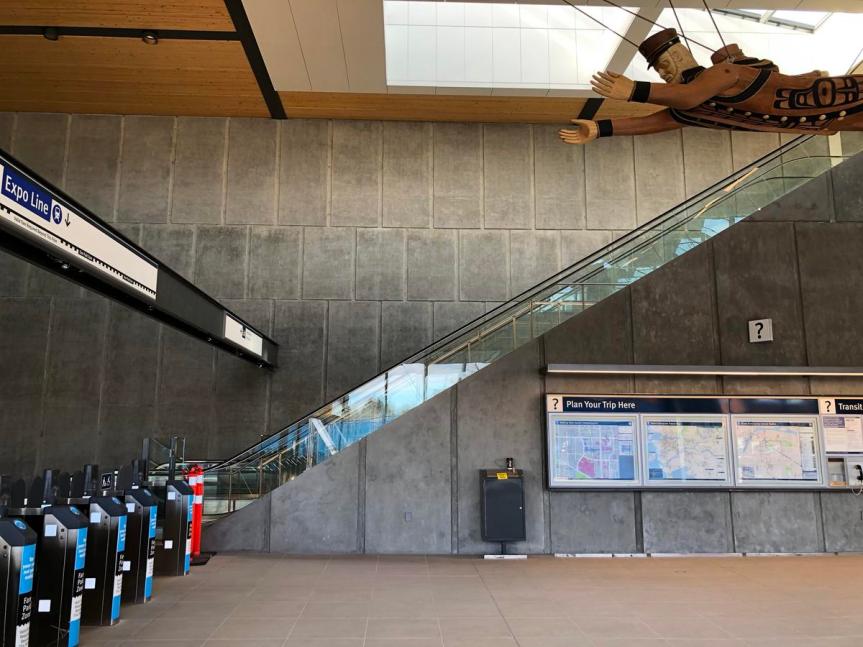 Fare gate concourse and art installation
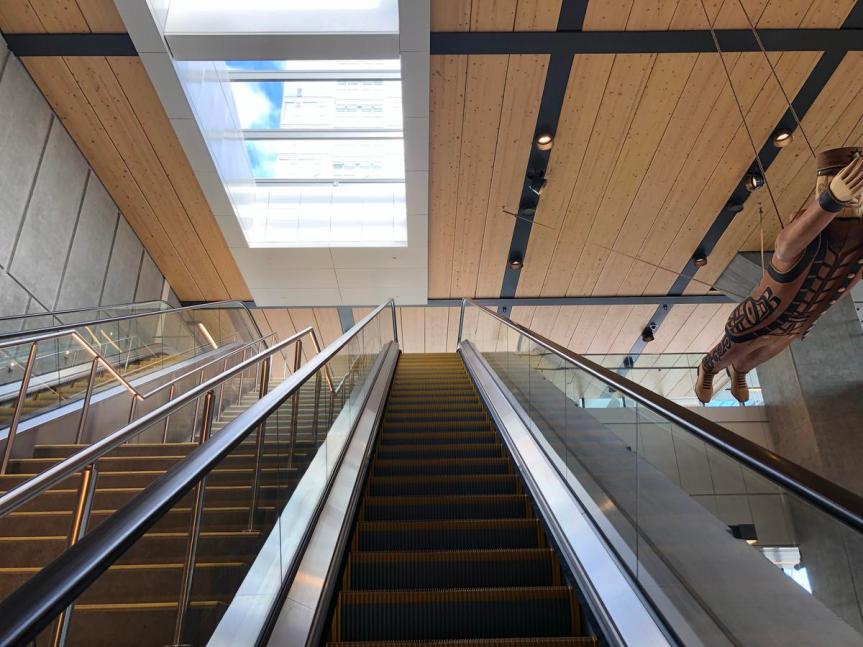 Escalator to second floor concourse
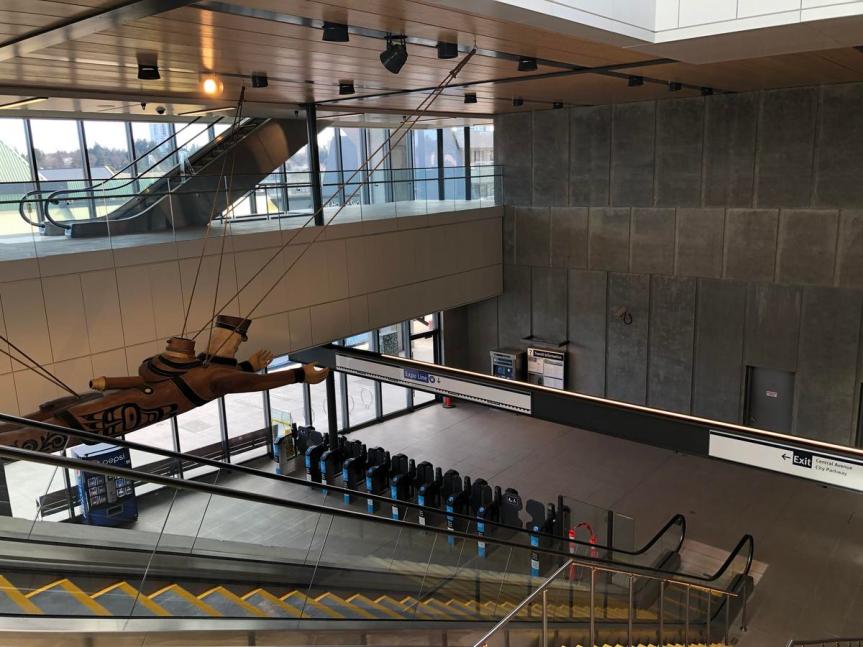
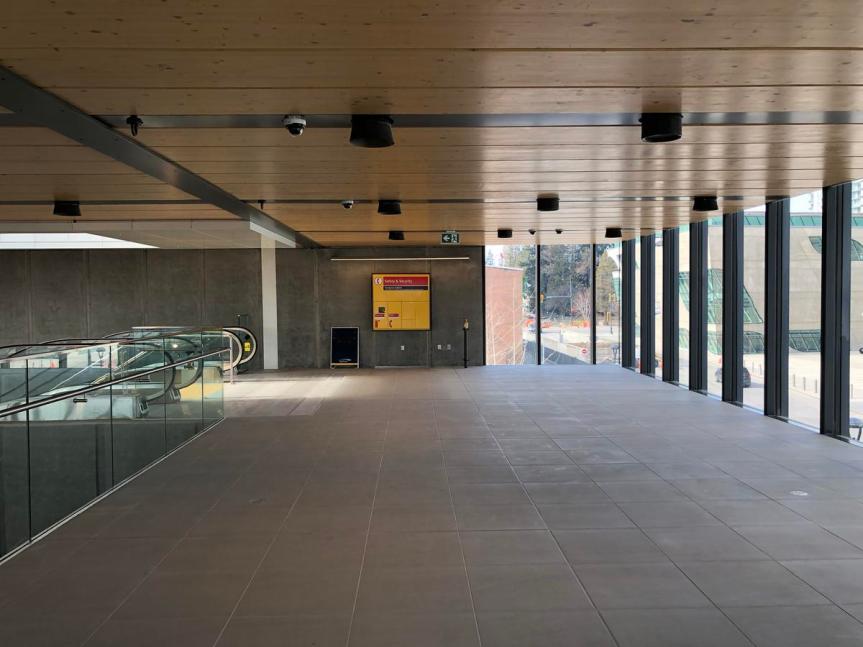 2nd floor concourse
 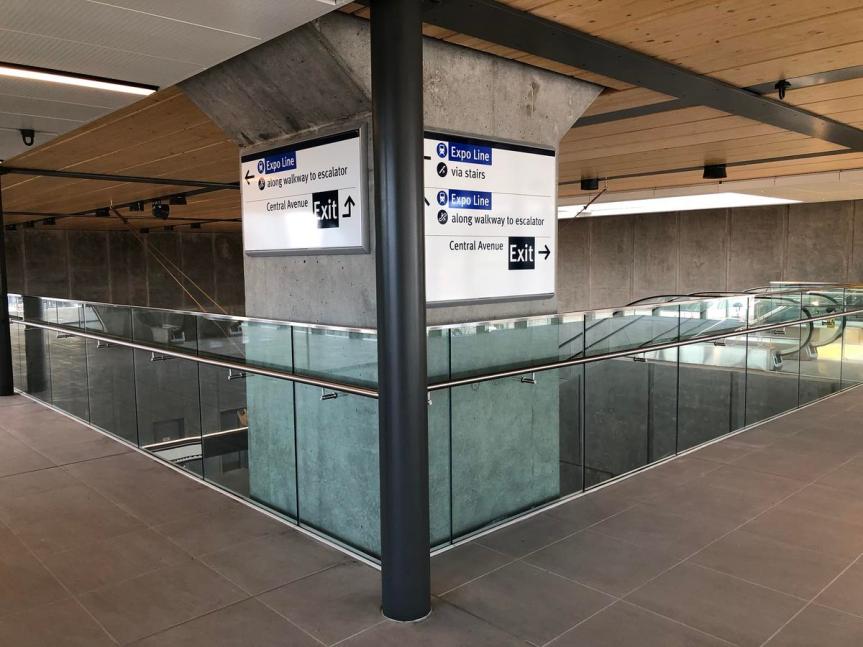 Wayfinding signage on second floor concourse
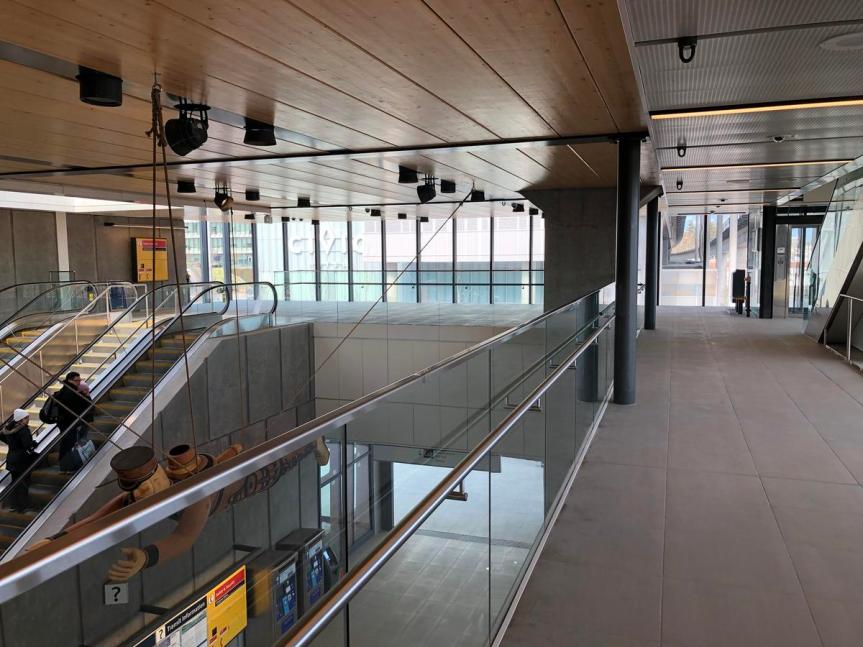
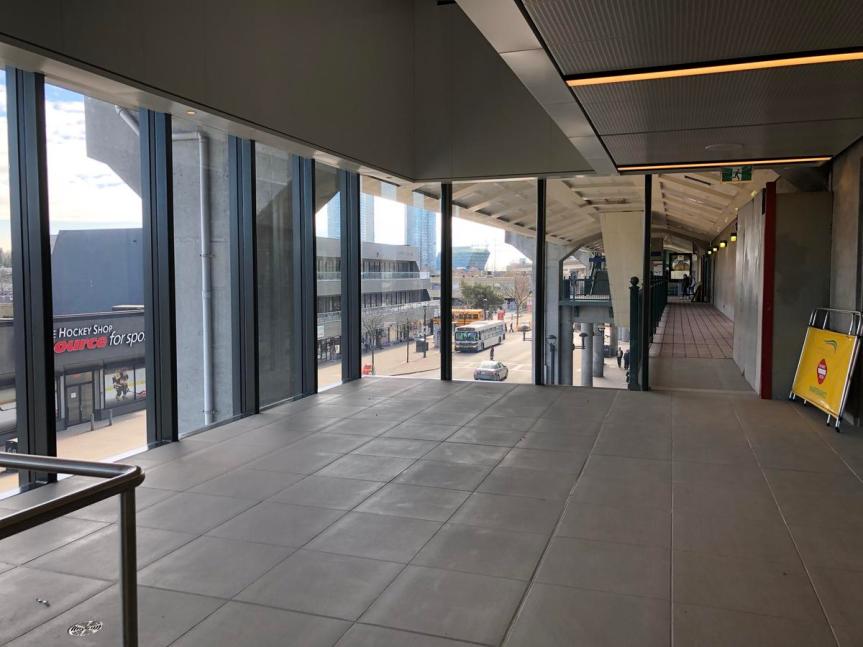 Connection to south station entrance
 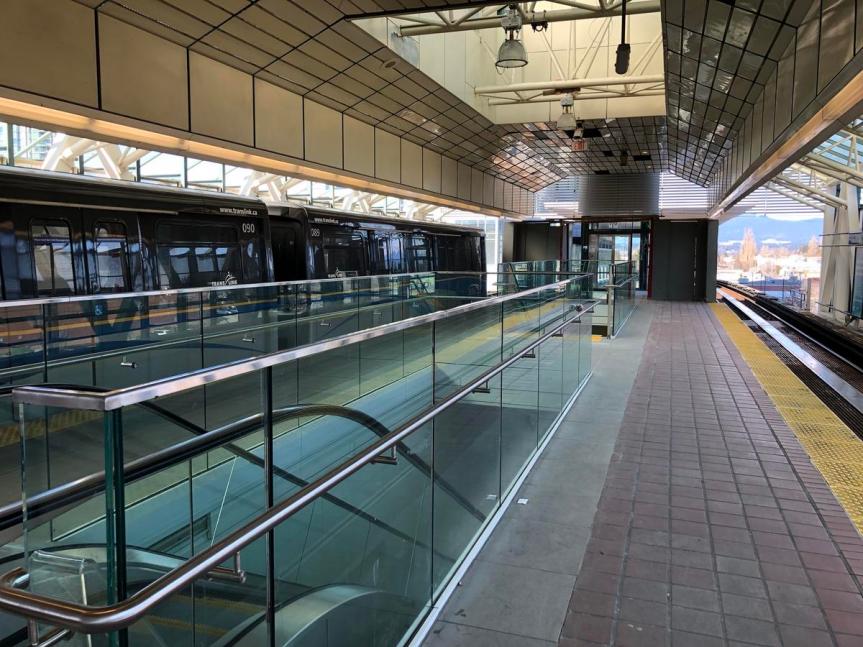 New platform level stairs, escalator and elevator
This latest upgrade to Surrey Central Station is just the beginning of an even larger expansion and re-configuration to come in the future. The lands immediately west of the station, where the current North Surrey Recreation Centre and Bus Loop sit – known as the ‘Centre Block’ are expected to be redeveloped in the coming decade. With that will come the removal of the suburban-style bus loop and re-positioning of bus bays onto streets surrounding the station. A major overhaul of the station is expected at that time to modernize and better integrate it into its evolving urban context.
With Doug McCallum’s win in last weekend’s election, Surrey appears to be in for change. Campaigning heavily on LRT and Safety, the topic of discussion now is whether he will deliver on his promise to ‘scrap’ LRT and ‘replace’ it with SkyTrain. It appears the majority of Surrey residents are in favour of this – fuelled by non-stop negative publicity of LRT in the media – but what does an LRT to SkyTrain ‘switch’ actually mean for Surrey? A few key implications to consider:
SkyTrain vs LRT – 2 different routes
A misconception that many who ‘voted’ for SkyTrain over LRT may have may have is that the proposed LRT will simply be ‘switched’ to SkyTrain. This is not the case – each would run along a different route. Let’s look at the difference:
LRT – City Centre-Newton-Guildford: The proposed ‘Phase 1’ LRT route – with secured funding and significant planning and design work already completed – is planned run from Guildford along 104 Avenue to City Centre, then south on King George Blvd to Newton. This is known as the ‘L’ Line or Surrey-Netwon-Guildford Line – serving Surrey’s most populated, and urban town centres.
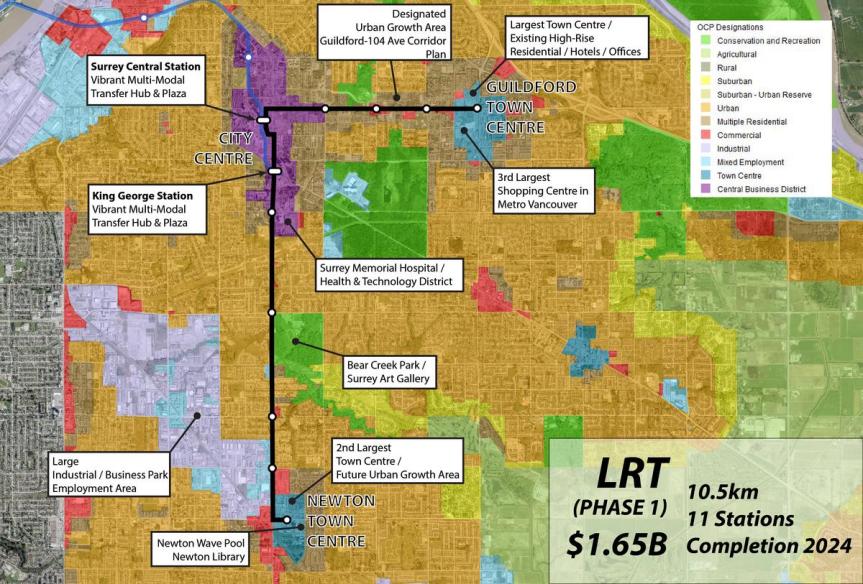
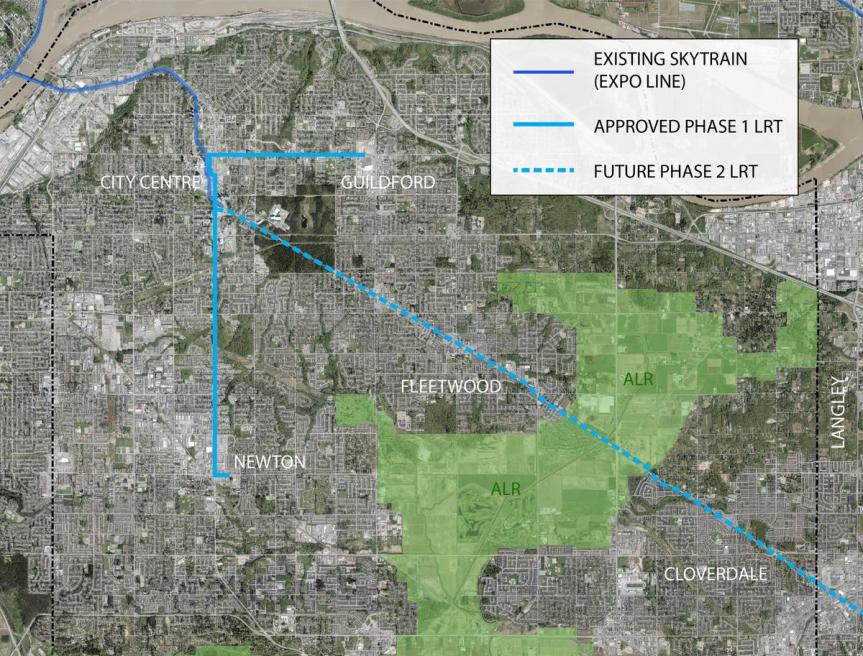 Phase 1 LRT route along 104 Ave & King George Blvd + future Phase 2 route to Langley
SkyTrain – Fraser Highway: Doug McCallum’s SkyTrain – which would need to be planned and designed from scratch – would provide no rapid transit to Guildford or Newton (Surrey’s most populated / urban town centres) – but instead be an extension of the existing Expo Line down Fraser Highway to Fleetwood, Cloverdale (Surrey’s least populated / urban town centres) and Langley.
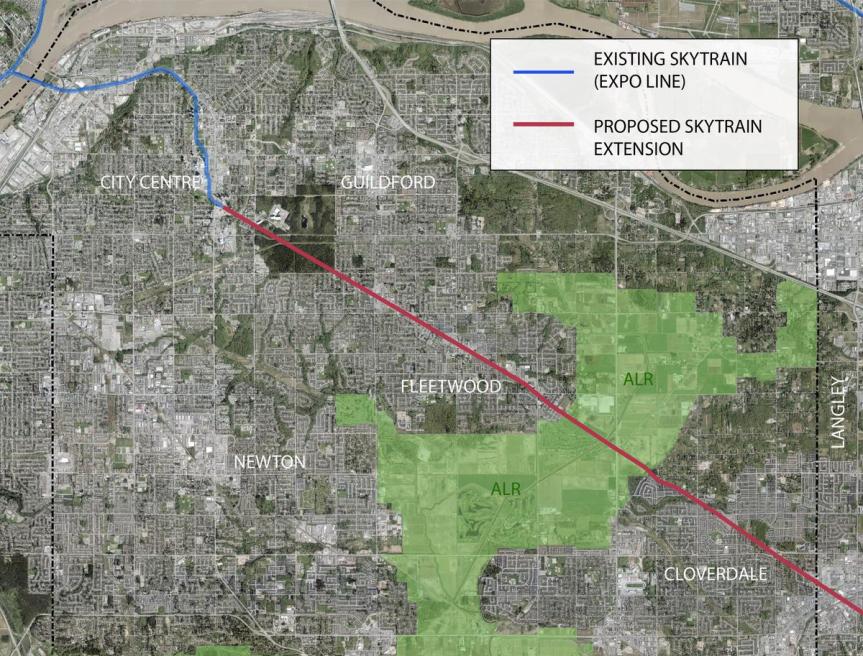 SkyTrain extension to Langley along Fraser Hwy through low density suburbs / ALR to Langley
The Land-Use Difference
LRT: The proposed ‘Phase 1’ LRT route would serve Surrey’s most established urban corridors with the highest densities – 104 Avenue and King George Blvd. Guildford Town Centre contains the regions 2nd largest shopping centre, numerous high-rises and offices. Further, the currently underway Guildford-104 Avenue Corridor Plan which is set to become adopted in 2019, has designated land all along 104 Avenue between City Centre and Guildford for increased urban densities appropriate for a rapid transit corridor. A similar plan is set to follow for the King George corridor between City Centre and Newton. Simply put – 104 Avenue and King George Blvd are the most appropriate corridors for initial rapid transit expansion in Surrey due to their already underway land-use planning for higher density, and their existing densities, land-use, and most urban character of Surrey’s corridors.
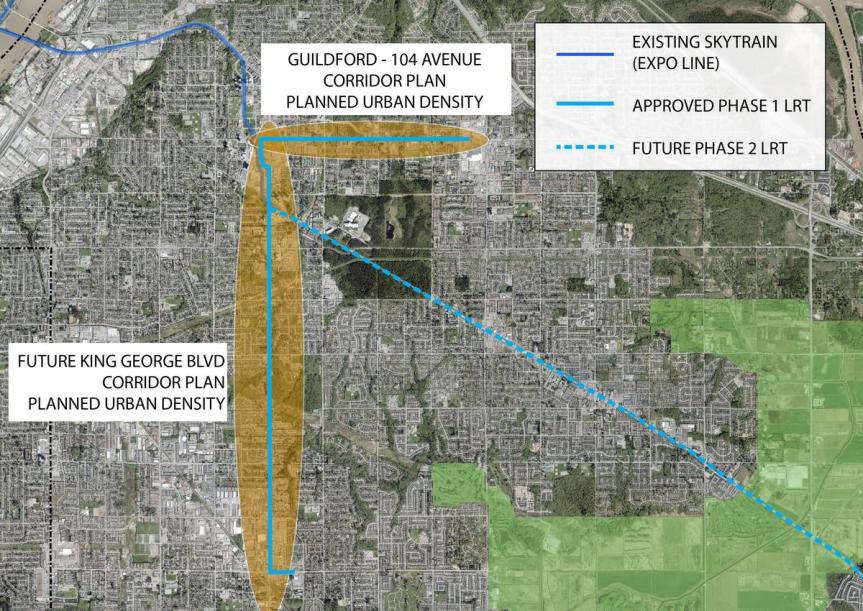 Phase 1 LRT route along existing urban corridors with planned density
 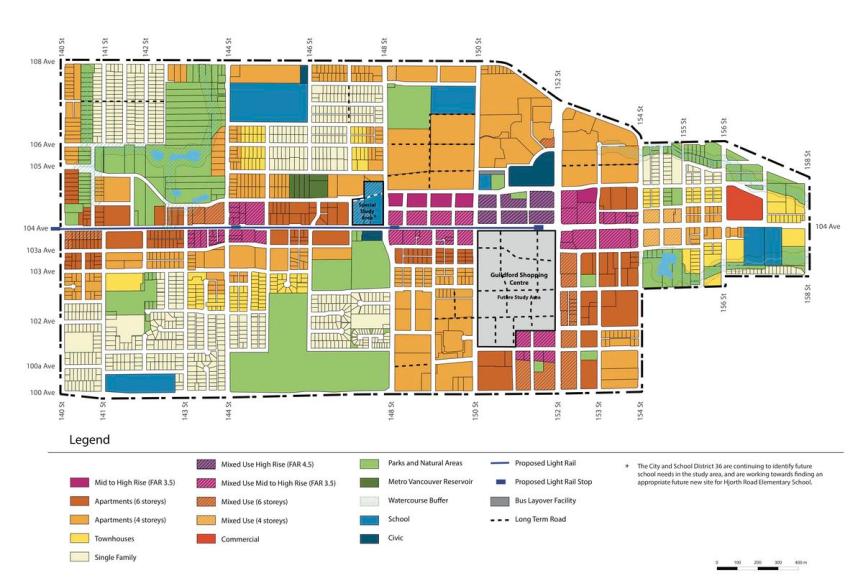 Guildford – 104 Avenue Corridor Plan – urban density planned along LRT route
SkyTrain: Doug McCallum’s SkyTrain would run down Fraser Highway which currently has no land-use plans for significant urban density underway, and is currently of the lowest density and suburban of corridors in Surrey. The SkyTrain route would run through:
- Green Timbers Forest for the first 2km of its route
- the low density suburban neighbourhood of Fleetwood for the next 5km
- ALR farm land for the next 2km
- and finally low density suburban Clayton/Cloverdale and Langley for the remaining 6km of the route
This route would have the lowest densities of any SkyTrain corridor in the region – including significant stretches through forest and ALR farm land – unseen anywhere else on the SkyTrain system. SkyTrain along Fraser Highway would require significant land-use changes along Fraser Highway to justify it – including significant increases in density, high-rise towers, and transit-oriented development – similar to elsewhere along the SkyTrain network. This would require changes to the Official Community Plan (OCP) – ironically Doug McCallum campaigned against OCP amendments.
Simply put – this type of development is incompatible with the scale and character of the Fraser Highway corridor that is predominantly newer single family homes and townhomes. Many living along that corridor would surely object to such drastic land-use changes appropriate for a SkyTrain line.
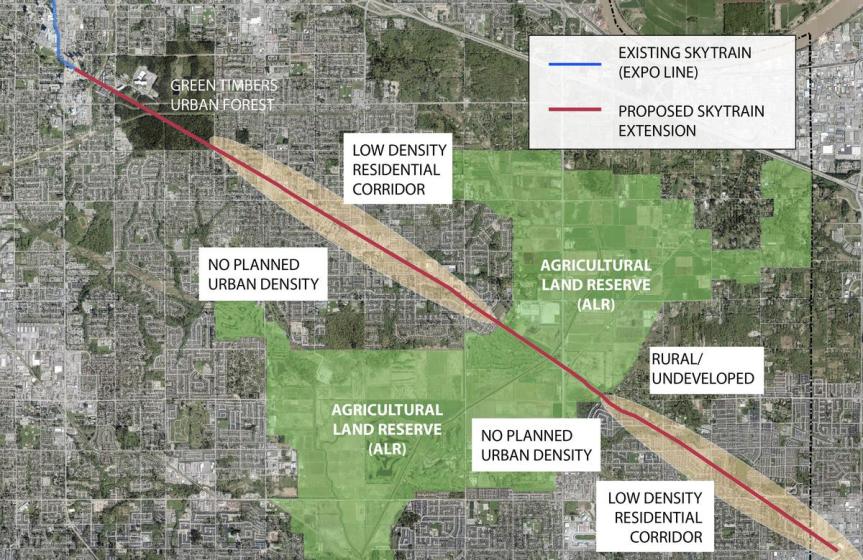 SkyTrain extension through low density suburbs / ALR with no planned urban density
From a land-use planning perspective – it makes the most sense to serve the highest density corridors and urban centres (104 Avenue – King George Blvd) with rapid transit prior to lower density corridors such as Fraser Highway. Instead, a SkyTrain extension over LRT would do the exact opposite of what makes sense. While it is important to provide a rapid transit link to Langley, and connect the communities of Fleetwood, Clayton/Cloverdale with regional rapid transit – from a land-use and planning perspective these areas are lower priority than Guildford and Newton – and Fraser Highway does not have density appropriate for SkyTrain. In an ideal world, Langley would be serviced by long-distance commuter rail such as all-day WestCoast Express – but realistically – LRT may be the best option for serving Langley down Fraser Highway as a Phase 2 project – given the density, scale, and character of that corridor.
Uncertain Timeline
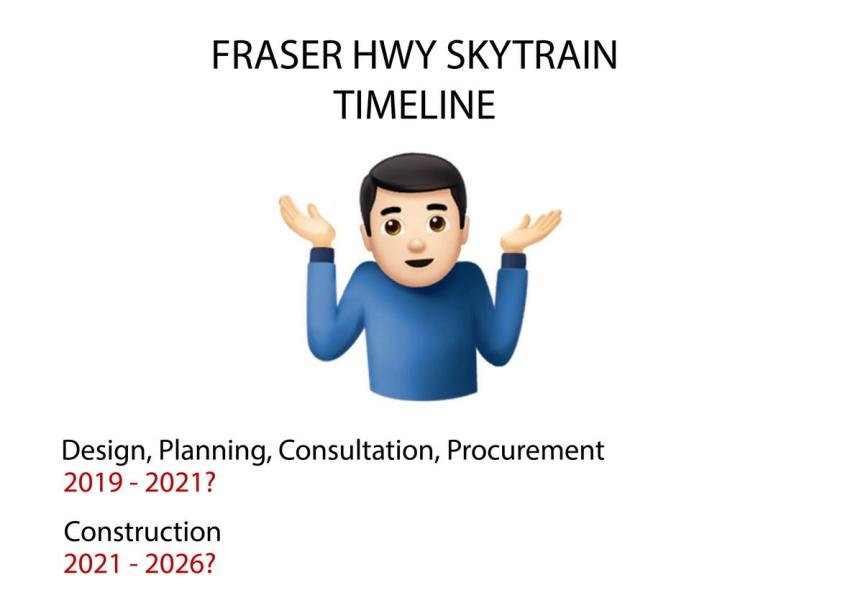
LRT: Funding for the proposed ‘Phase 1’ LRT route is “in the mail” from the Federal and Provincial Governments. Significant planning, consultation work, and design has been underway for years, and the project is now at the procurement stage with construction set to begin in 2019 and completion by 2024.
 LRT scheduled to begin construction in 2019 – years of planning, consultation, design already complete.
SkyTrain: Doug McCallum claims that secured funding for LRT can simply be ‘switched’ to fund a SkyTrain extension to Langley instead of the Guildford Newton line. While this may be possible, as the funding doesn’t specify a type of rail – the fact is – no planning, consultation, or design work has been completed on a SkyTrain extension down Fraser Highway. The amount of time and additional resources that would need to go into a SkyTrain extension prior to its construction would not only delay the project for an unforeseen number of extra years – pushing completion of this line to the late 2020’s.
By that time, Phase 2 of the LRT is likely to be under construction – resulting in Surrey having 2 new rapid transit lines by the late 2020’s instead of just a single SkyTrain extension down low-density Fraser Hwy within the same time frame.
While these reasons aren’t exhaustive in the debate – they are very key ones that have been surprisingly absent talking points. Surrey residents may not have been the best informed on the SkyTrain vs LRT debate thanks to the media – to make an educated decision that weighs more factors than just ‘speed of service’ and ‘glamour of SkyTrain vs LRT’ – but in the end it may not matter. The LRT project is likely too far along at this stage and with too much else to consider to simply be ‘switched’. It is being led by non-partisan land-use and transit planning experts in the Planning & Transportation Departments (not the former Mayor or Councillors as some may believe) – experts who should be leading such projects – rather than transit planning on a whim by politicians and voters.
The City of Surrey began a series of 3 open houses on Thursday for Phase 1 of the upcoming Surrey LRT project. This latest public engagement is the 3rd round of open houses on Phase 1 the project, providing refined plans based on public input from previous consultations. Presented at the open house were preliminary station designs, road designs, information on construction planning, environmental and socio-economic study results, and more. A full set of the Open House Boards can be found here.
Station Designs
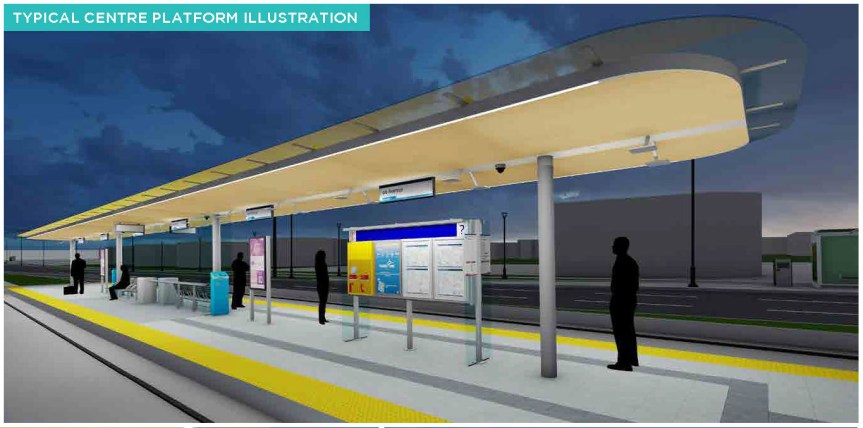
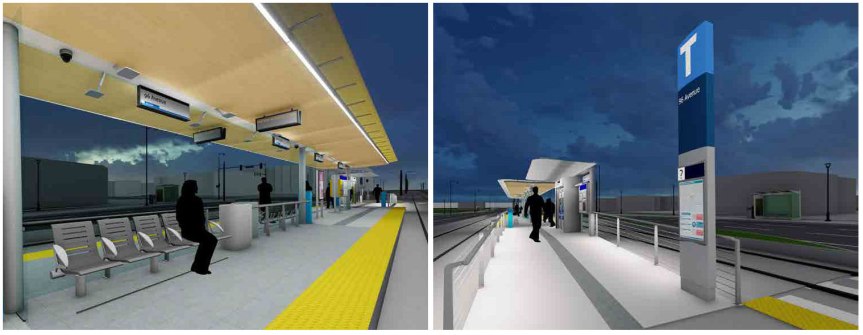
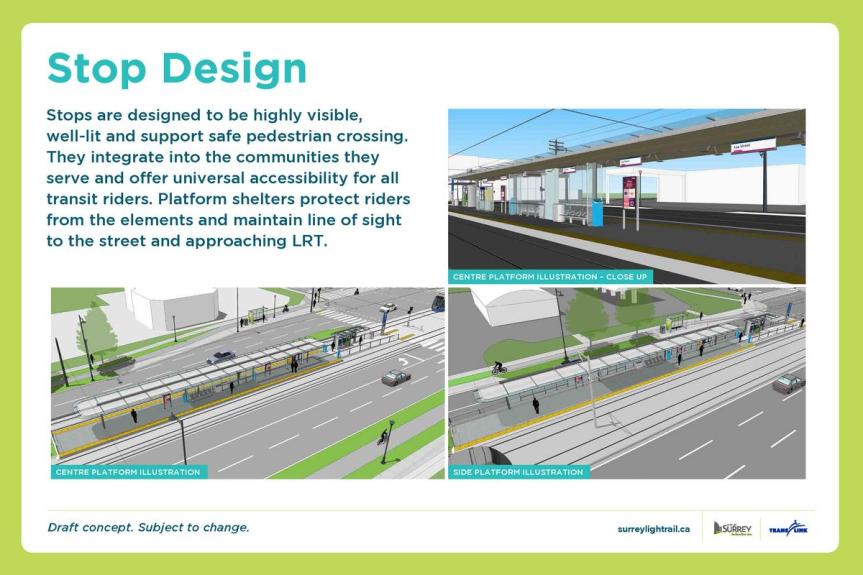
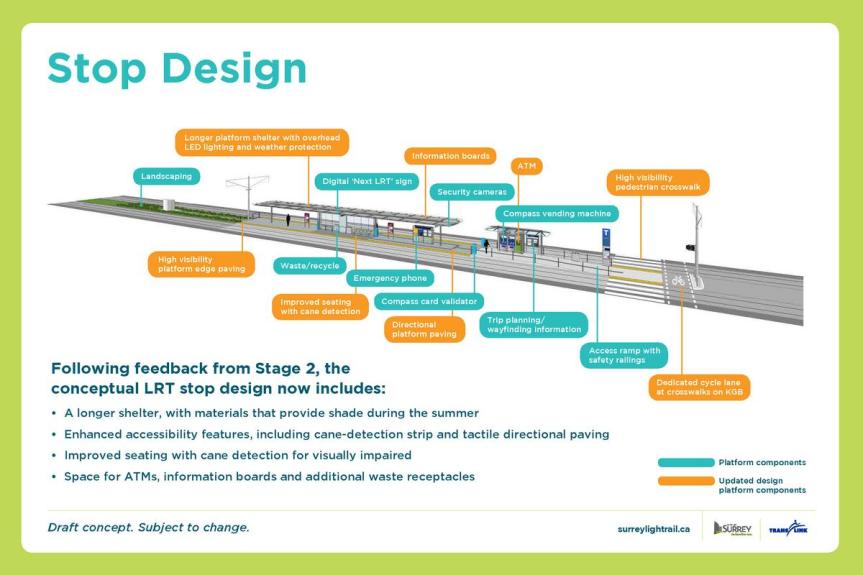
Overall, stations are designed to be highly visible, well-lit, and well integrated into the community – accessible by well-marked pedestrian crossings providing universal accessibility for all riders. Lengthy platform shelters protect riders from weather, and include space for ATM’s, information boards, seating, and more – while maintaining a clear line of sight to the street and approaching trains. Stations will in most cases be located in the centre median of the street, with the exception of King George, Surrey Central and Newton Town Centre – where they will be plaza oriented, or off to the side. Public art will also be integrated into stations along the route.
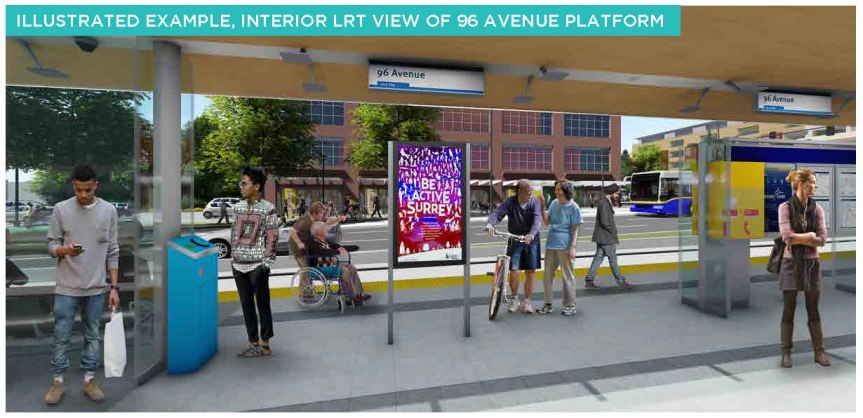
Roadway Design
LRT will run on its own dedicated track for the entirety of the line, with the exception of City Parkway where it will be integrated into a pedestrian plaza. Placement of the LRT track will vary – typically located in the centre median for most of the route, but off to the side in some sections.
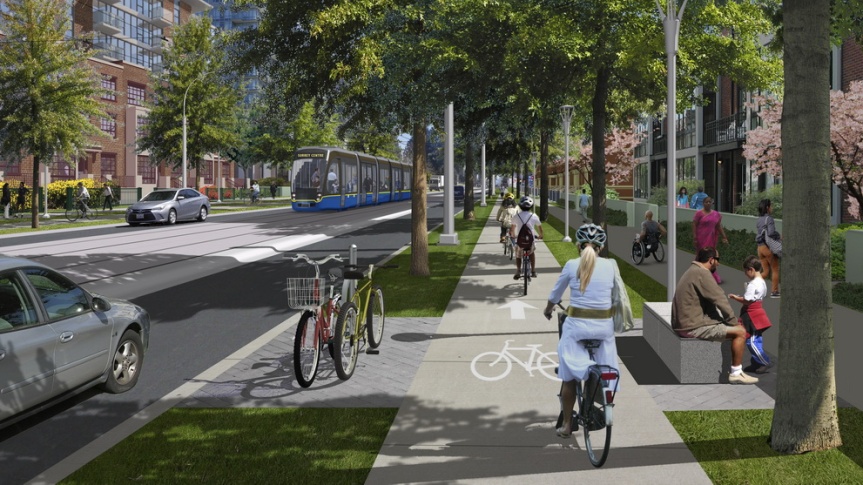
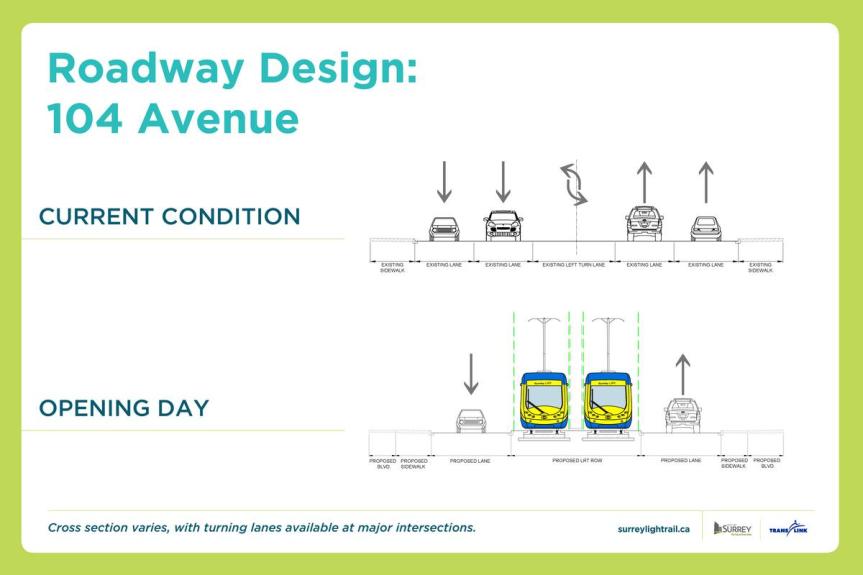
Roadway design for 104 Avenue will consist of LRT in the centre median, and 1 traffic lane in each direction, widening to include an additional turning lane at major intersections. The 104 Avenue design will also provide upgraded and enhanced sidewalks, pedestrian crossings, and connections to stations. Currently 104 Avenue functions as a non-pedestrian friendly, busy arterial for cars. A re-purposed 104 Avenue with LRT will transform the street into a calmed, pedestrianized and transit-oriented corridor, supported by multi-family housing and streetfront shops along the route. The newly widened 100 Avenue and existing 108th Avenue corridors will become the new car-prioritized east-west routes between City Centre and Guildford while 104 Avenue will be the pedestrian/transit prioritized corridor.
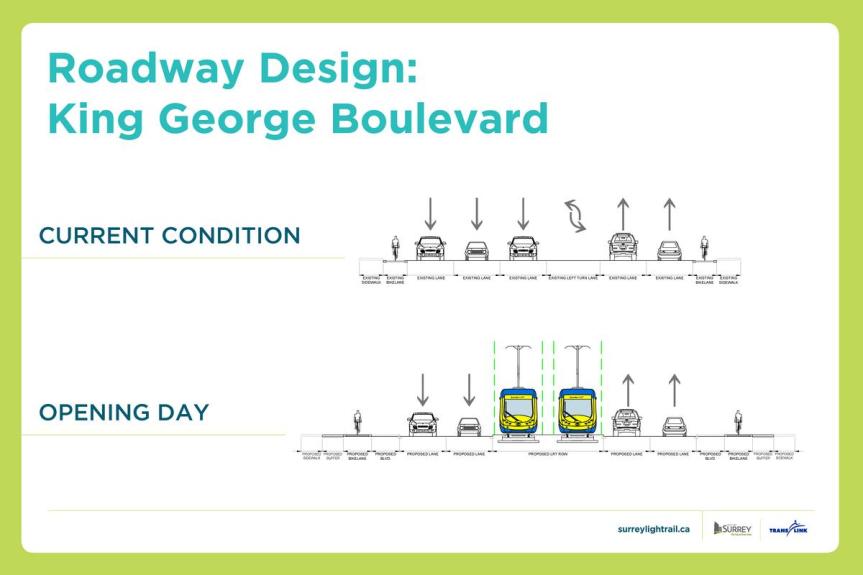
Roadway design for King George Blvd will retain 2 traffic lanes in each direction while allowing for LRT in the median for the majority of the route. Sections of King George in City Centre will see LRT routed off to one side. New separated bike lanes, enhanced sidewalks, and pedestrian crossings will also be a key component of the re-designed King George.
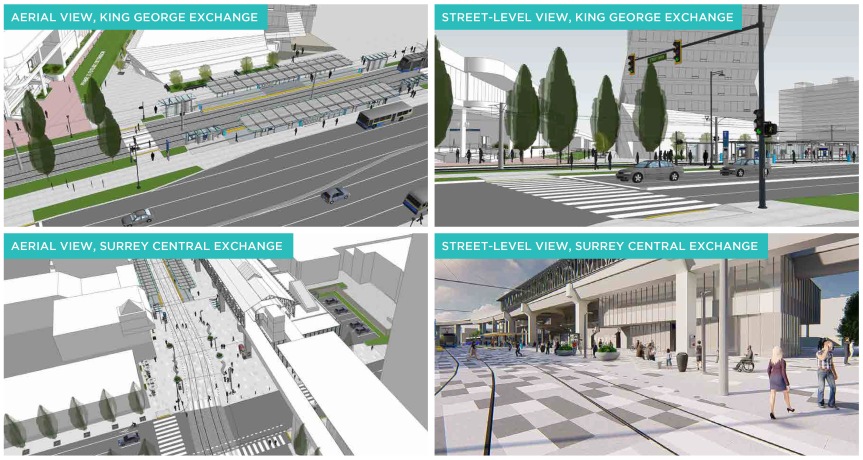
Pedestrianized Plazas at Surrey Central & King George Stations
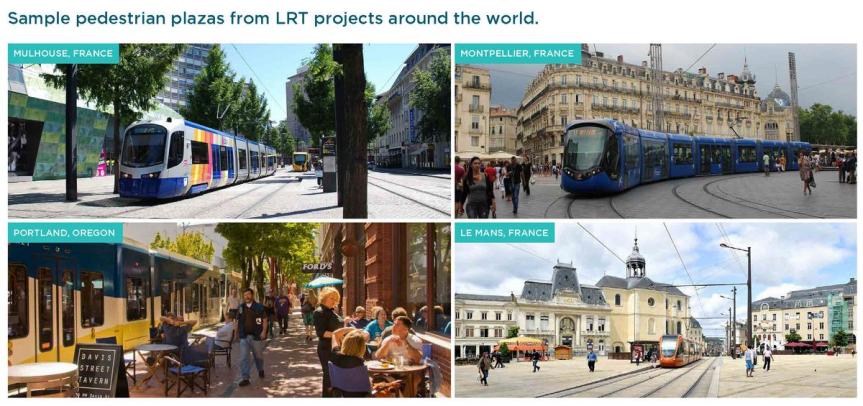
Taking inspiration from leading cities around the world, Surrey Central and King George Stations in City Centre are designed to be integrated into new pedestrianized public plazas. These plazas will help to create vibrant transfer points between LRT and SkyTrain’s expo line, similar to plaza’s found throughout Europe with multi-modal rail connections running through them.
Socio-Economic Study: Improved Travel Times
A key finding of the socio-economic study released at the open house, was the improvement in travel times that LRT will offer over the existing 96 B-Line bus service, as well as private automobile. Under Section 7.2 of the study it was found that the existing 96 B-Line service between Guilford-Newton currently takes 29 minutes under ideal conditions. During periods of congestion however, this trip can take longer than 50 minutes. Further, this travel time is expected to worsen as population grows. LRT is able to cut this travel time by up to half, taking a consistent 27-minutes every time, on opening day, and a decade later, due to its dedicated track. In addition to this, LRT offers faster service and improved experience due to:
- More doors for boarding, significantly reducing stop times at stations, and travel times overall.
- Nearly twice as frequent peak service as the existing 96 B-Line peak bus service.
- A smoother, more comfortable ride than B-Line bus, with less stop and go.
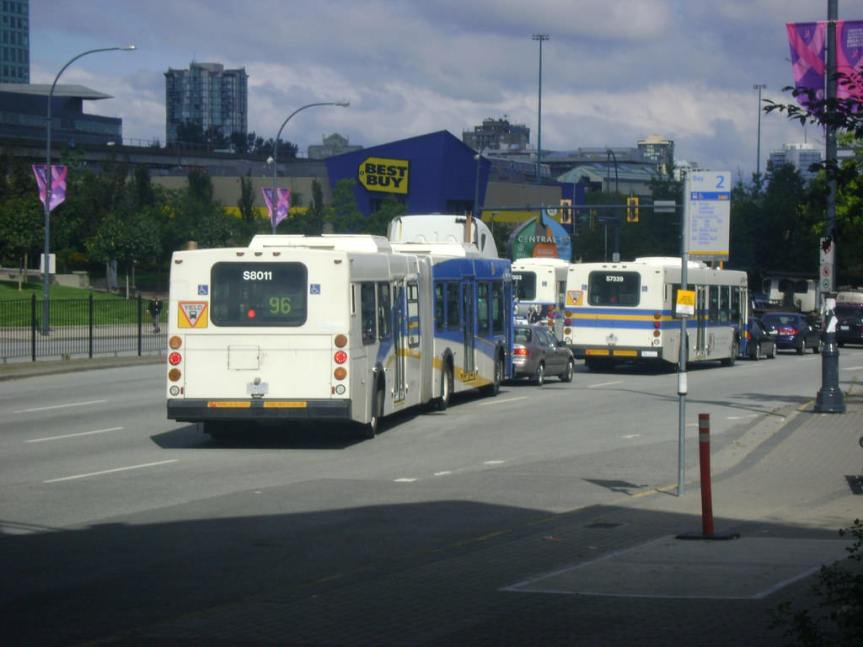 96 B-Line subject to traffic congestion – travel times between Guildford and Newton up to 50 mins during peak hours.
Integration with the Community
One of the key benefits of LRT is its integration with the community and streetscape compared to SkyTrain. While SkyTrain serves well as a long distance commuter rail service, LRT is better suited to more localized routes in the region – similar to other cities where there are various tiers of rail transit making up the regional transit network. Not every line in a city needs to be the same type of rail transit – LRT, Subway, and Commuter Rail are often combined to compliment each other and serve different needs. The introduction of LRT to Metro Vancouver represents a maturing of our rail transit network into a multi-modal system, and it is very likely we will see LRT implemented elsewhere in the region following Surrey.
In Surrey, the 104 Avenue and King George Highway corridors that make up the ‘L’ line are much better suited to urban-style LRT than SkyTrain. Not only is this route more localized than regionally serving, but SkyTrain just doesn’t make sense from a cost perspective, and the impacts that such guideways would have on the streetscapes. Looking at a comparison between SkyTrain guideways in Richmond City Centre and Coquitlam City Centre, it is clear to see how much better LRT integrates with the streetscape and community it passes through, rather than bisecting it with an obtrusive, shadowing, and noisy concrete structure. LRT can transform a streetscape into an inviting, pedestrian friendly, vibrant urban environment – whereas SkyTrain does the opposite.
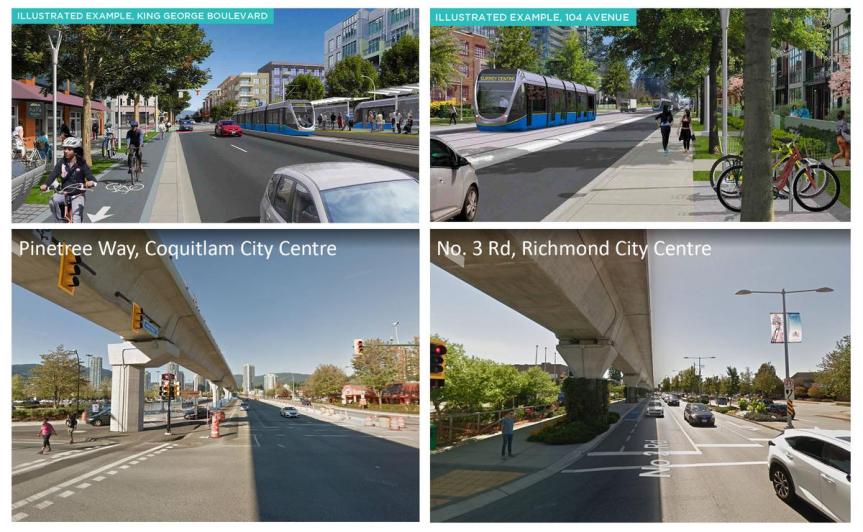 Impact of SkyTrain guideways on the urban environment/streetscape vs urban-style LRT
For more on Surrey LRT:
https://surreylightrail.ca

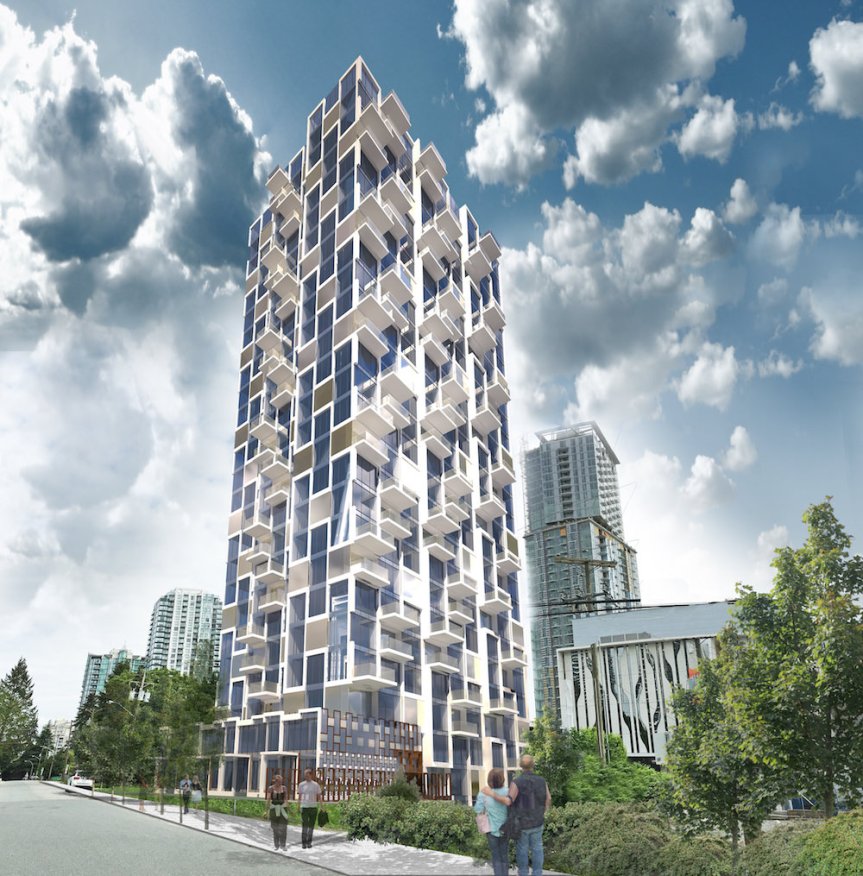 Rendering of proposed tower from 133A St
 Subject Site within City Centre Plan
 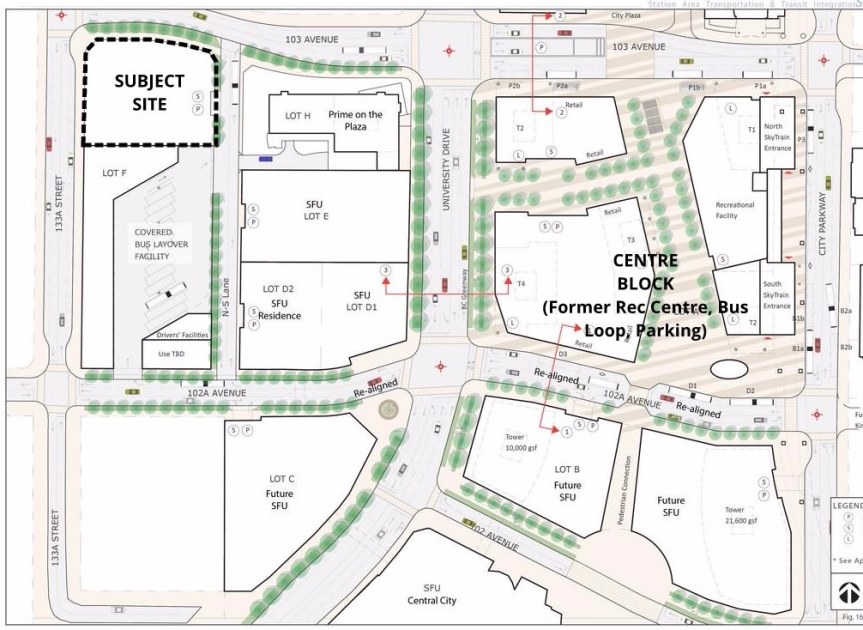 Conceptual plan for ‘Centre Block’ area showing future Covered Bus Layover Facility and Subject Site
 View looking west along 104 Avenue from King George Blvd
 View looking north along City Parkway from Surrey Central Station
  View from public and amenity space within interior of site looking south
  View looking east along 104 Avenue
  Future ‘Market-hall’ commercial building in centre of site as part of future phases.

 PCI Development’s King George Hub project has officially sold out both residential towers within Phase B of the project. The 40-storey tower first went to market in October, quickly selling out, followed by the 29-storey tower in November. Phase B will also include a 15-storey office tower, 2-storey stand-alone restaurant, as well as over 100,000 sq.ft. of retail space integrated with a plaza.
 With the success of King George Hub selling out so quickly, PCI developments has indicated that they are now moving forward with plans for Phase C of the project, which should include 1 additional residential tower to the east of the existing Coast Capital Savings headquarters. A future Phase D is set to follow that with space for up to 3 more towers, however detailed plans for both sites have yet to be finalized or released.
 Plan showing King George Hub Phasing – Future phases C & D to the north and east of Phase B
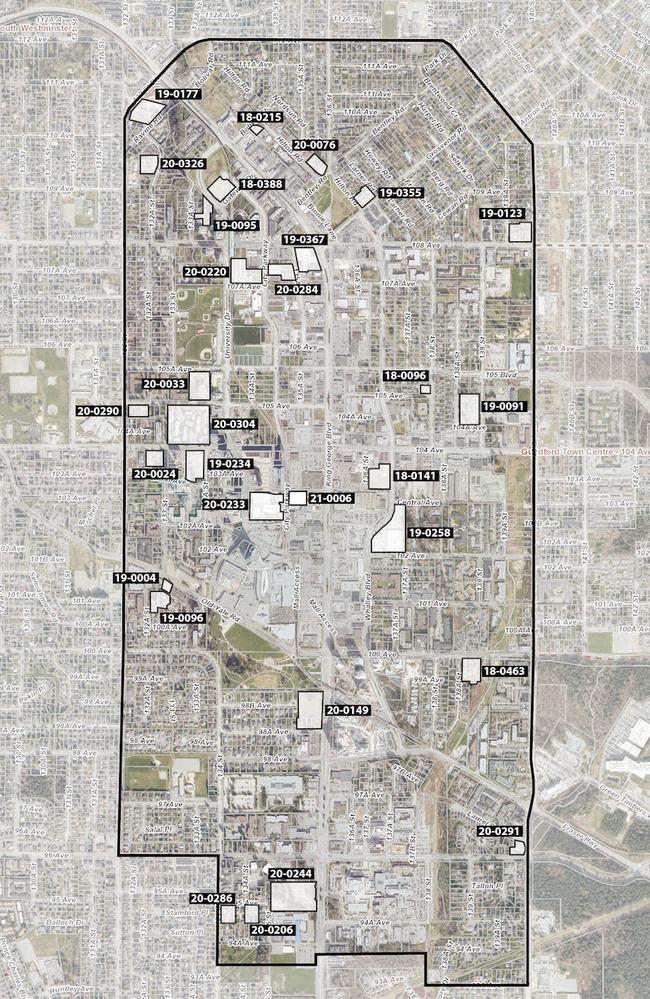 Major development applications under initial review as of April 2021
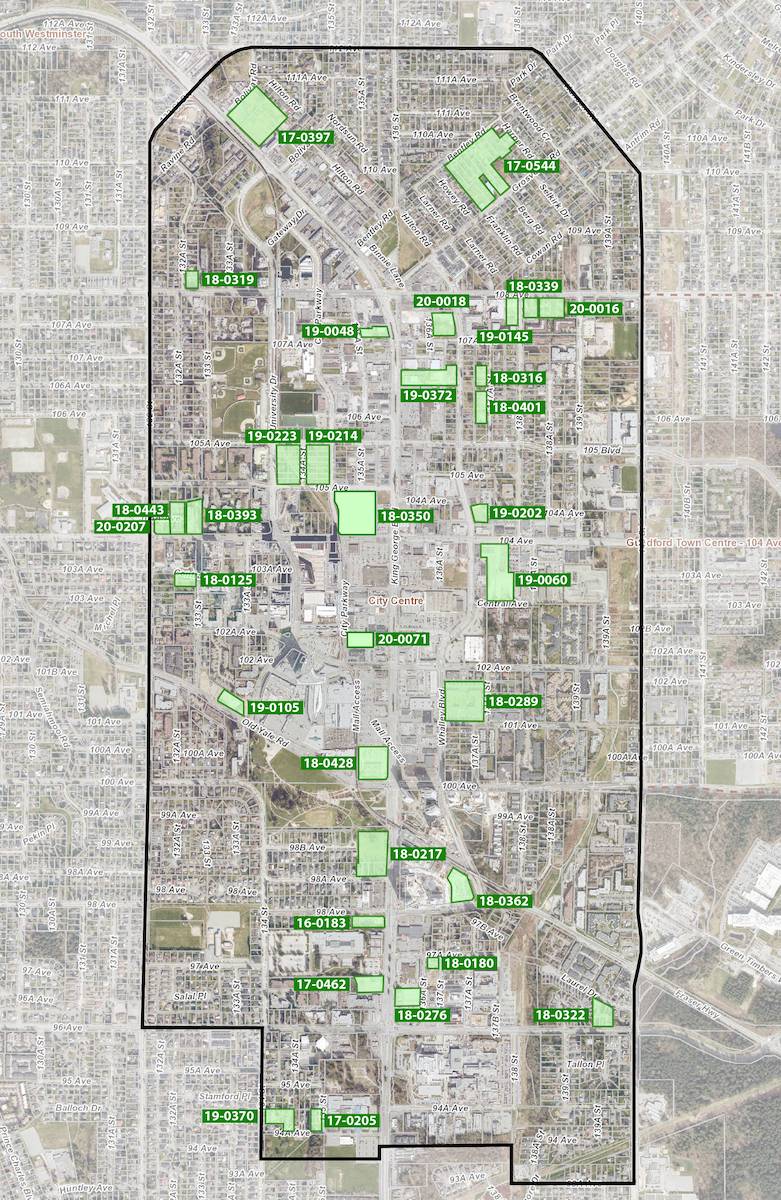 Approved major development applications as of April 2021
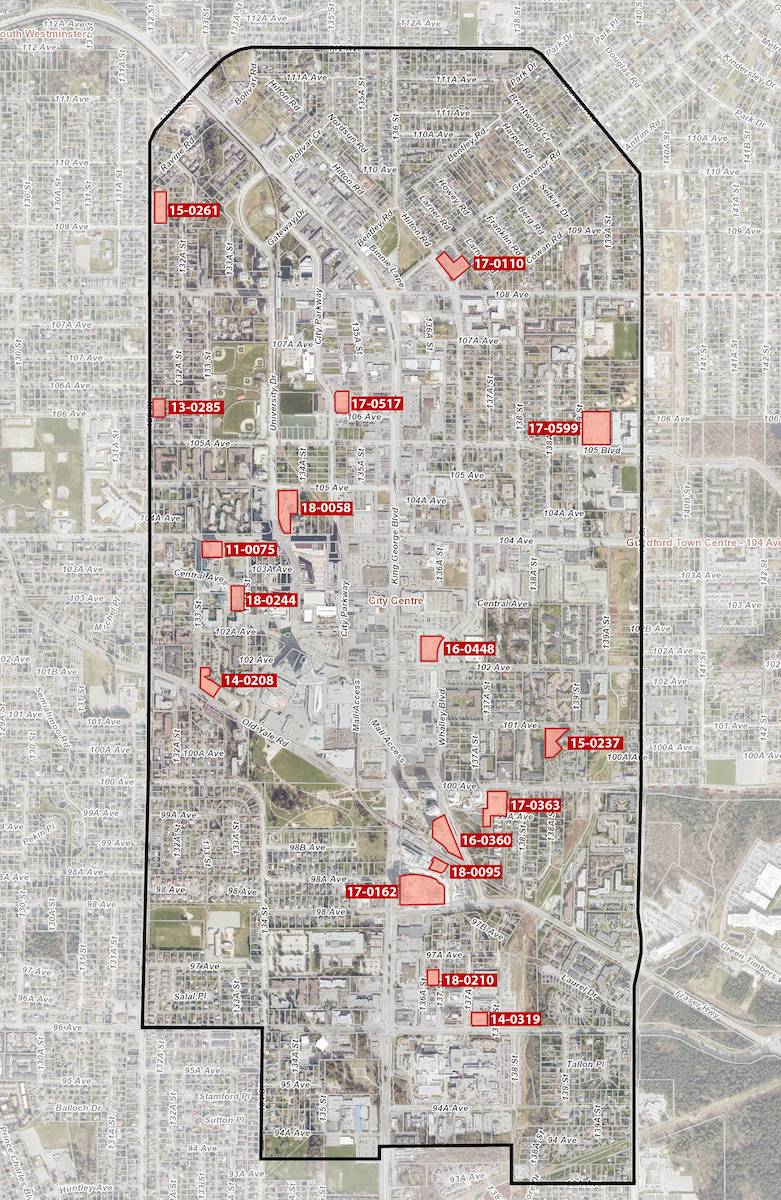 Major projects under construction as of April 2021
 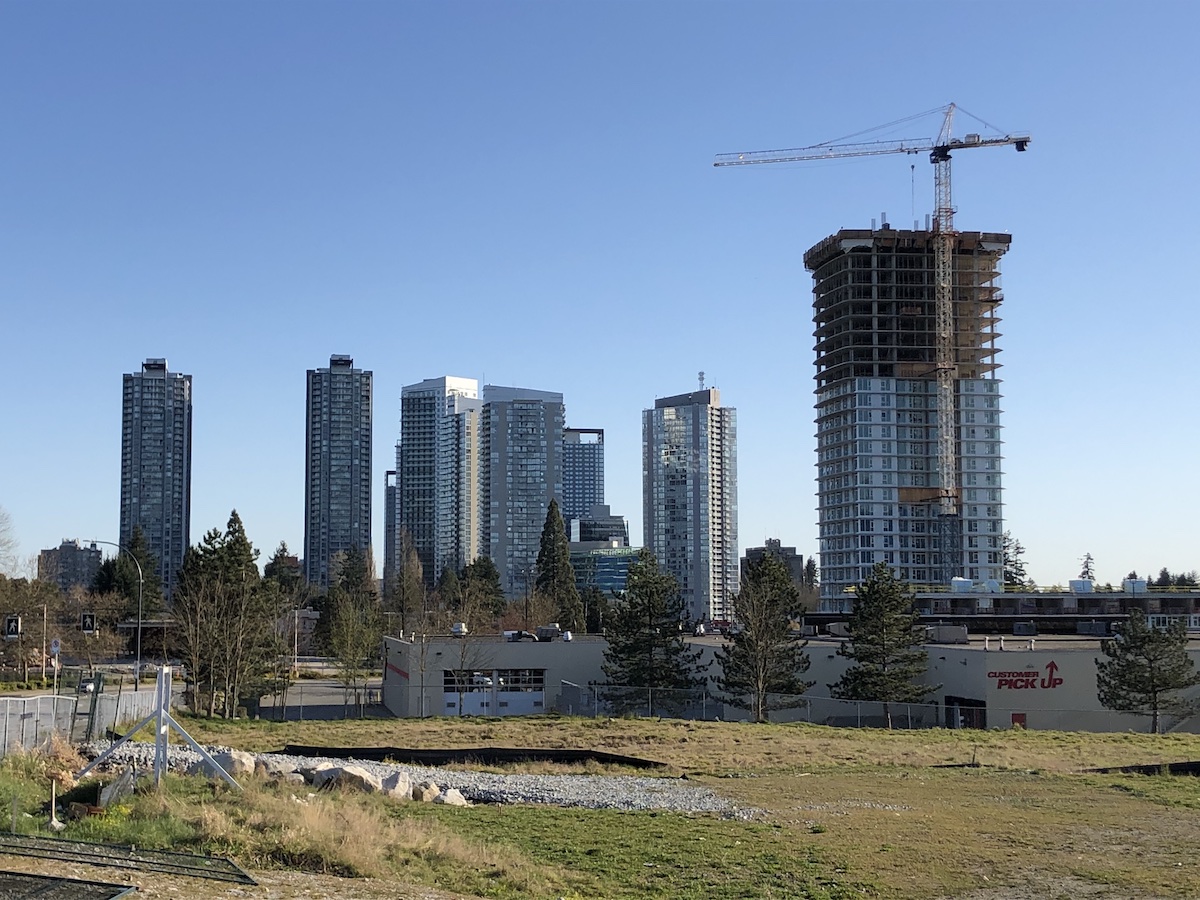 30-Storey Georgetown One rising amidst the backdrop of King George Hub
 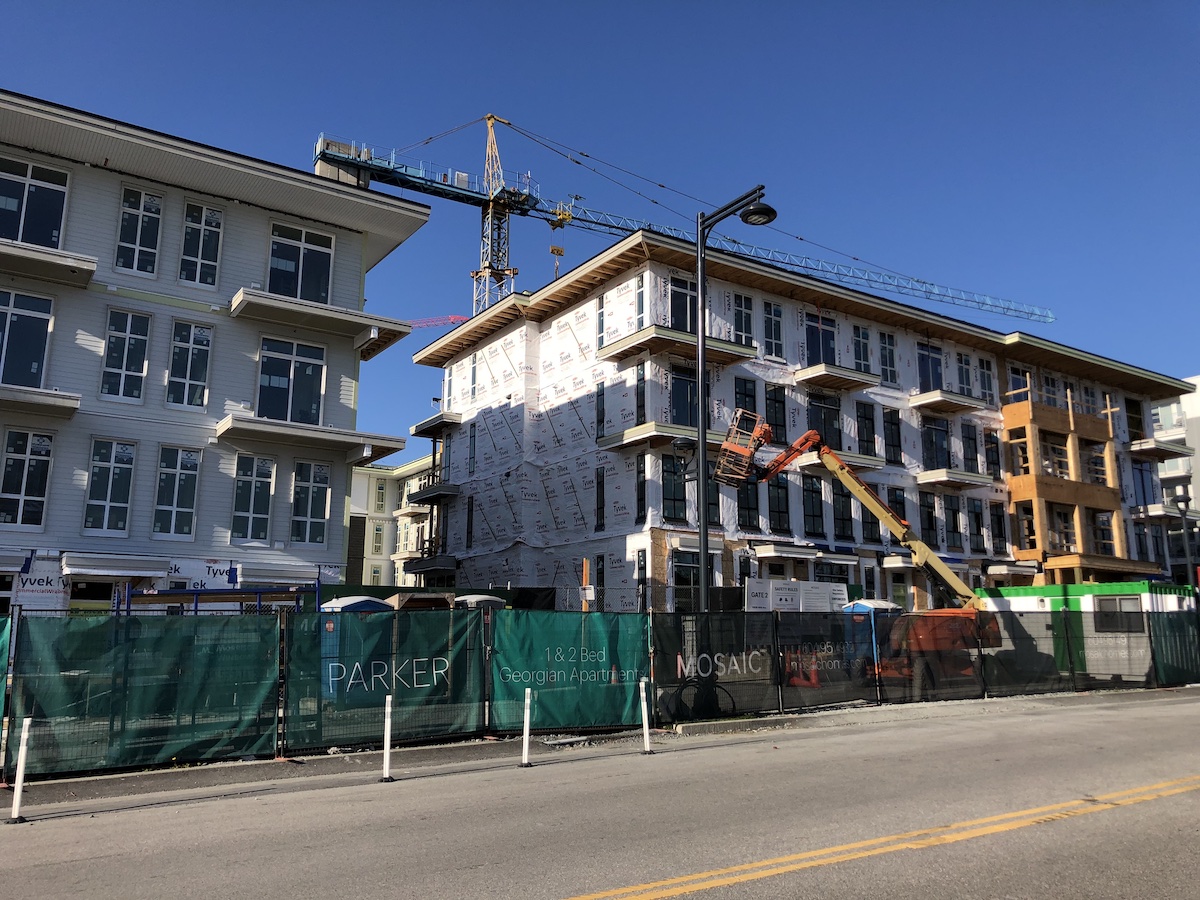 Parker by Mosaic progressing on 105 Ave near 140 St
 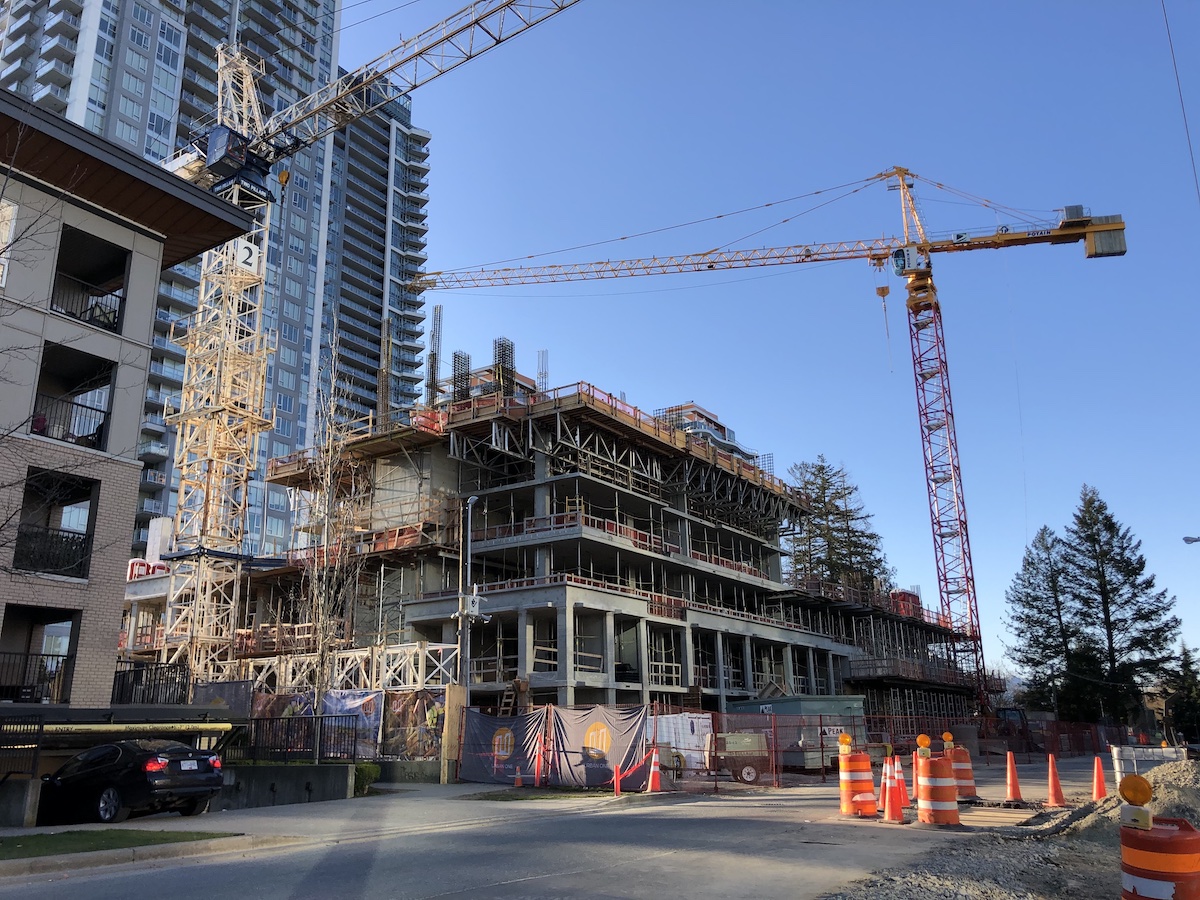 44-Storey One Central rising above its podium on 133A St at Central Ave
 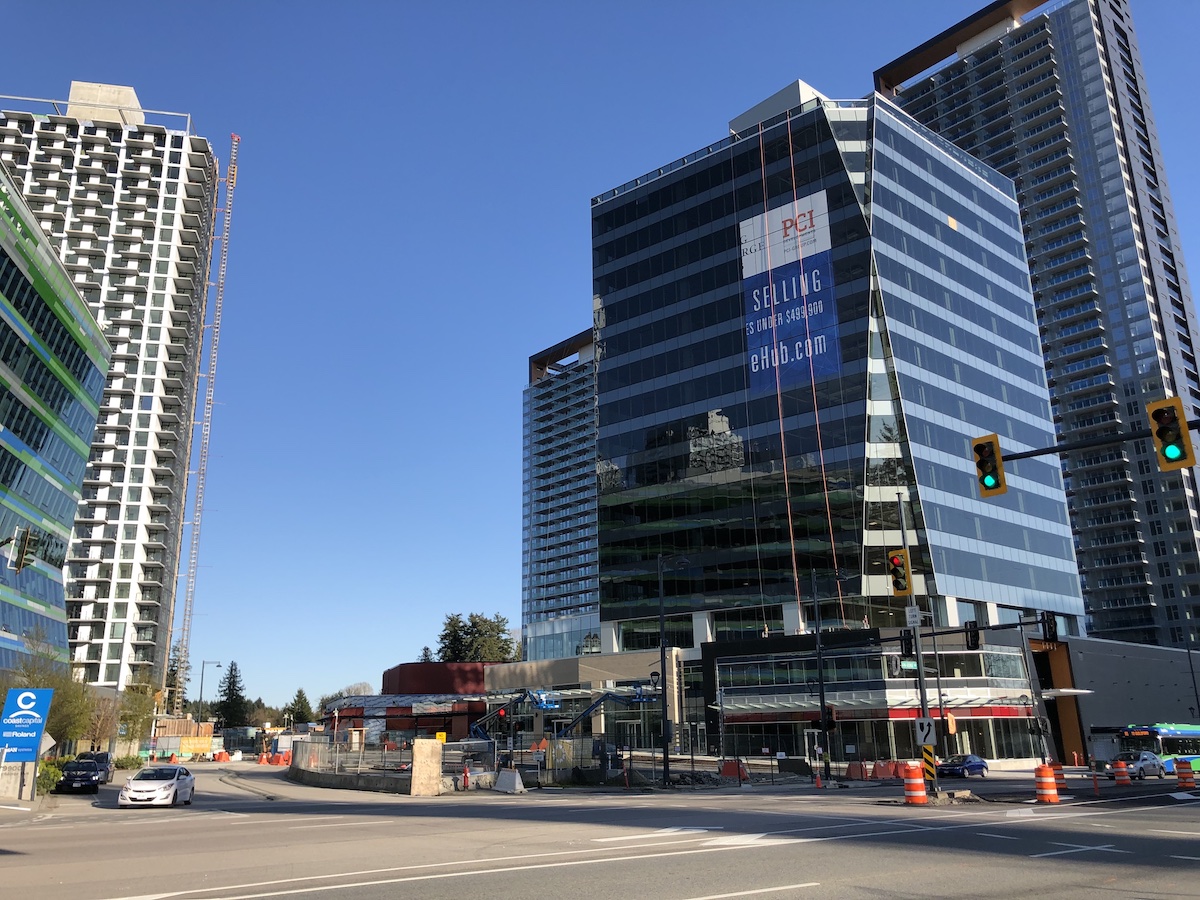 King George Hub office tower nearing completion at new intersection of King George Blvd and George Junction
  New road, bike path, and sidewalk along George Junction
 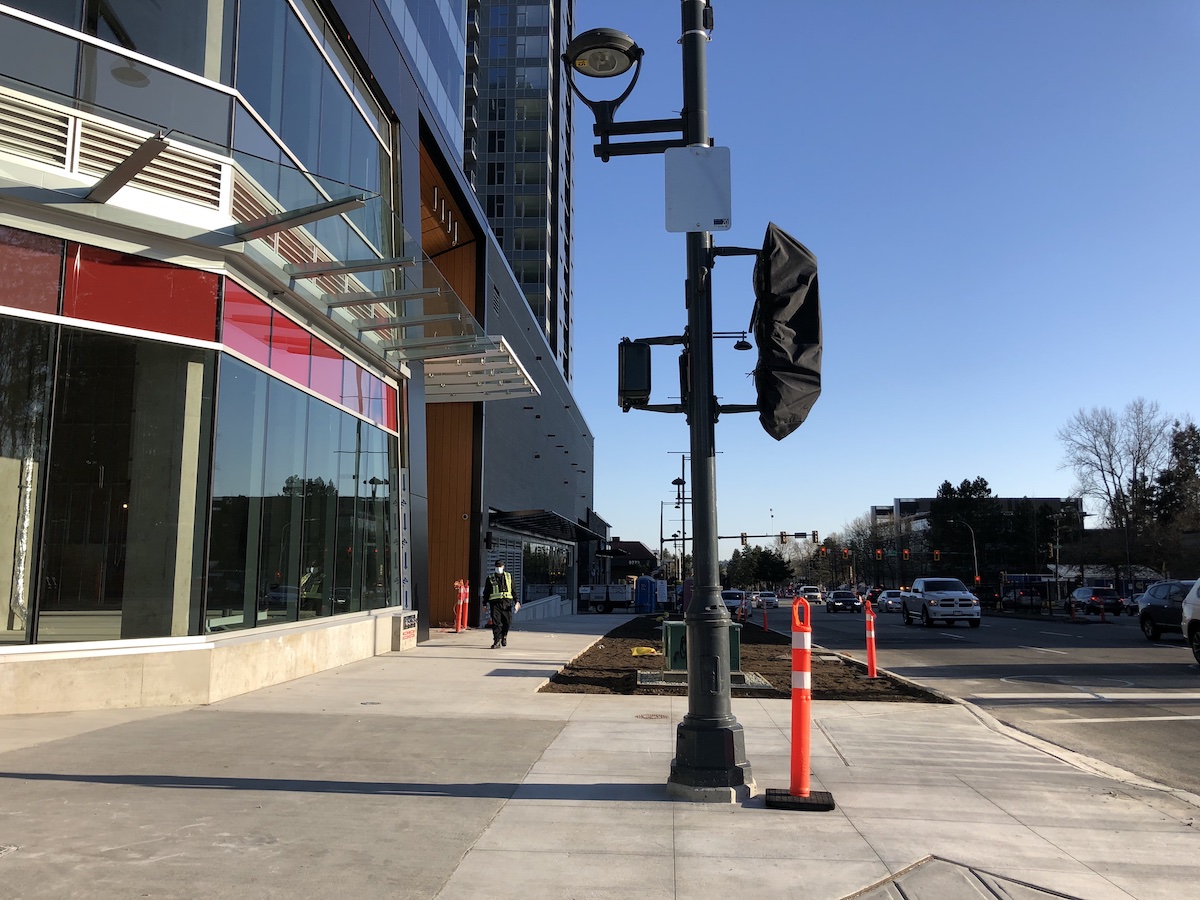 King George Hub office tower entrance fronting King George Blvd
 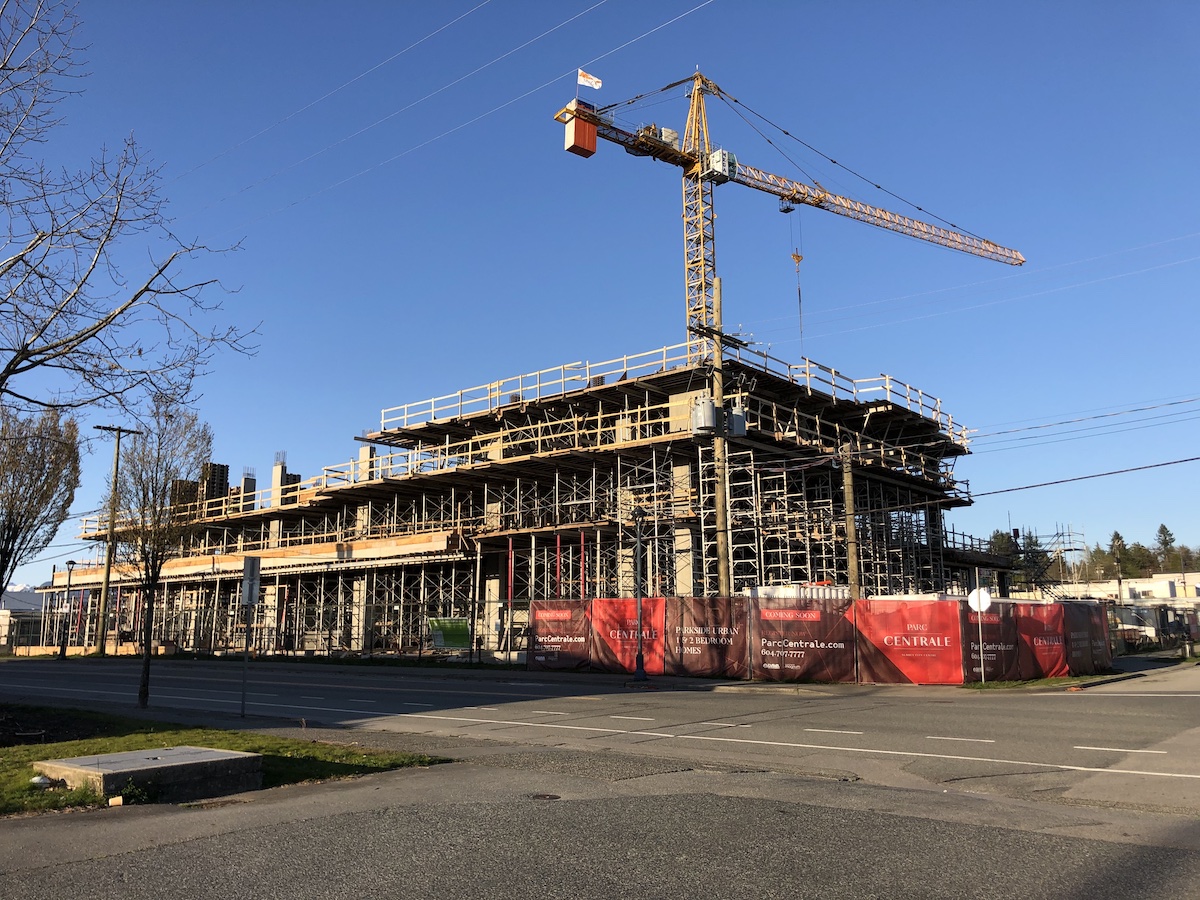 Legion ‘Veterans Village’ / Parc Centrale rising above City Parkway at 105A Ave
 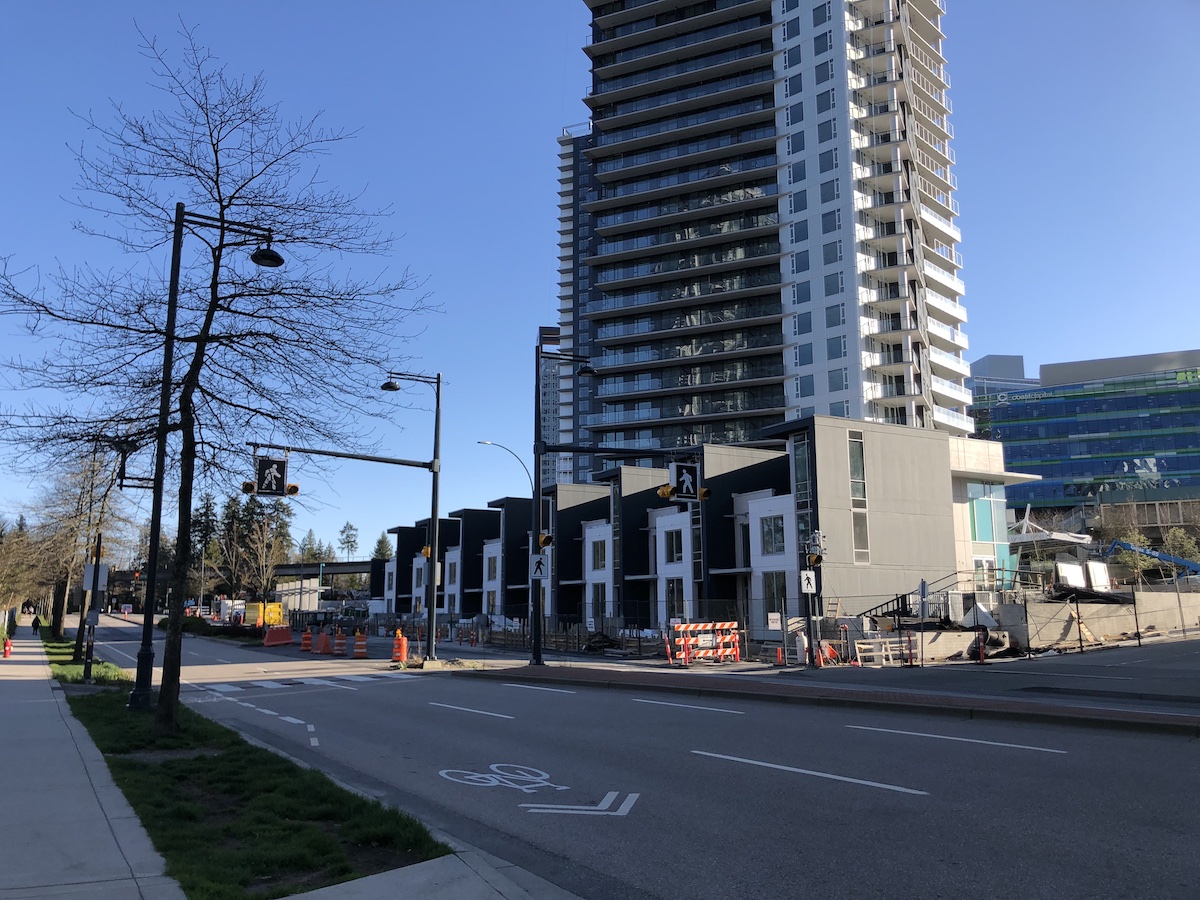 41-Storey Park Boulevard nearing completion along Whalley Blvd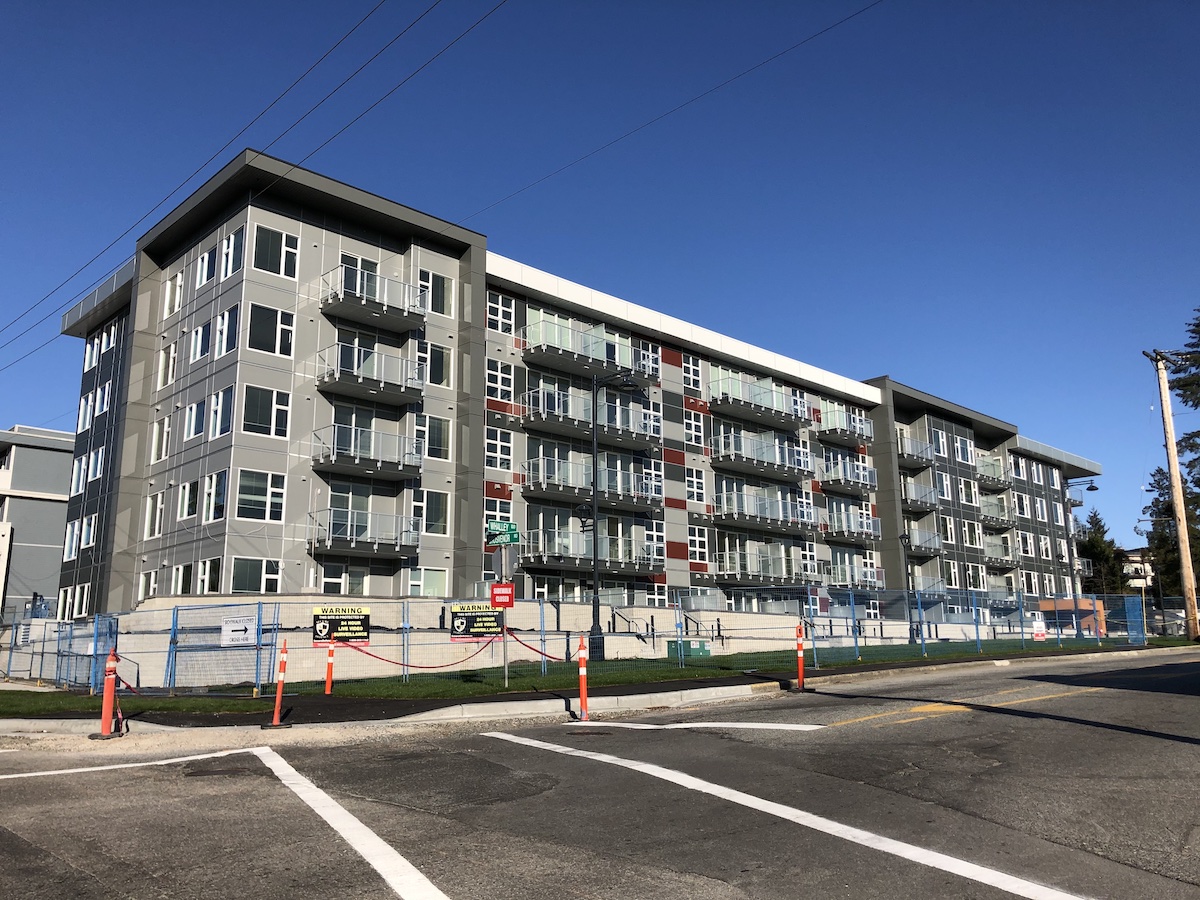
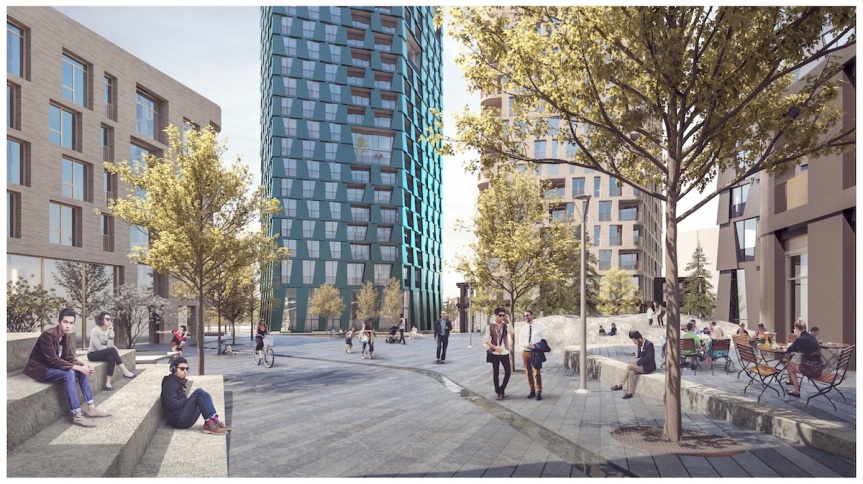
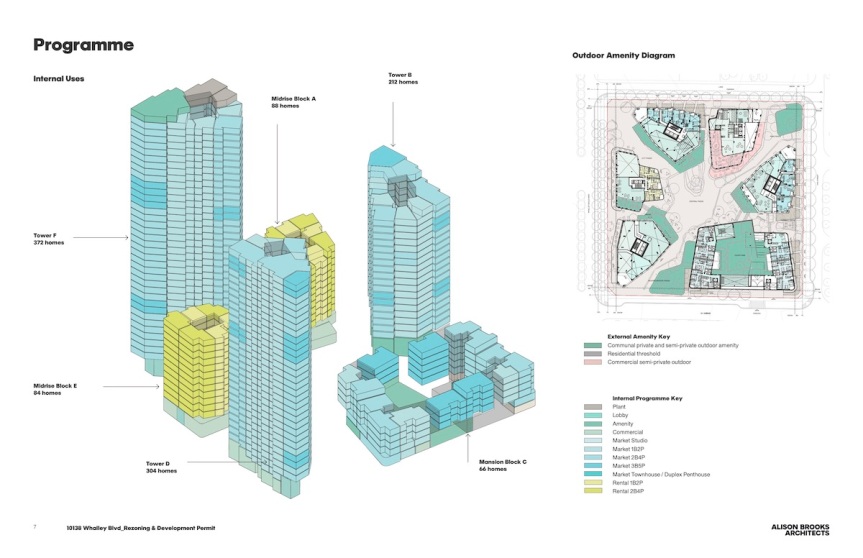
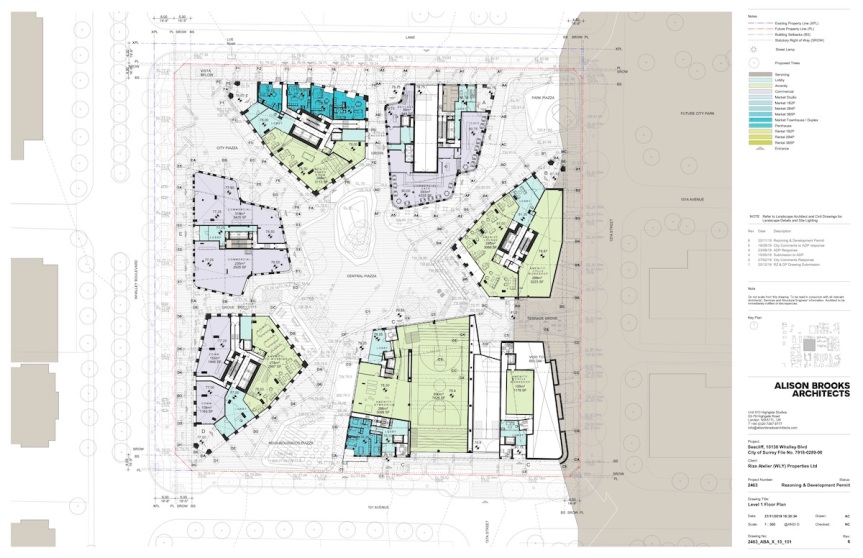
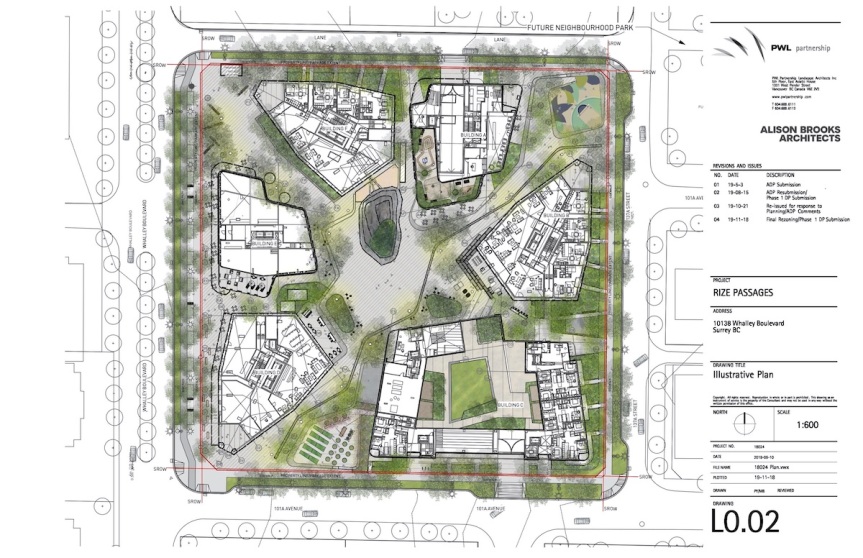
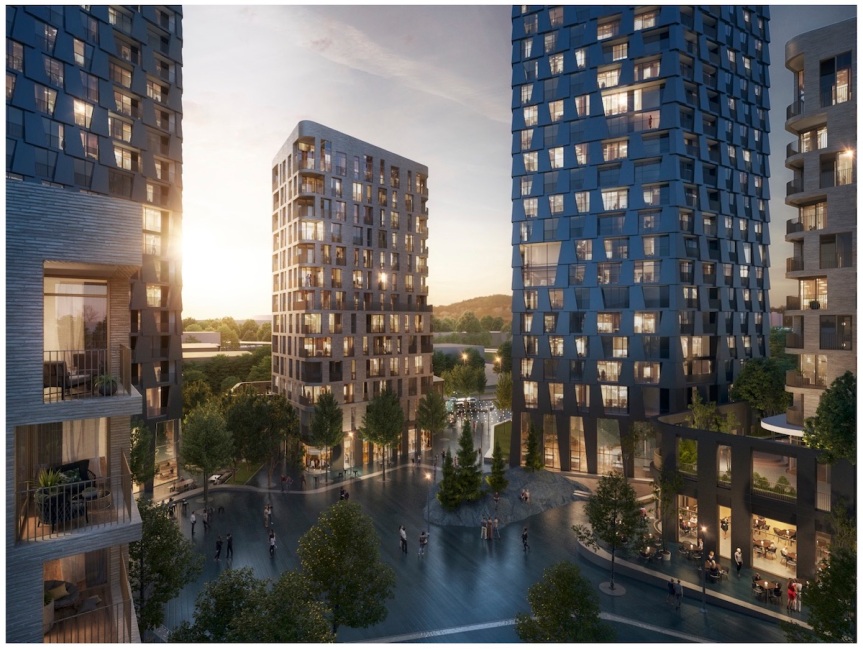 Rendering of central public ‘Piazza’ space within Passages development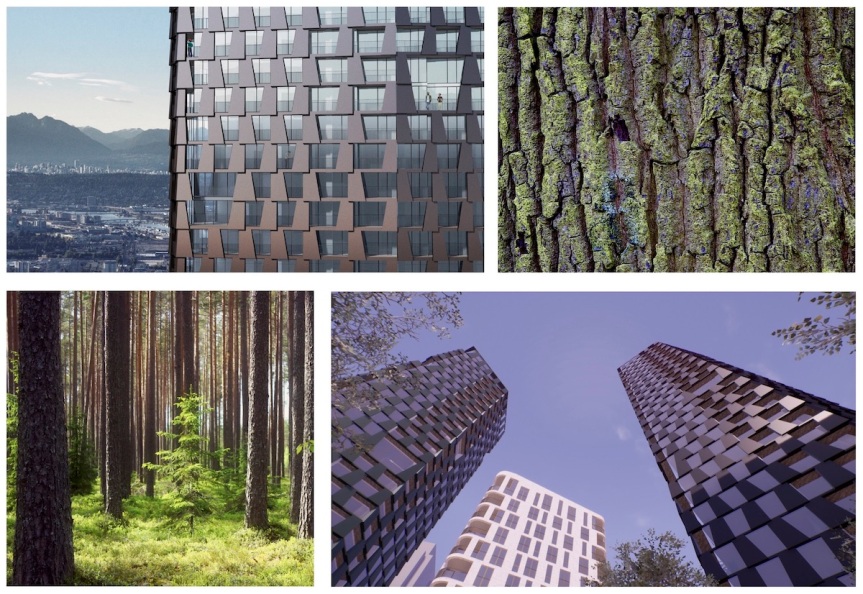
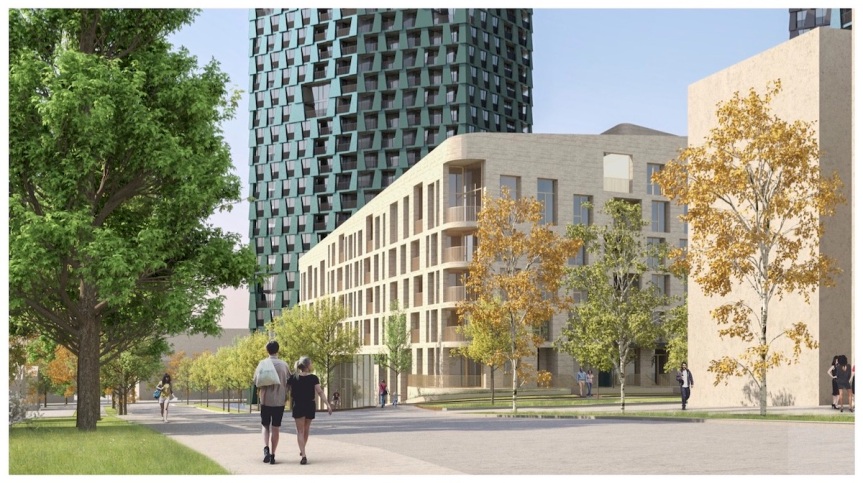
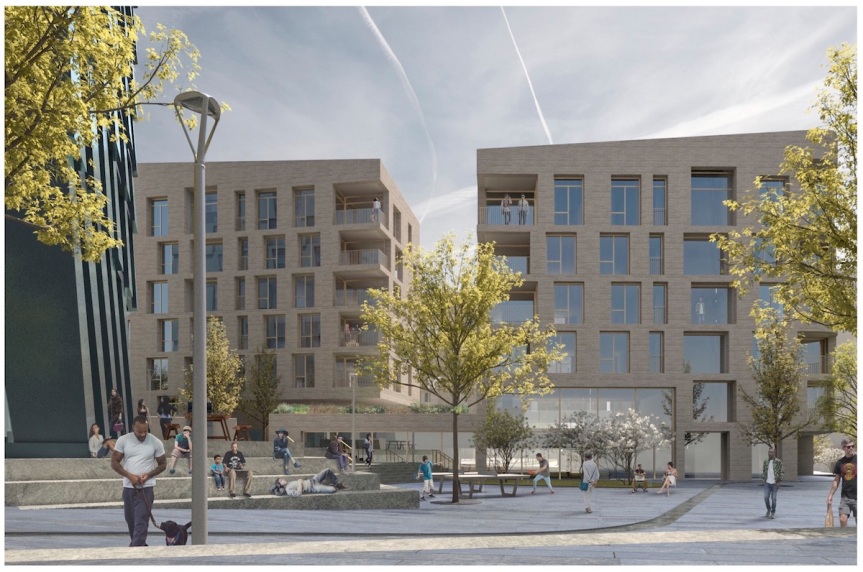
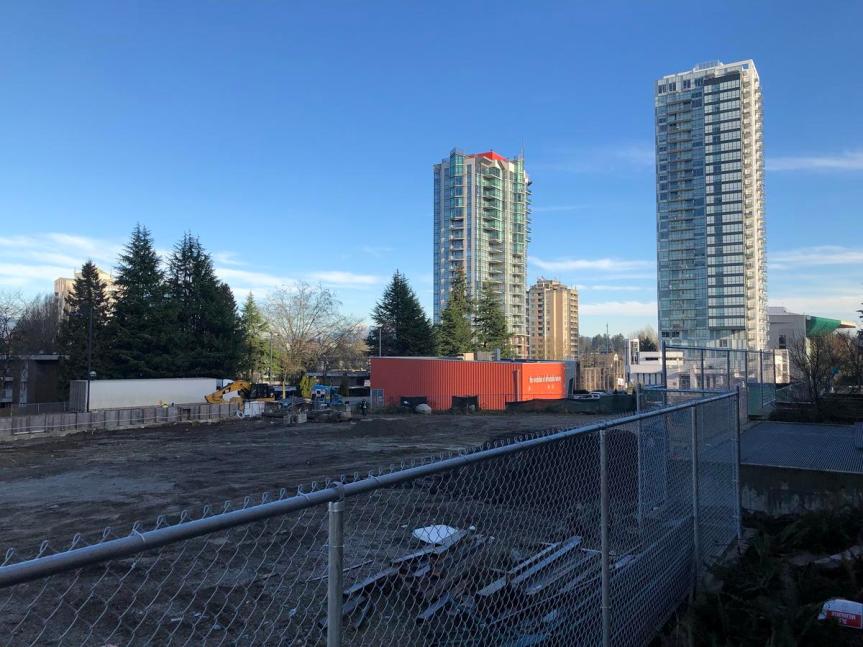 Linea site from Wave tower
 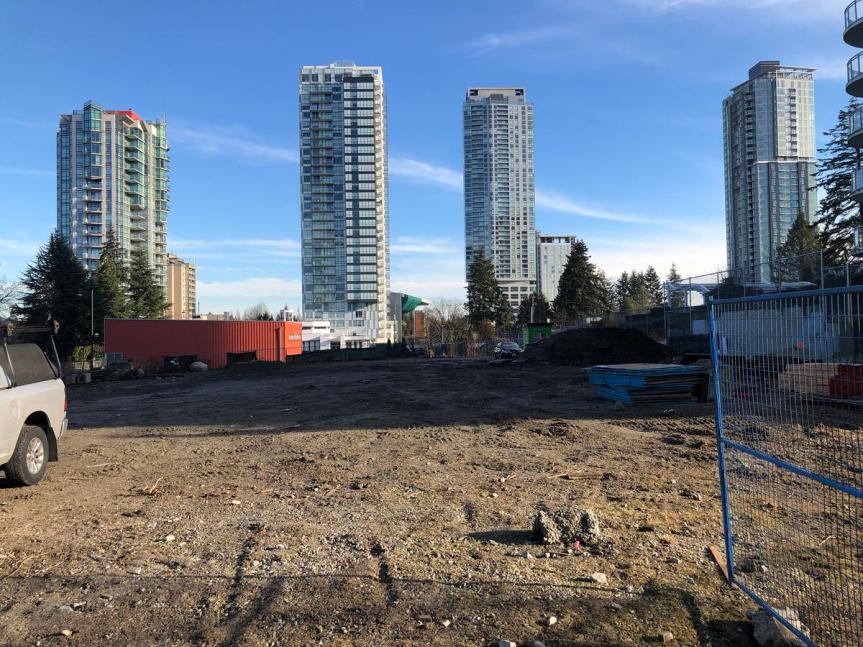 Linea site from 133 Street
 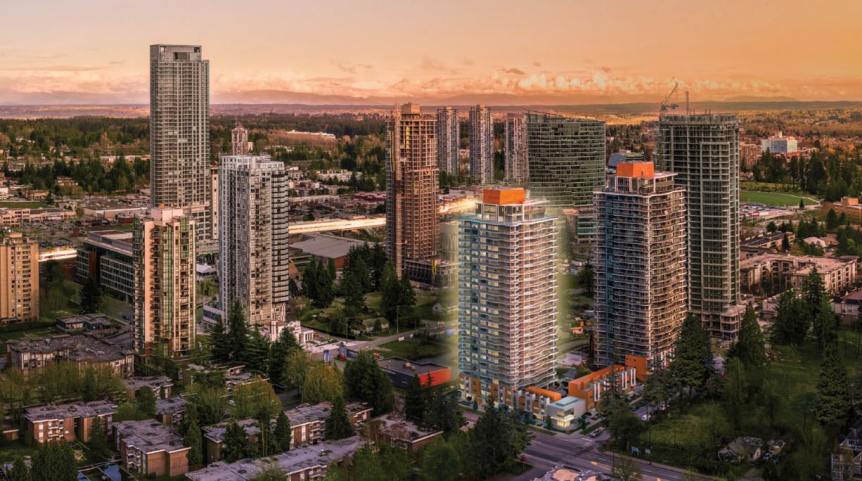 Rendering of Linea and Wave
 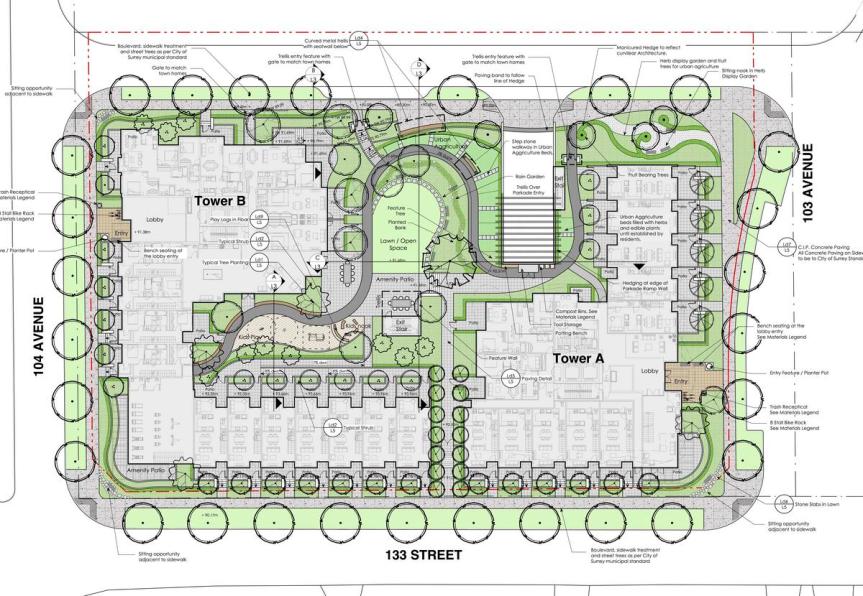 Ground level Site Plan of Wave and Linea site
 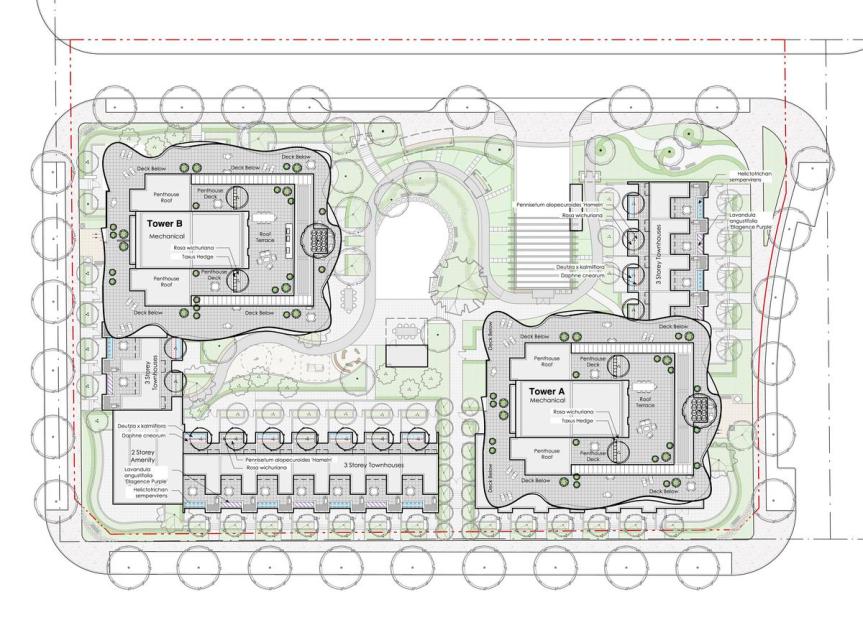 Rooftop Site Plan of Wave and Linea site
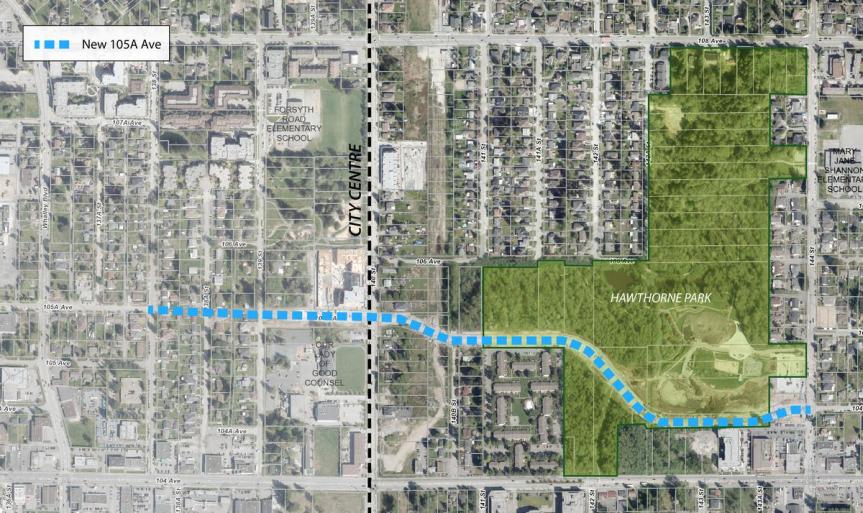 Completed phase 1 of 105A Connector project
 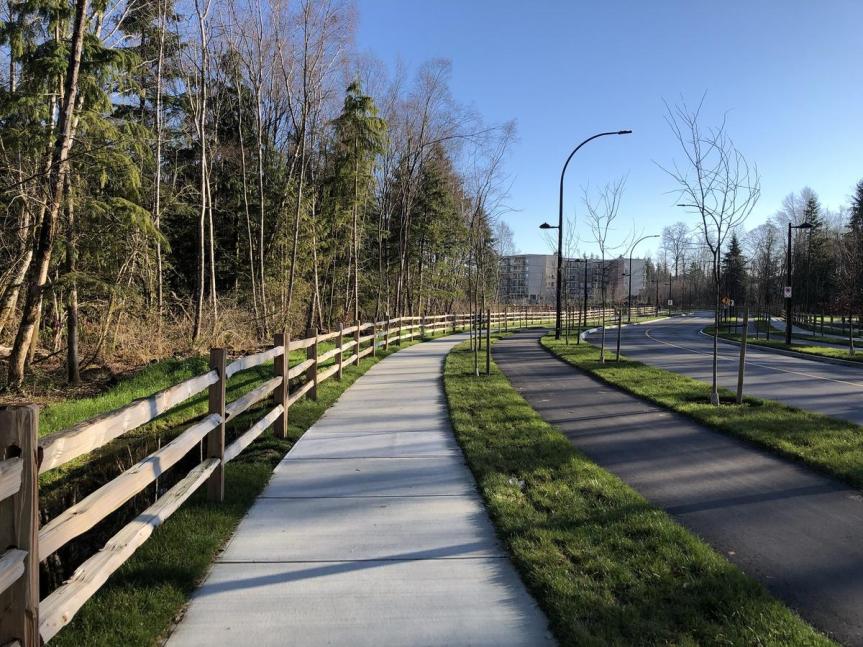 New 105A Ave though Hawthorne Park with sidewalk, bike-lane, and roadway
 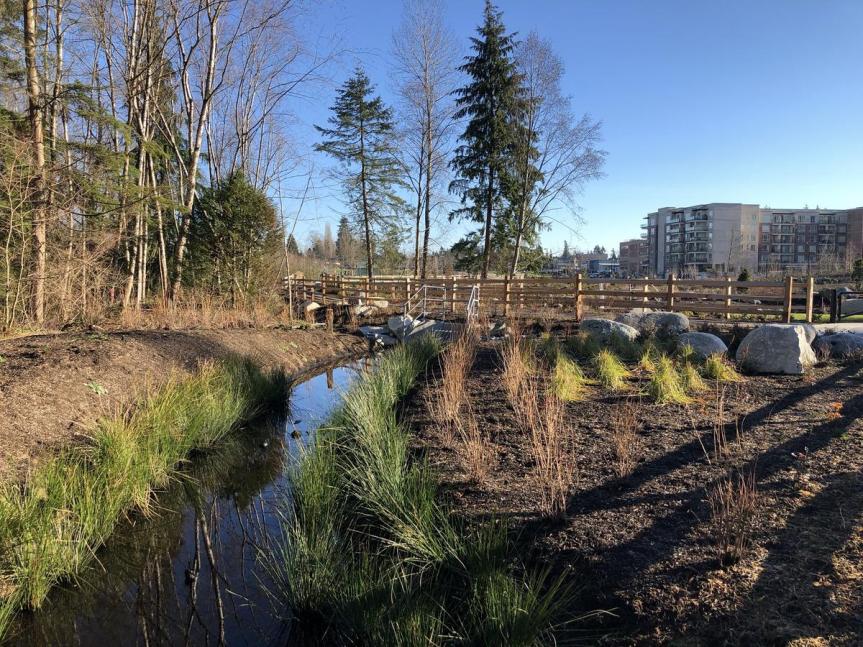 New landscaping and habitat area
 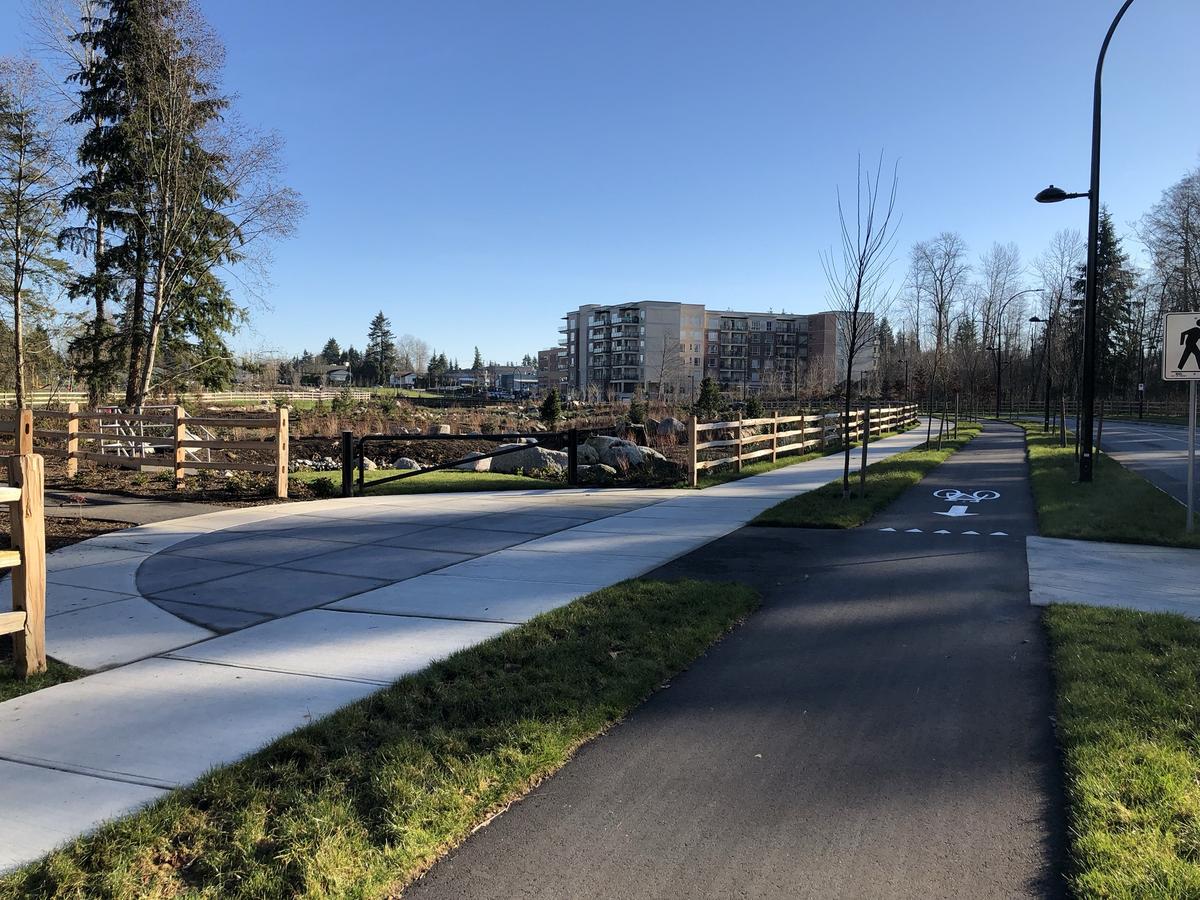 New sidewalk and bike lane near Aquatic Habitat
 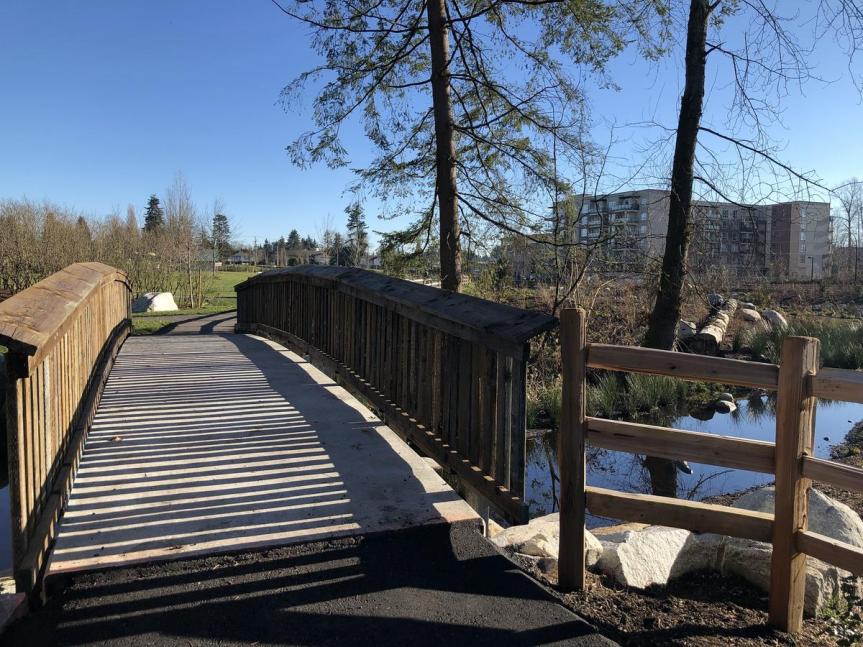 New pedestrian bridge over aquatic habitat
 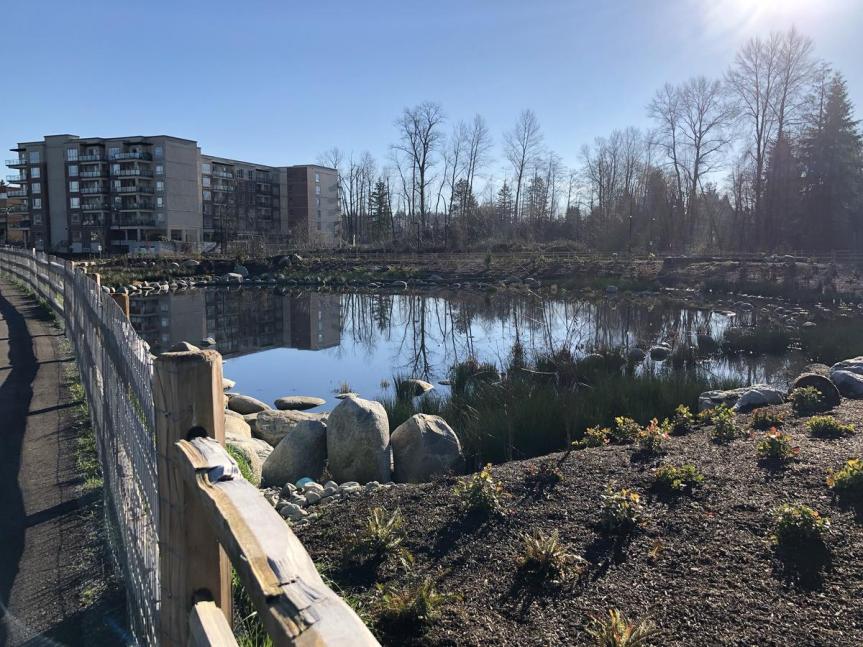 New Aquatic Habitat at Hawthorne Park
 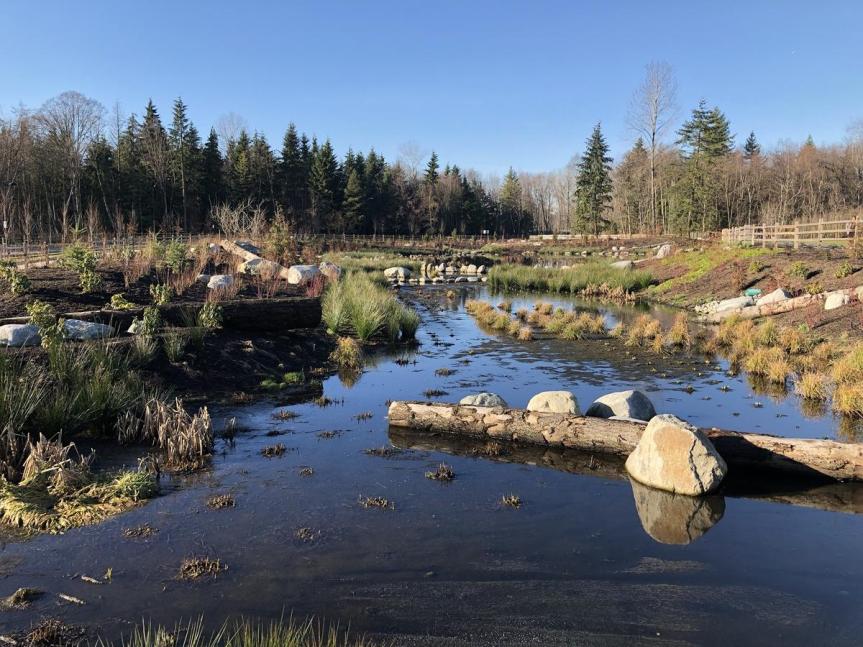 New Aquatic Habitat in Hawthorne Park
 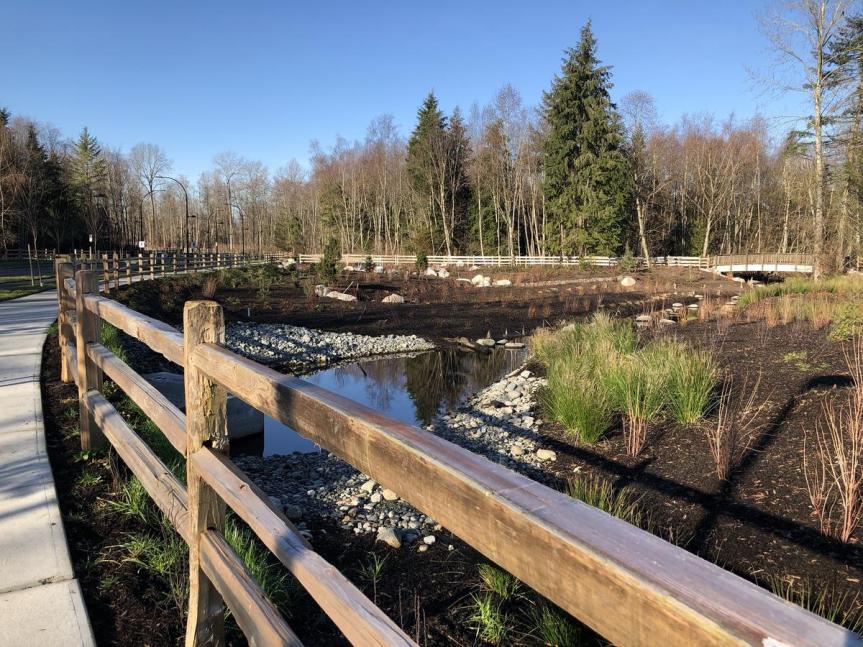 New Aquatic Habitat from 105A Ave
 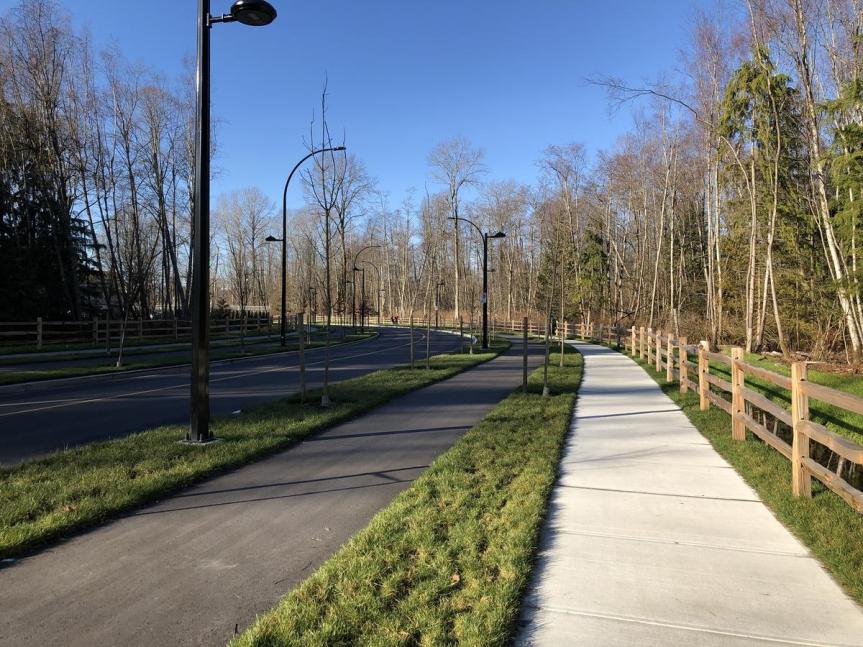 New 105A Avenue along south edge of Hawthorne Park
 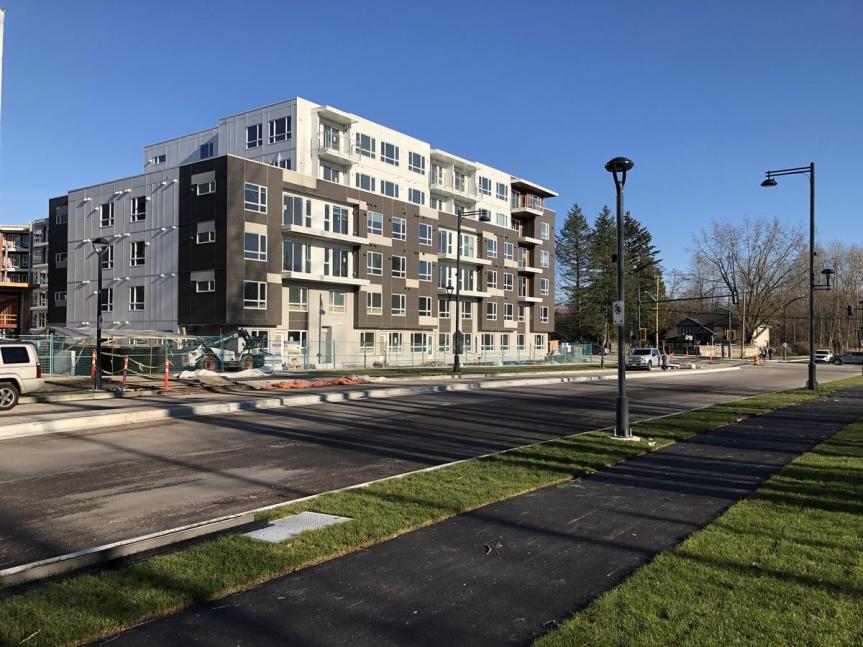 New 105A Avenue between 139 Street and 140 Street
 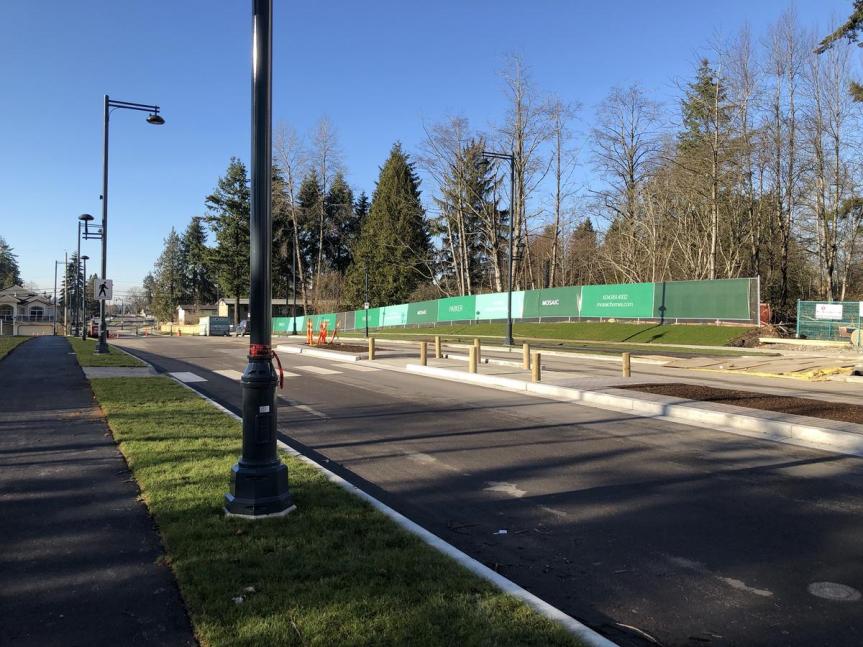 New 105A Avenue between 139 Street and 140 Street
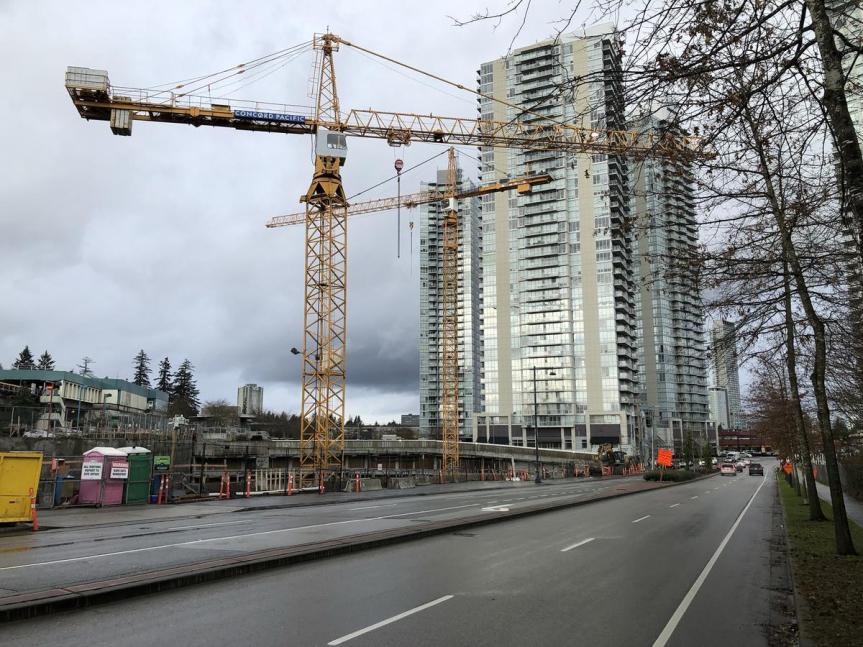 Park Boulevard under construction on Whalley Blvd
 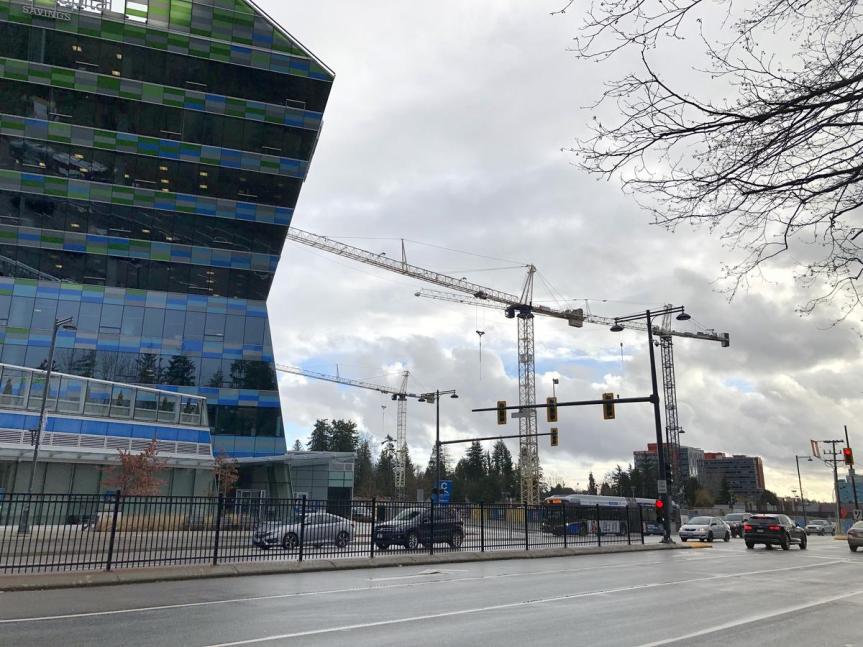 King George Hub (Phase B) under construction at King George Blvd & Fraser Hwy
 Prime on the Plaza under construction at University Dr + Central Ave
  Evolve under construction at 133 St + Central Ave
 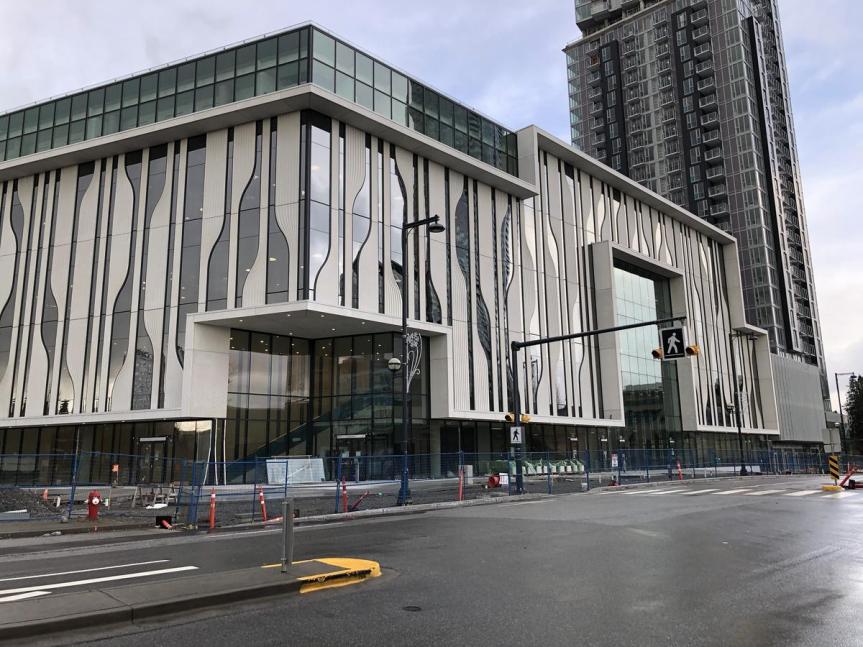 SFU Sustainable Energy + Environmental Engineering Building – set to open Fall 2019
 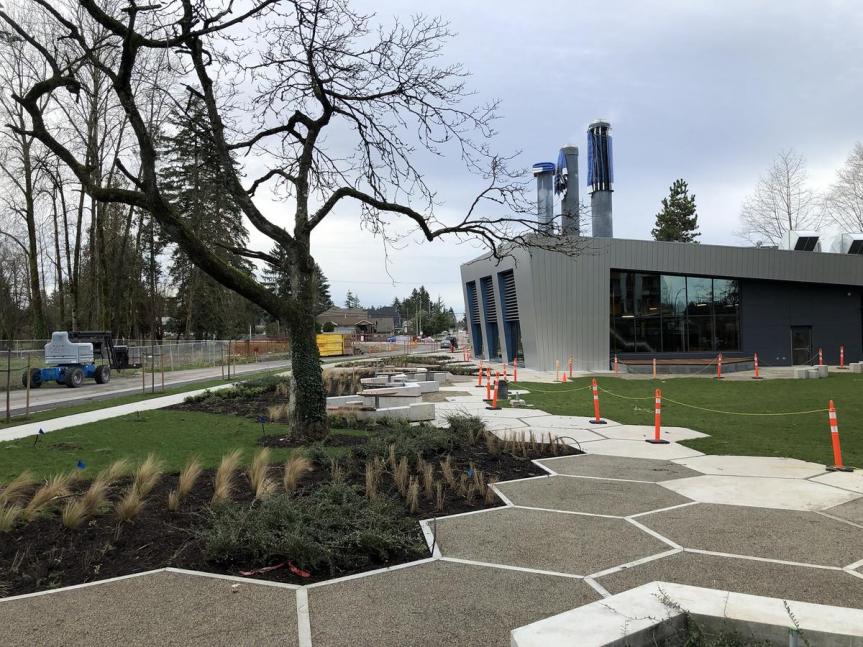 West Village Park + District Energy Centre
 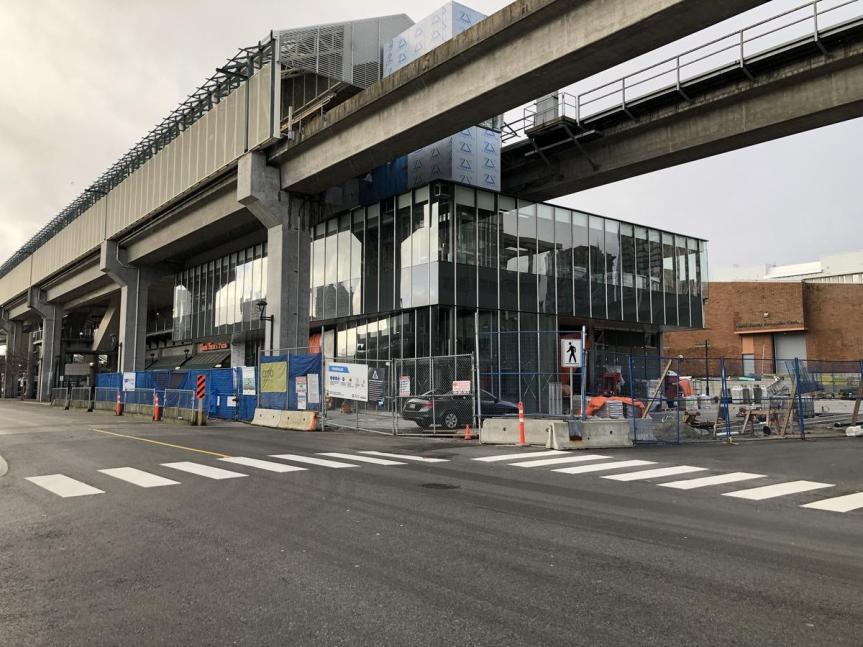 Surrey Central SkyTrain – North Station House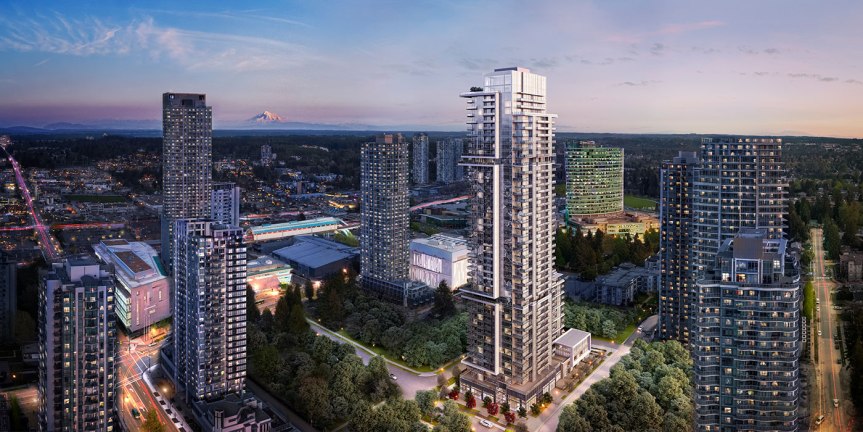
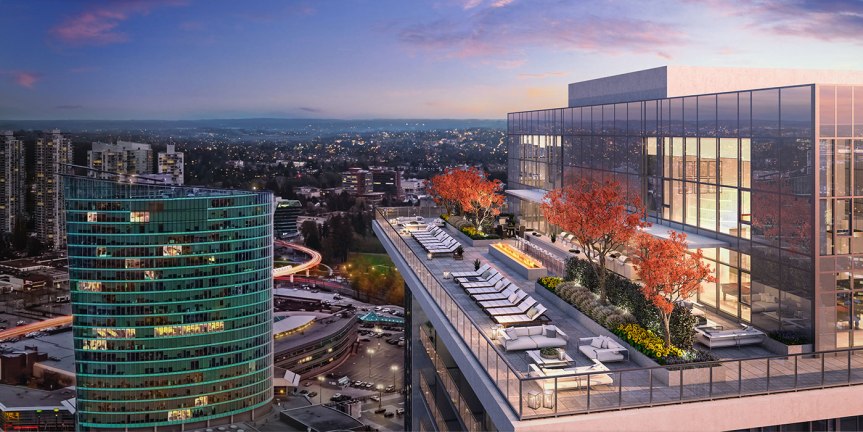 View from rooftop amenity area of One Central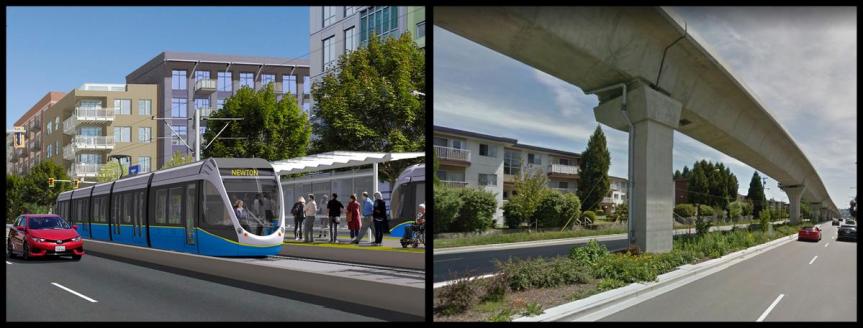
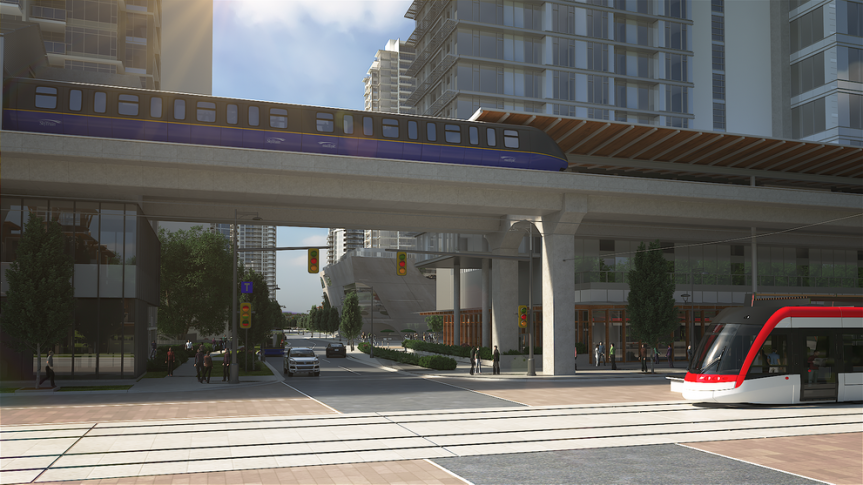 Multi-Modal Transfer Hub Station at Surrey Central integrated into Plaza
 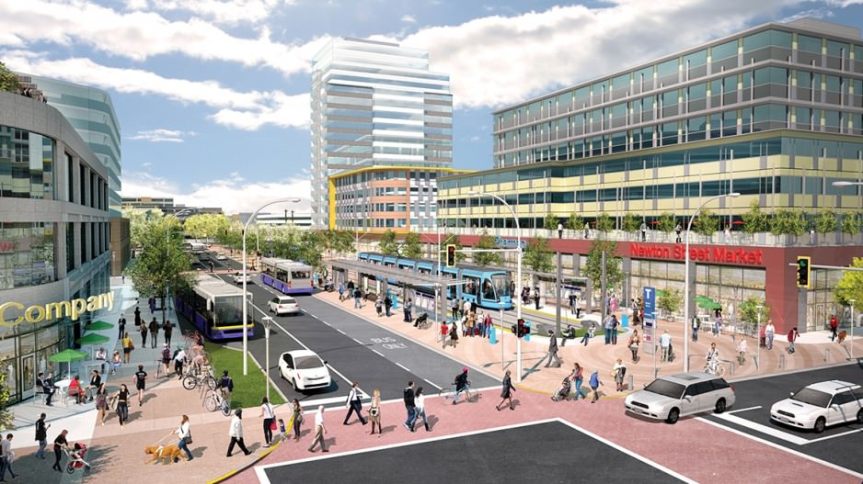 Envisioned Newton Town Centre Plaza with LRT integration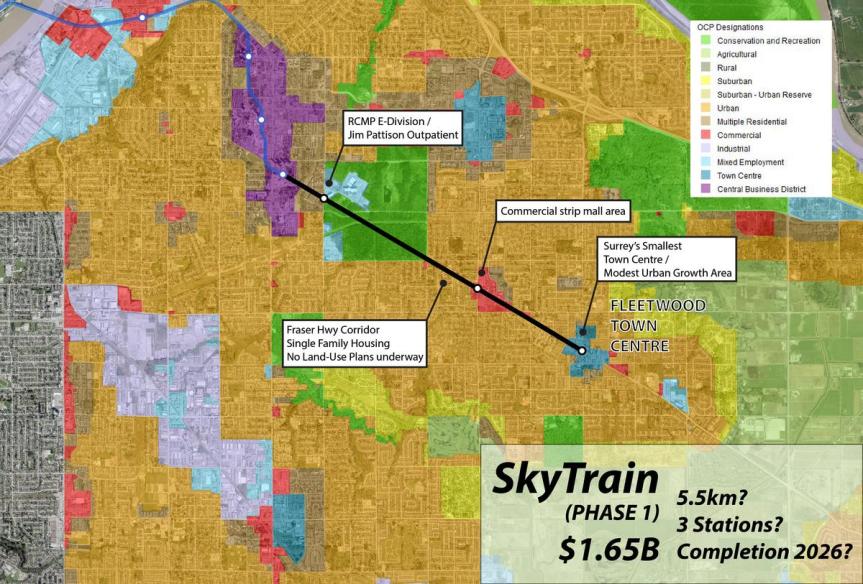
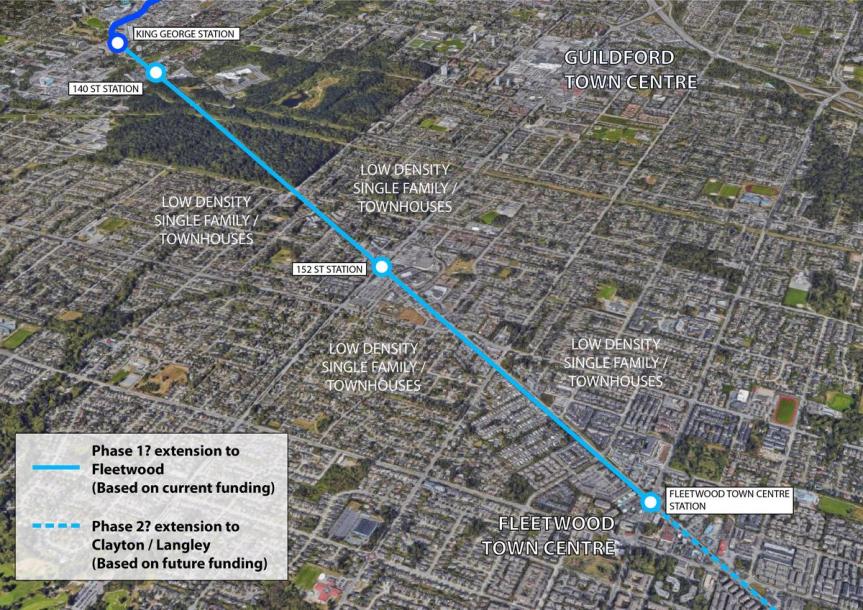 Likely 3-stop ‘Phase 1’ SkyTrain extension to Fleetwood with current funding
 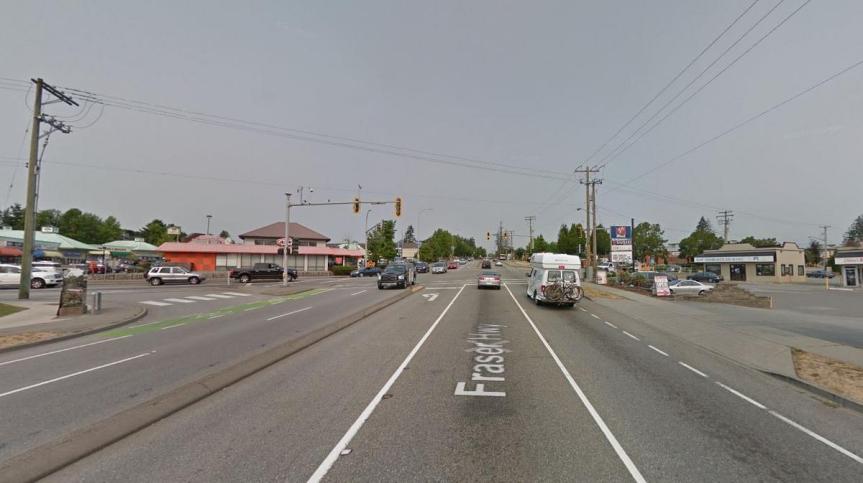 Likely terminus of Phase 1 Fraser Hwy SkyTrain extension in Fleetwood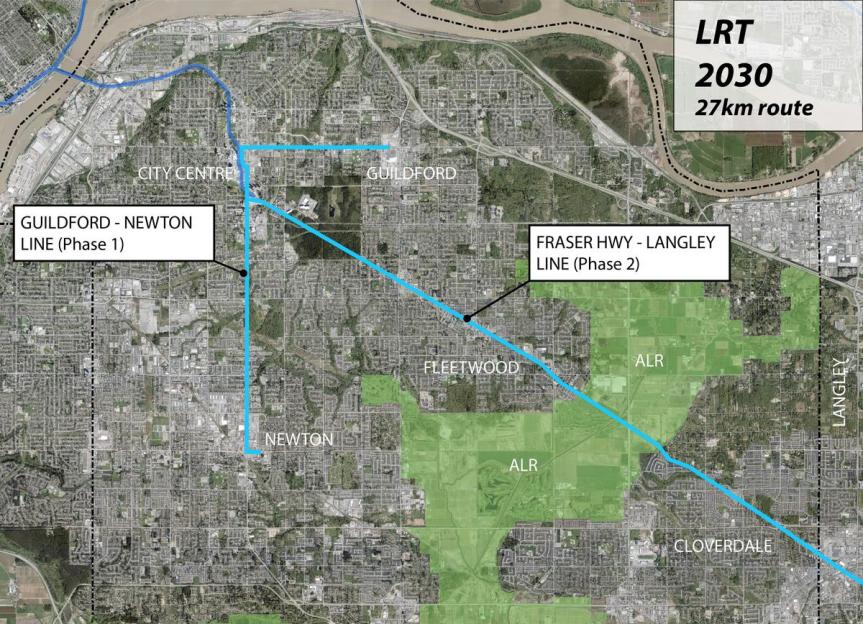
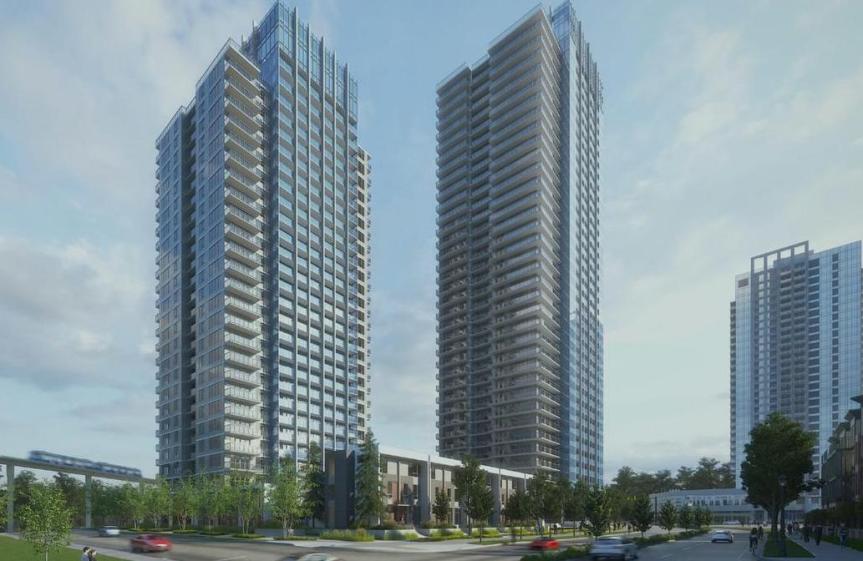
 Model seen from University Drive + 105 Avenue
 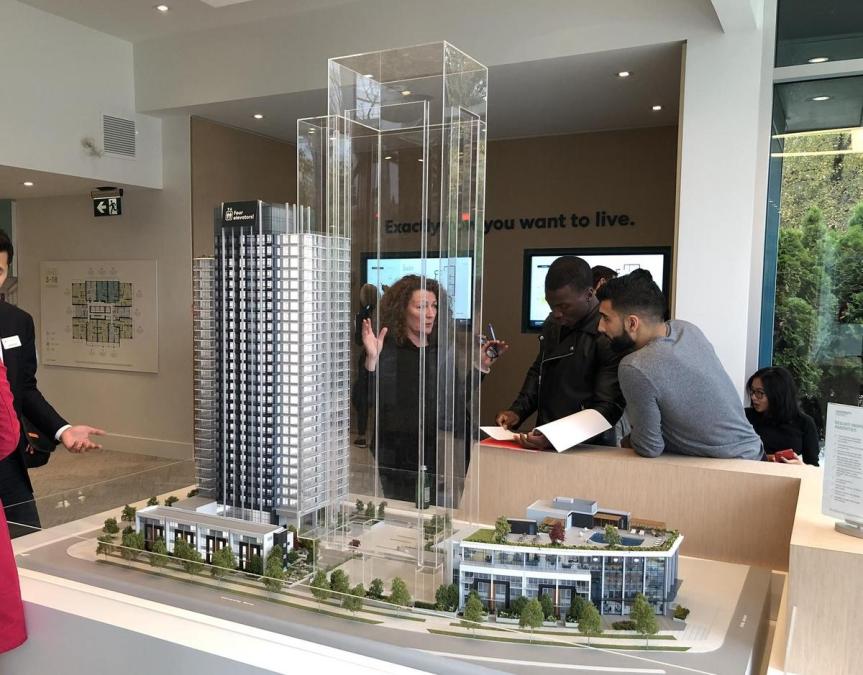 Model seen from University Drive
 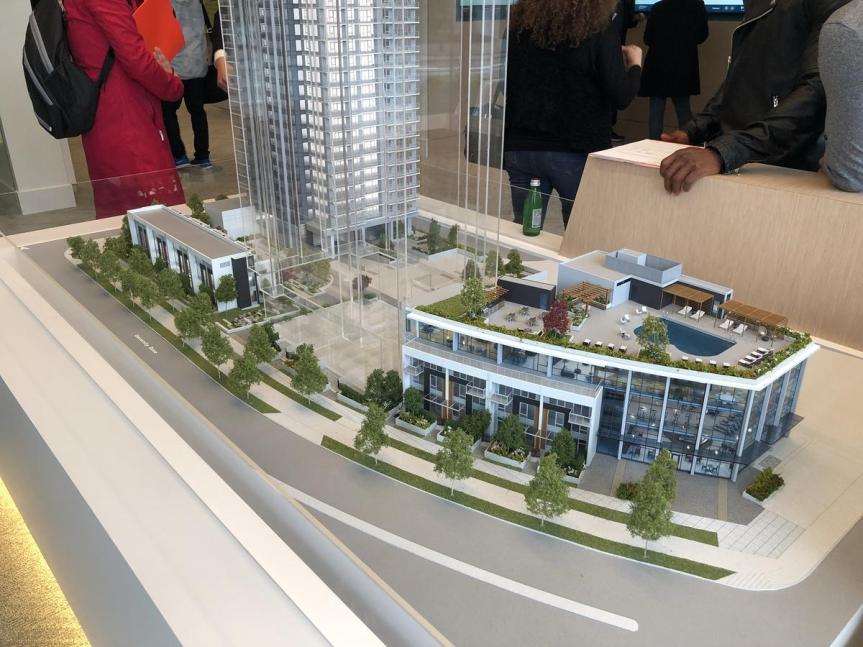 Model of commercial and amenity podium at University Drive + 104 Avenue
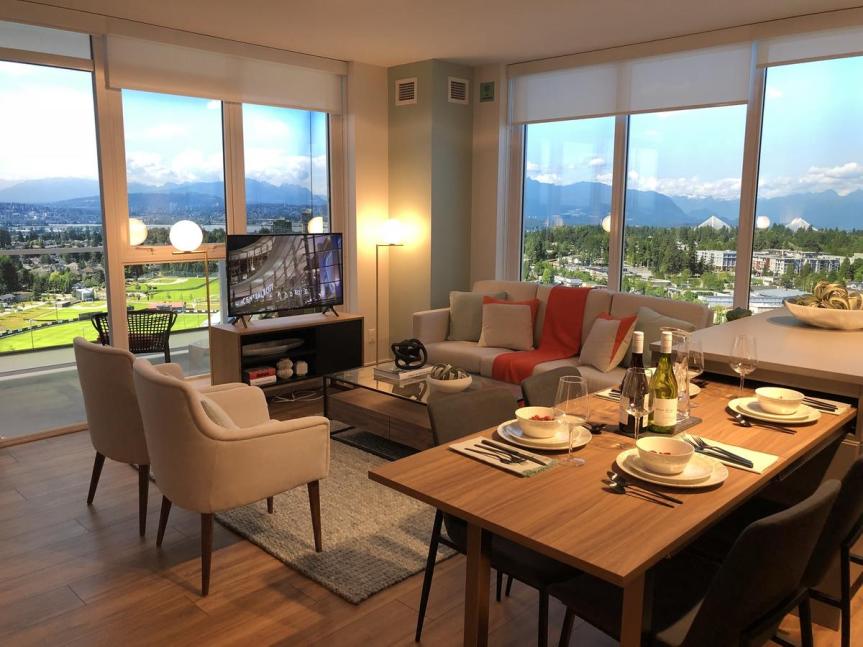 North-West facing corner suite
 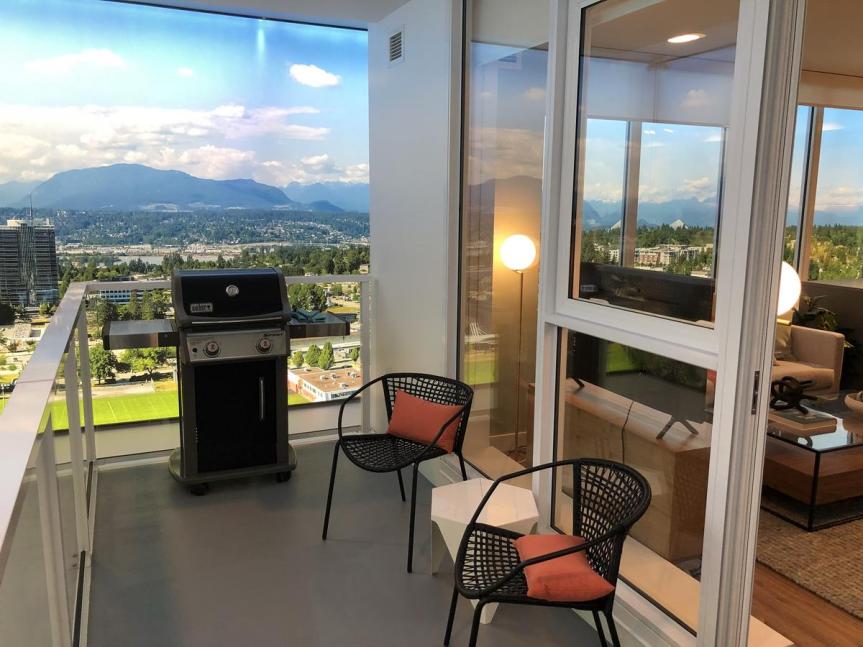 Balcony facing North-West
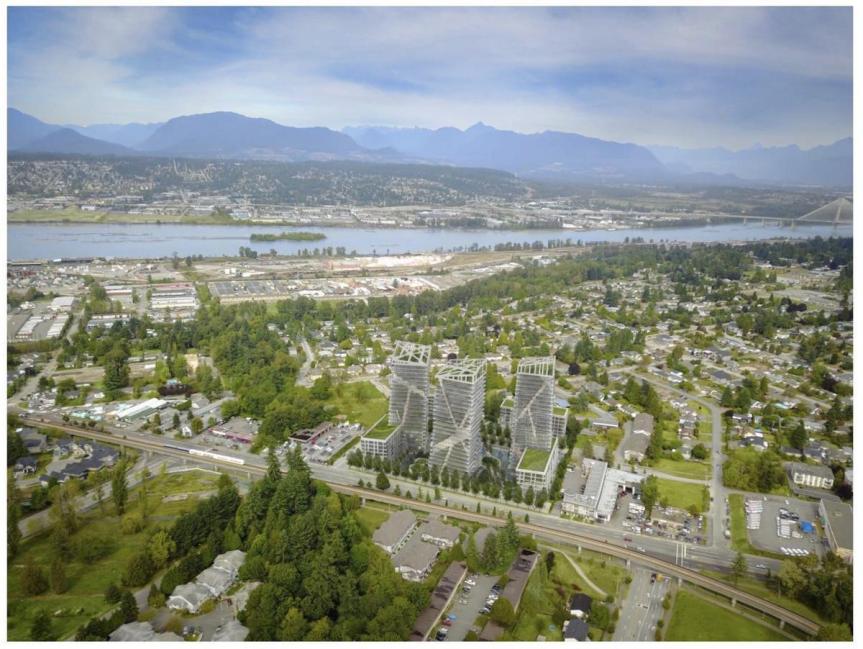 Proposed ‘Gateway’ tower site on King George Blvd at Bolivar Rd
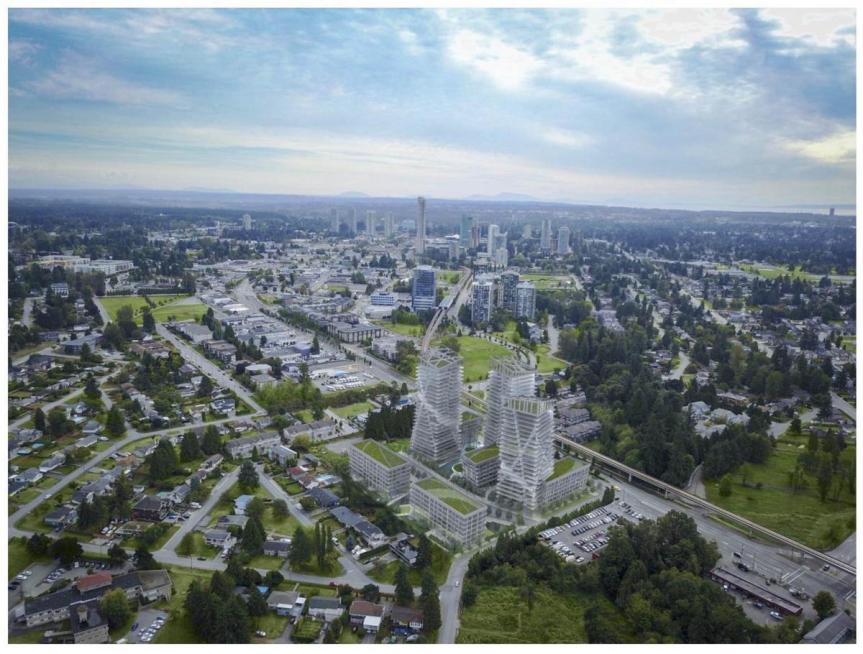 Proposed development looking south towards existing City Centre
 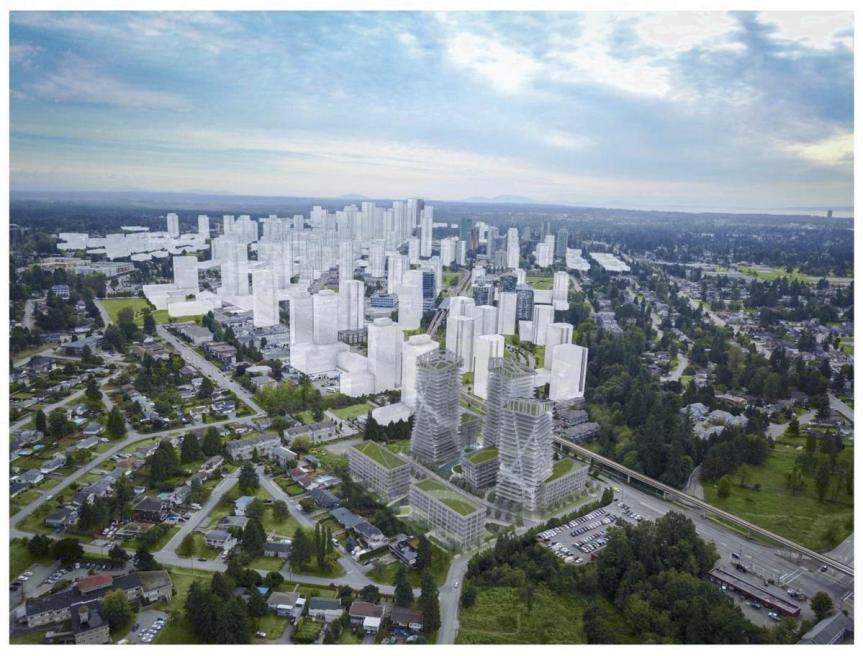 Proposed development looking south towards future built-out City Centre
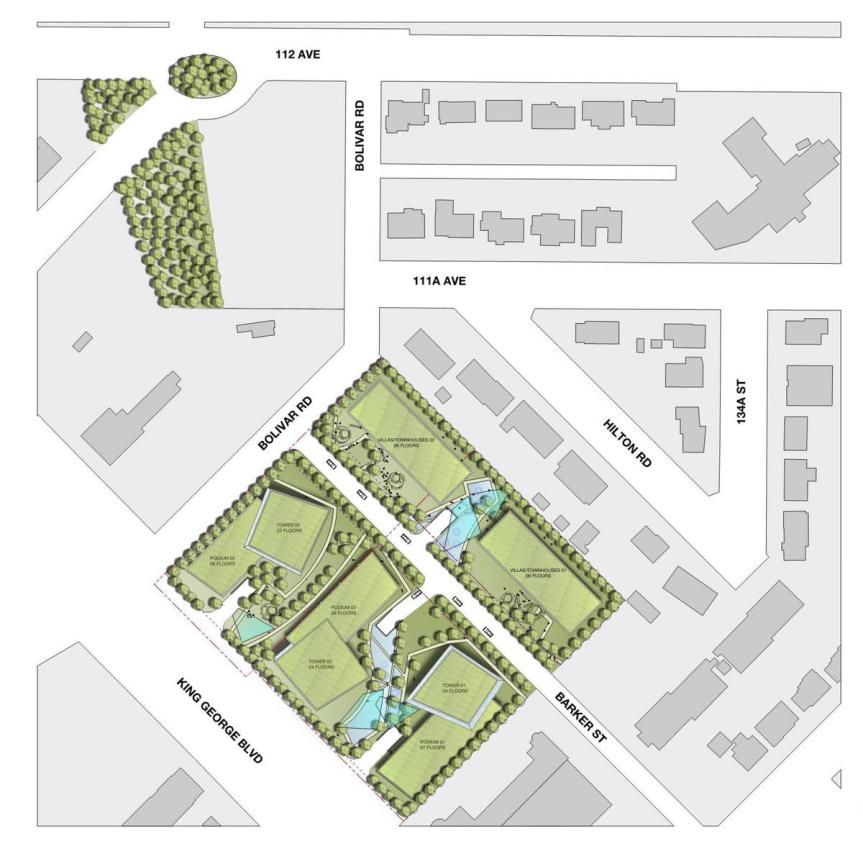 Proposed site plan with unique angular floor plates and substantial green roofs
 Subject Site at the north end of the City Centre Plan area (Orange = Low to Mid Rise, Purple = High Rise)