Guildford Town Centre Plan – UrbanSurrey

The City of Surrey held a public open house last week on the in-progress, Guildford Town Centre – 104 Avenue Plan. The plan, which has been under study since last year, is seeking to define a vision and prepare a long-range land-use plan to guide future growth along the 104 Avenue Corridor and Guildford Town Centre areas.

Presented to the public at the open house last week were 2 land-use concept options, along with a proposed street network, bicycle and pedestrian network, and parks and open space concept.

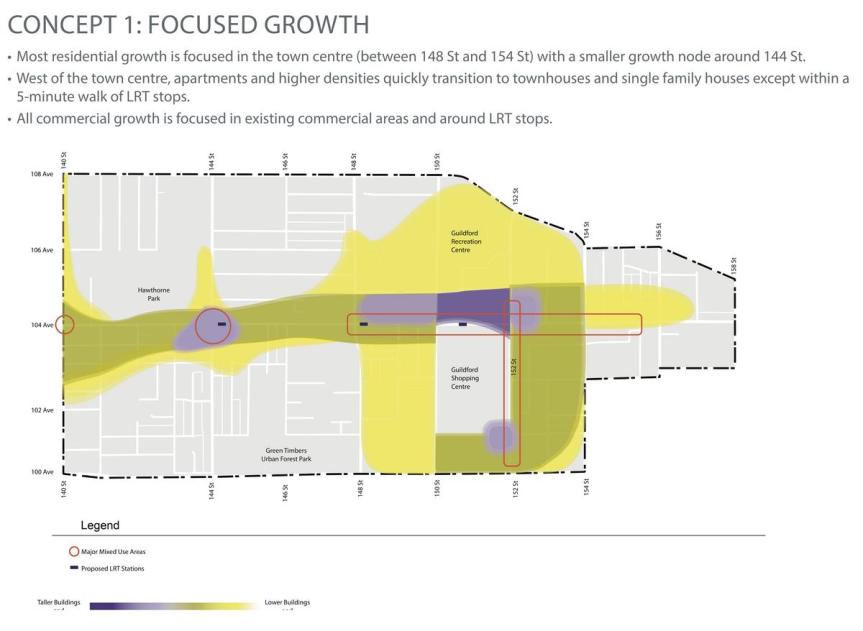
Land-Use Concept Option 1: Focused Growth

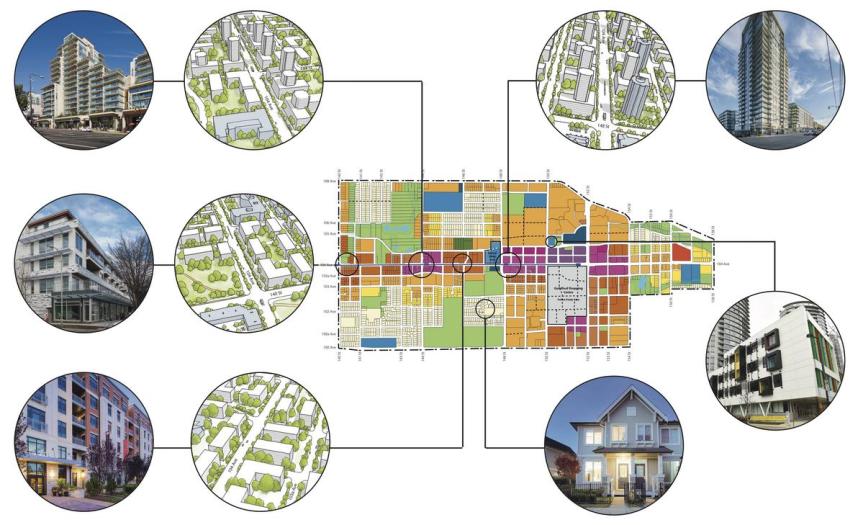
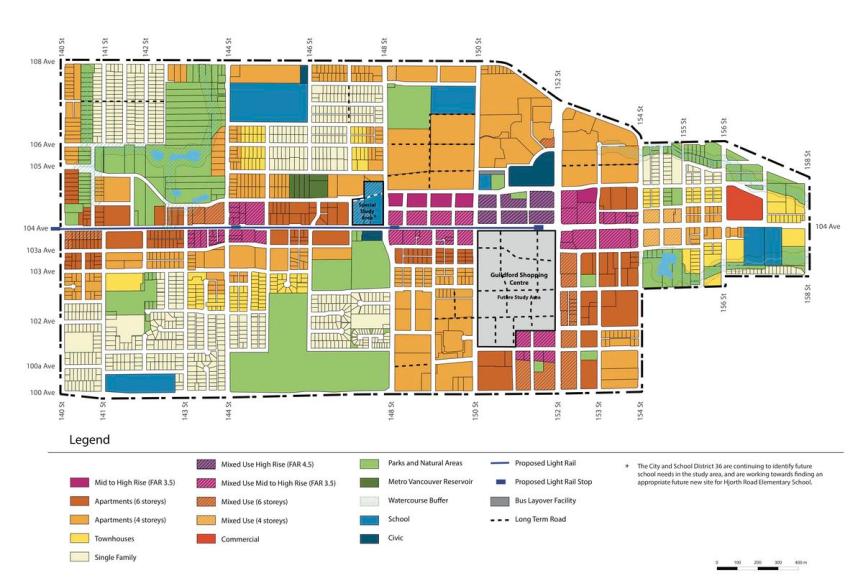
Land-Use Concept Option 1 seeks to focus growth and density in key areas of the plan, such as along 104 Avenue and areas surrounding Guildford Town Centre. The plan envisions:

  • A continuous stretch of 6-storey mixed-use/apartments (Dark orange) along 104 Avenue
  • Mid to high-rise mixed-use (pink) at 104 Ave & 144 St.
  • Mid to high-rise along 104 Ave east of 148 St and to the north and east of Guildford Town Centre – with the tallest tower heights (purple) concentrated on the former Sears site.
  • 4-storey apartment areas (light orange) dispersed throughout the plan area
  • Townhouses (yellow) in a few areas
  • Single Family housing preserved in a number of areas, mostly west of 148 St.

Land-Use Concept Option 1: Focused Growth

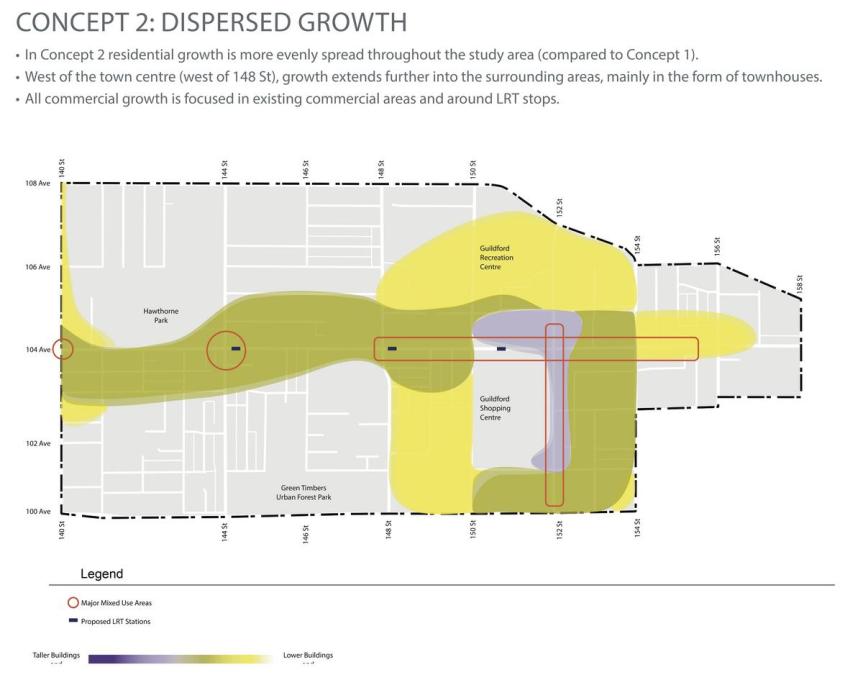
Land-Use Concept Option 2: Dispersed Growth

Land-Use Concept Option 2, while very similar, seeks to disperse growth and densities over the plan area, with lower intensities of density, but increased density covering more area. This includes:

  • A wider continuous stretch of 6-storey mixed-use/apartments (Dark orange) along 104 Avenue
  • Mid to high-rise mixed-use (Pink) to the north and east of Guildford Town Centre.
  • 4-storey apartment areas (light orange) more widely dispersed throughout the plan area
  • Townhouses (yellow) more widely dispersed across the plan area
  • Slightly less preserved Single Family housing.

Land-Use Concept Option 2: Dispersed Growth

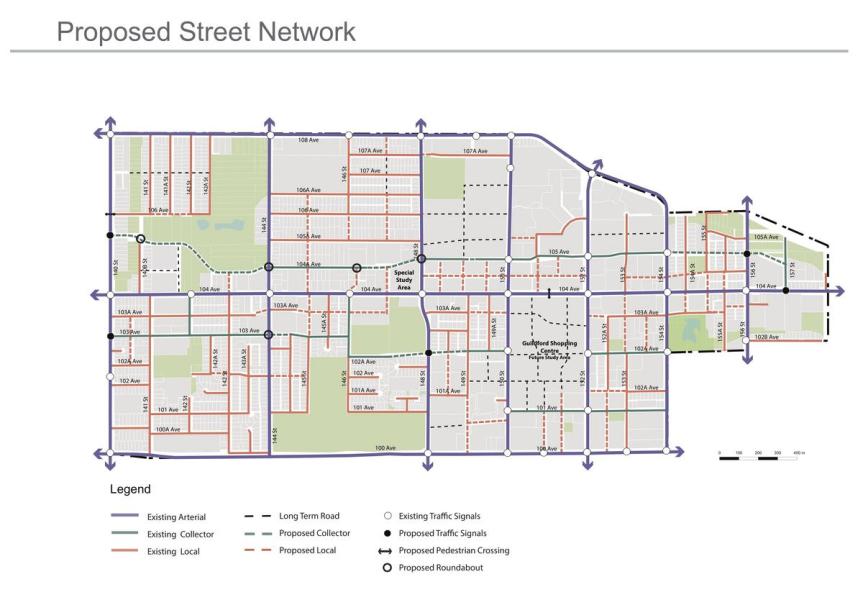
Proposed Street Network

The proposed street network adds a number of new local and collector streets to improve connectivity through a finer-grained network. One of these new collectors is the currently underway 105A Avenue connector project which will provide an alternate east-west route to 104 Avenue linking City Centre to Guildford. A long-range new street network is shown on the site of Guildford Town Shopping Centre – envisioning the future redevelopment of this mall into an urban district far into the future – similar to the vision for the Metropolis at Metrotown Shopping Centre site in Burnaby under the Metrotown Plan.

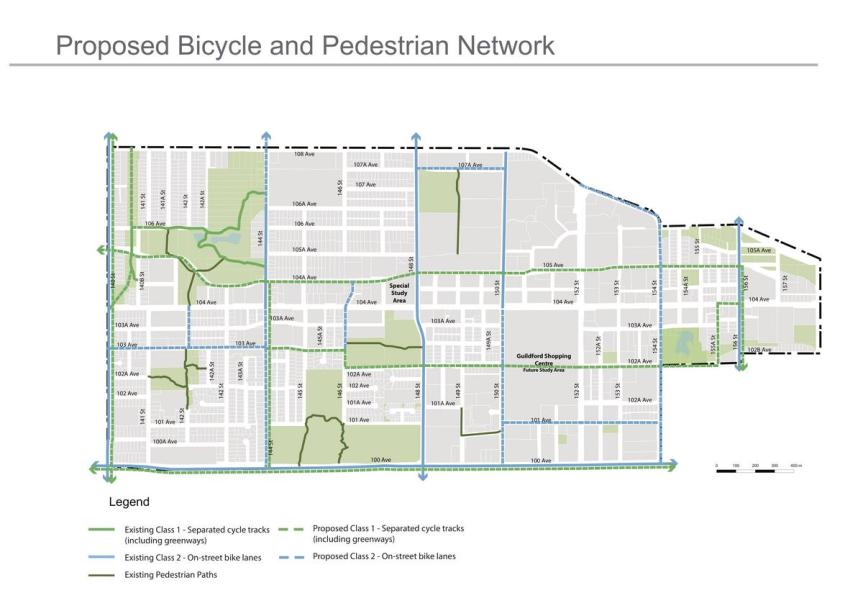
Proposed Bike and Pedestrian Network

The proposed bike and pedestrian network creates a number of new multi-use paths and road-separated bike lanes improving connectivity throughout the plan area. Pedestrian and cycling crossings at busy intersections would be enhanced under the plan to improve safety and streetscape integration. Existing bike lanes would be upgraded to be physically separated from the road.

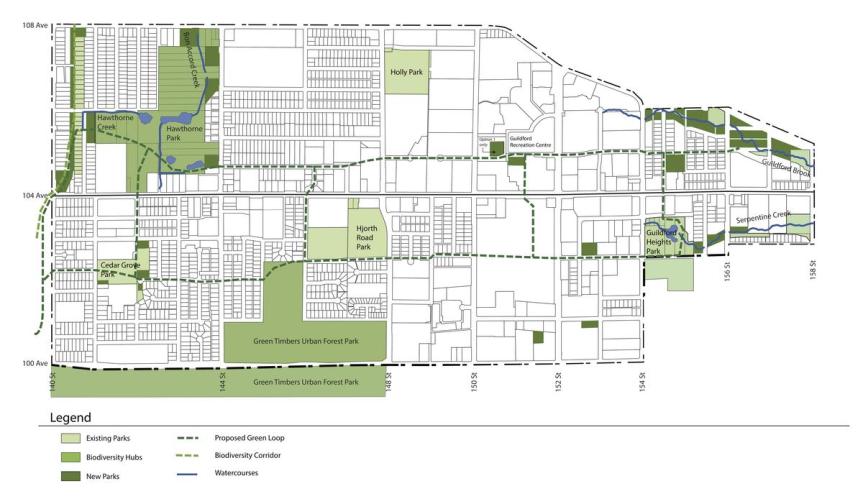
Proposed Parks and Open Space

The proposed parks and open space plan illustrates how parks, habitat areas, and the city’s Green Infrastructure Network will be integrated into the plan area. A key feature of the plan is a ‘Green Loop’ pedestrian and cycling network stretching east-west with north-south connections – improving non-automobile connectivity in the area and connecting the many parks. In addition to existing parks shown in light green, many new parks are shown in dark green, including expansions to Hawthorne Park.

Future Light Rail Transit (LRT)

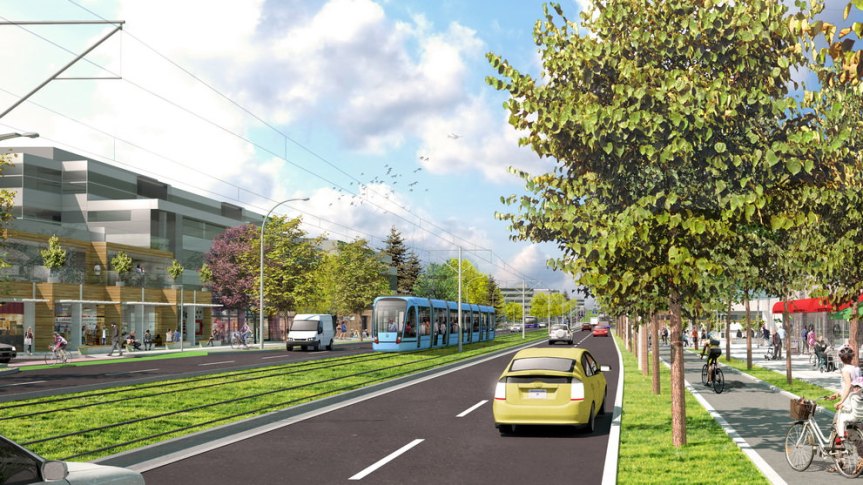
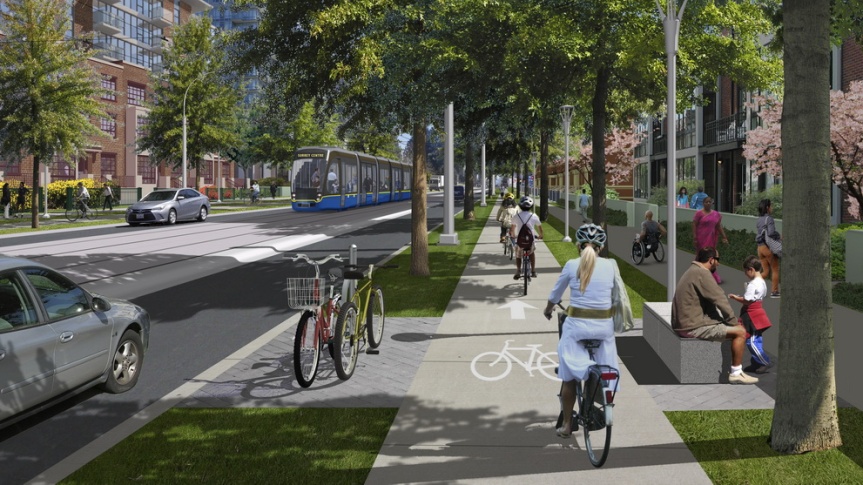
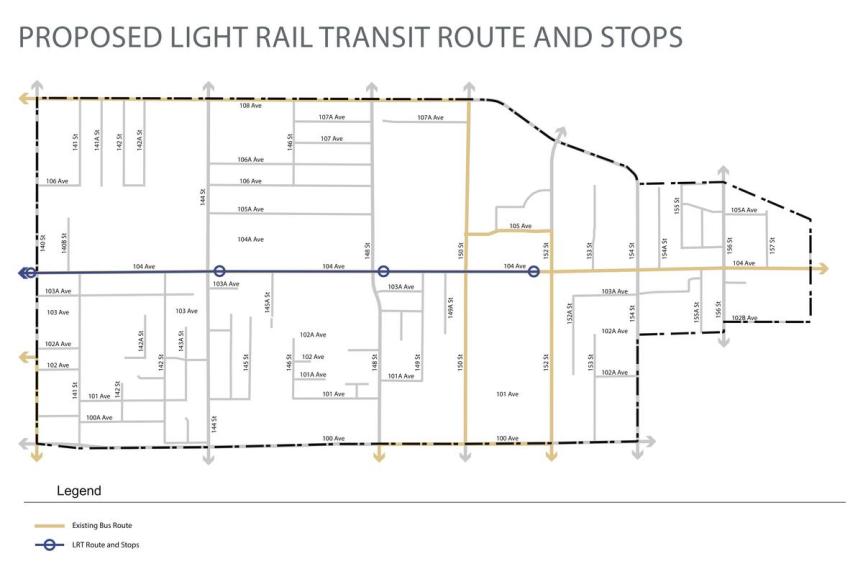
An integral part of the 104 Avenue – Guildford Town Centre Plan area will be the new LRT line linking City Centre to Guildford along 104 Avenue, and further south to Newton. This urban-style, low floor, LRT system will not just be a rapid transit line passing through the area, but a fully streetscape-integrated, centrepiece of the 104 Avenue corridor. Combined with a continuous 6-storey mixed-use density along 104 Avenue, the corridor will be transformed into a transit/pedestrian-oriented and prioritized streetscape, similar to precedents in Europe and elsewhere around the world. The LRT will support the densities along the the 104 Avenue Corridor, and integrate seamlessly into the community – unlike SkyTrain which bisects and has a negative visual and physical impact on the streetscape.

To find out more about the Guildford Town Centre – 104 Avenue Plan, and participate in the public survey – visit:
http://www.surrey.ca/city-services/24723.aspx

12-Storey WestStone Care Facility heading to Public Hearing – UrbanSurrey

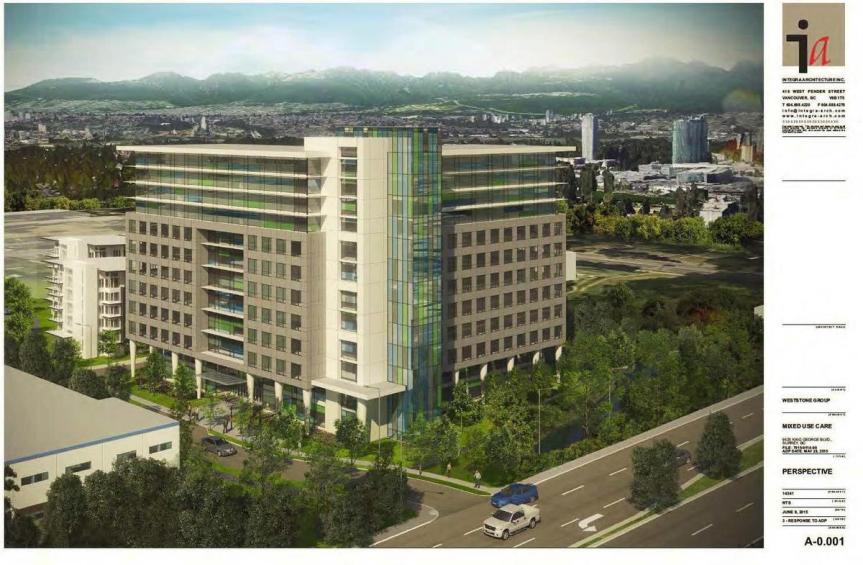
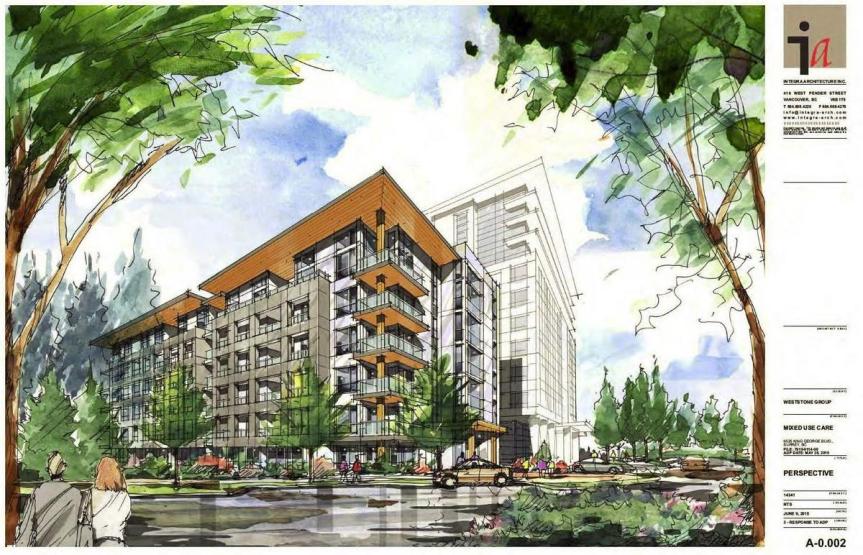
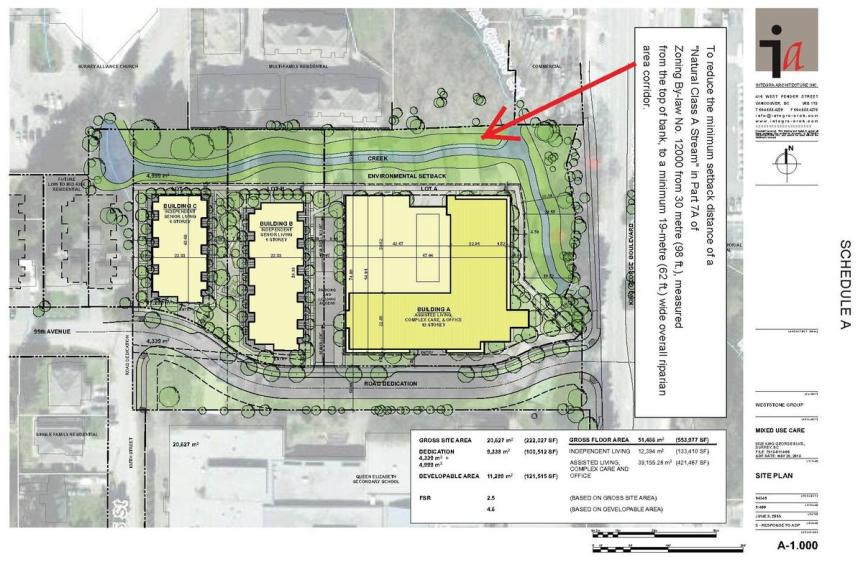
WestStone’s controversial Care Facility and Seniors Living project on the site of a mobile home park at 9525 King George Blvd is returning to Council December 5. The project received preliminary approval (1st & 2nd reading) back in June of 2015, but scheduling of a Public Hearing (3rd reading) was deferred to a later date until a City policy on manufactured home park redevelopment be updated, and resident concerns be addressed. Since then, WestStone has completed its acquisition of all 47 mobile-homes in the park, in accordance with the City’s updated manufactured home redevelopment policy, providing relocation assistance to park residents. City staff are now recommending that Council set a date for Public Hearing and approve proceeding to Public Notification for a Development Variance Permit.

According to WestStone, the closing date for the last of its acquisitions in the park will be in June 2017, at which point, the park will be vacated, and work can begin on site clearing, preparation, and construction, pending approvals. When complete, the project will bring a new 12-storey mixed-use care facility and office building to the site, along with two 6-storey independent seniors living apartment buildings. The site is located just south of 96th Avenue on the west side of King George Blvd across from Surrey Memorial Hospital, and will add to the growing cluster of medical-related care, research, and office uses in the Innovation Boulevard district. The project will also dedicate an extension of 95th Avenue through the site, improving the City Centre road network.

http://www.surrey.ca/bylawsandcouncillibrary/PLR_7915-0114-00(3).pdf

2019 – UrbanSurrey

With the new year upon us, it’s time for this blog’s annual review of the past year in Surrey City Centre, as well as a look at what can be expected ahead in 2020. Additionally this year, we will also take a look back at the past decade, which saw accelerating growth and transformation in City Centre, a trend likely to persist as Surrey’s downtown becomes further established, and continues to attract more people, businesses, institutions, and jobs.

Growth in 2019

Construction activity in Surrey City Centre reached record levels in 2019, with many projects approved in previous years entering the construction phase, joining others already under construction, and others completing. Overall 2019 construction activity is summarized below:

6 significant projects began construction

  • One Central | 44 Storeys
  • Georgetown One | 30 Storeys
  • Linea | Residential | 28 Storeys
  • Veterans Village | Mixed-Use | 20 Storeys
  • Camellia | Residential | 5 Storeys
  • La Voda | Residential | 6 Storeys

7 significant projects continued construction

  • King George Hub B | Residential, Office, Retail | 15 + 29 + 40 Storeys
  • Park Boulevard | Residential | 39 Storeys
  • King George Hub C | Rental Residential | 34 Storeys
  • City Centre 3 | Office, Retail | 10 Storeys
  • Fraser Landmark | Residential | 6 Storeys
  • Maverick | Residential | 5 Storeys
  • 13904 102 Ave | Residential | 4 Storeys

8 significant projects completed construction

  • Prime | Residential, Office, Retail | 37 Storeys
  • Evolve | Residential, Office, Retail | 36 Storeys
  • Aspire | Residential | 6 Storeys
  • Porte HQ | Residential | 6 Storeys
  • SFU Sustainable Energy & Environmental Engineering Building | 5 Storeys
  • 9909 140 St | Residential | 4 Storeys
  • Surrey Central Station Expansion
  • West Village Park & District Energy Centre

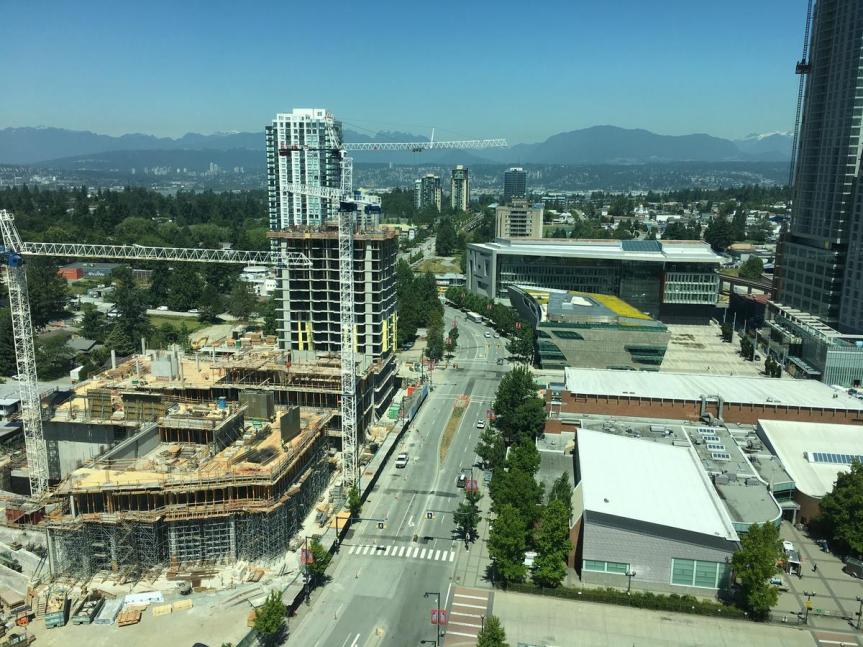
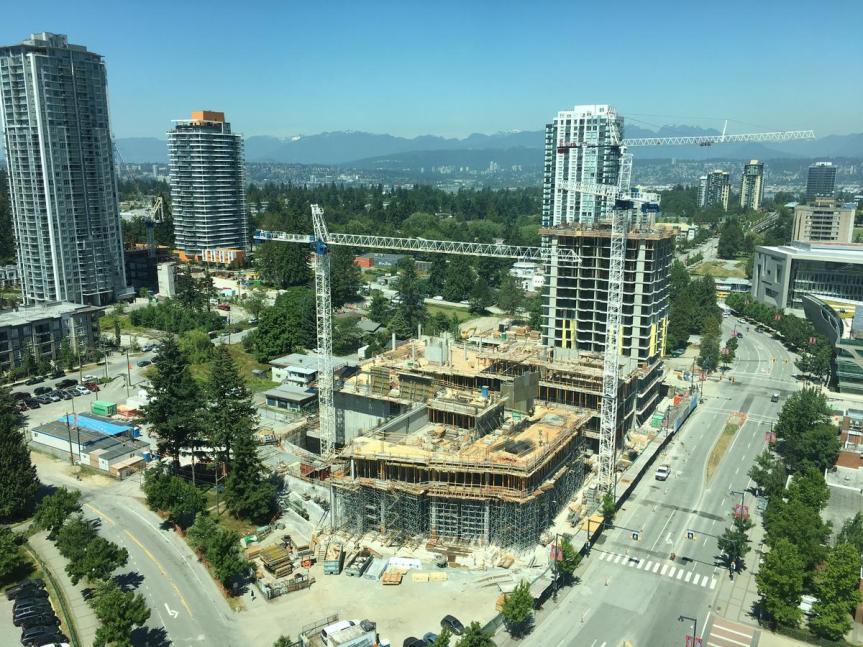
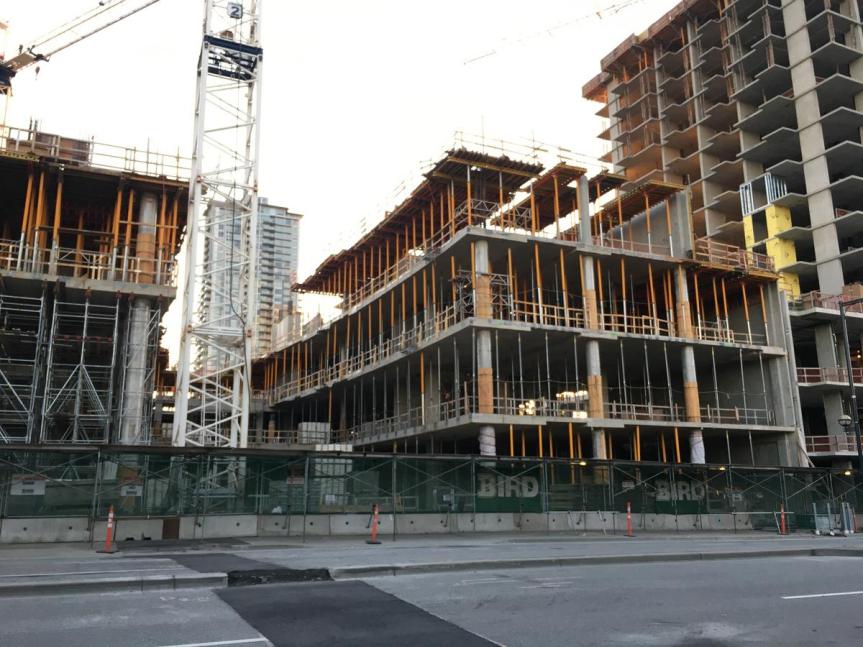
One Central under excavation at Central Ave & 133A St Linea by Rize under construction at 104 Ave & 133 St King George Hub (Phase B) under construction at King George Blvd & Fraser Hwy Park Boulevard under construction on Whalley Blvd near 100 Ave King George Hub B & Park Boulevard as seen from Fraser Hwy Georgetown One under excavation at Whalley Blvd & 102 Ave City Centre 3 by Lark Group under construction on 96 Ave Aspire recently completed on 101 Ave near Whalley Blvd Prime completed in Fall 2019 at University Dr & Central Ave HQ by Porte at 140 St & 105A Ave completed early 2019 Evolve completed in 2019 at Central Ave & 133 St SFU Sustainable Energy & Environmental Engineering Building completed in Spring 2019 Surrey Central Station expansion completed in Spring 2019 West Village Park & District Energy Centre completed in Spring 2019

As for new Development Applications, 2019 saw a drop from 2018’s record number of 25 applications, to 19 new applications. This is still well above all previous years in the decade between 2010 and 2017, indicating continued strong interest from the development community in 2019. These 19 new Development Applications included approximately 21 towers (>6 Storeys) and 14 low-rises (4-6 Storeys), comprising over 7,200 units and over 300,000 sq.ft. of commercial space in 2019 applications alone.

As of January 2020, in total there are currently 65 significant active applications either under review, approved, or under construction in City Centre consisting of approximately 69 high rises (>6 Storeys) and 44 low-rises (

Bing Thom Architects – UrbanSurrey

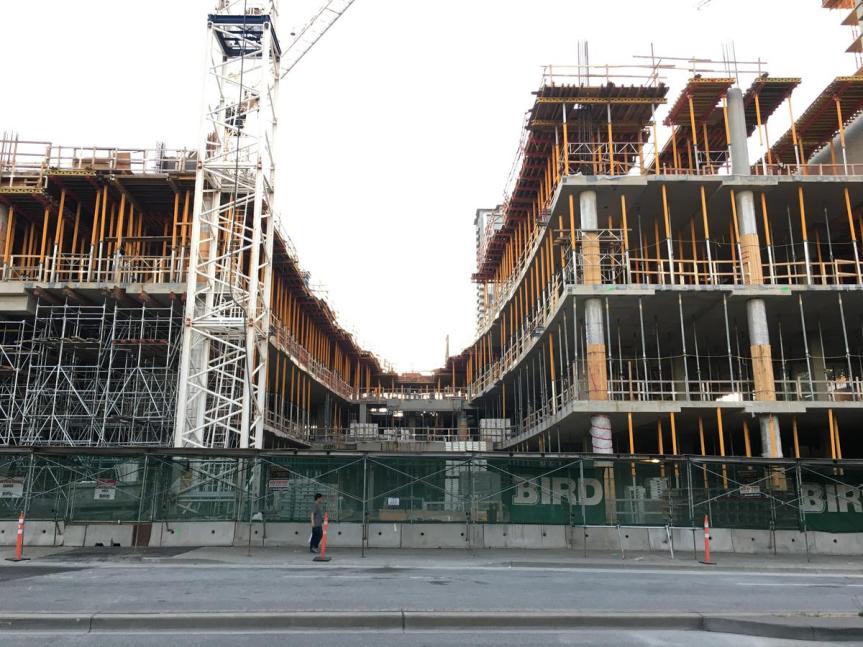
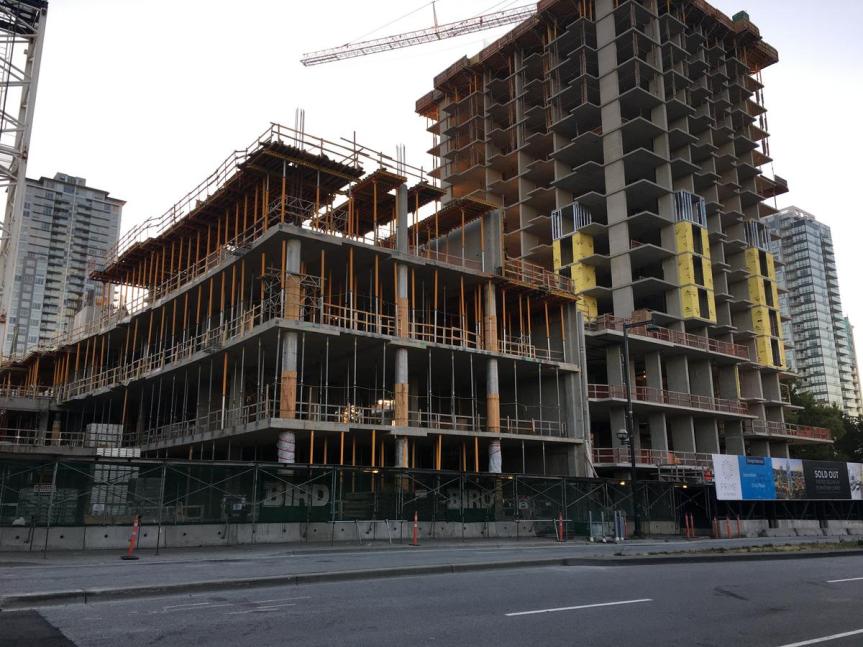
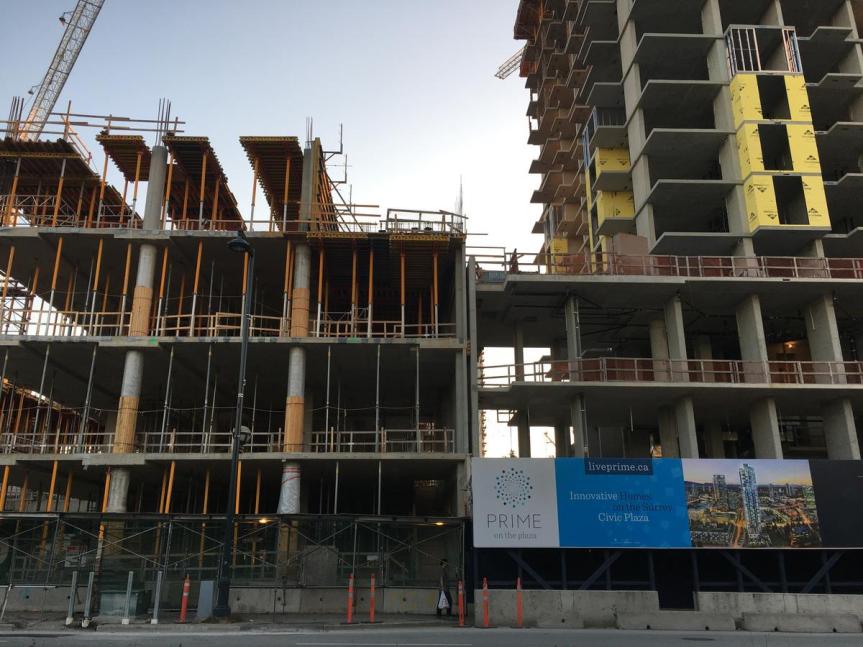
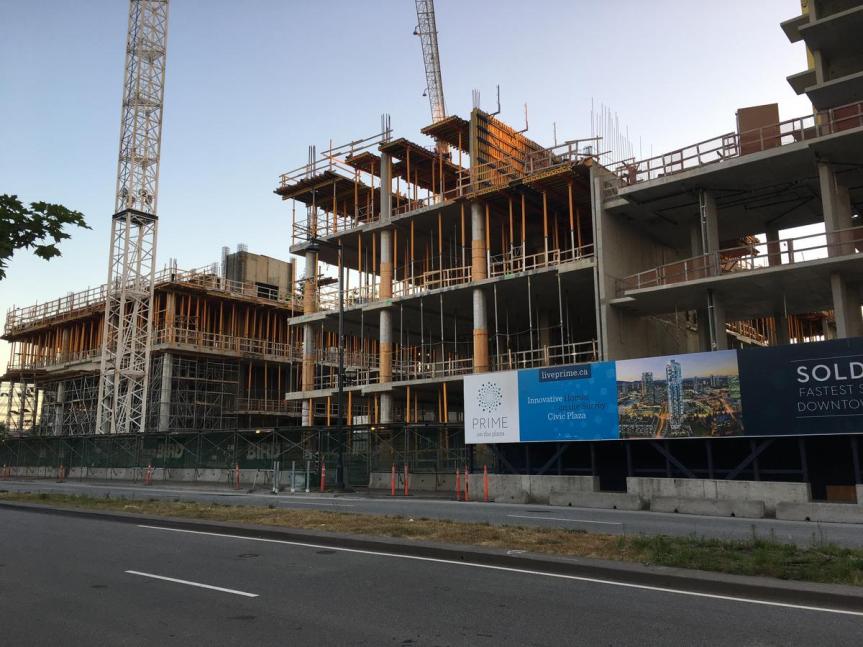
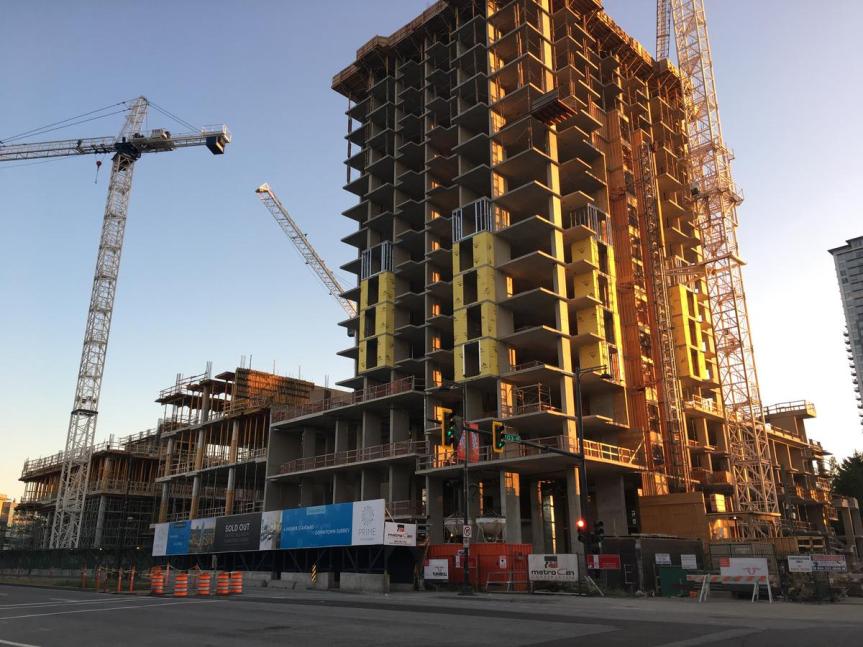
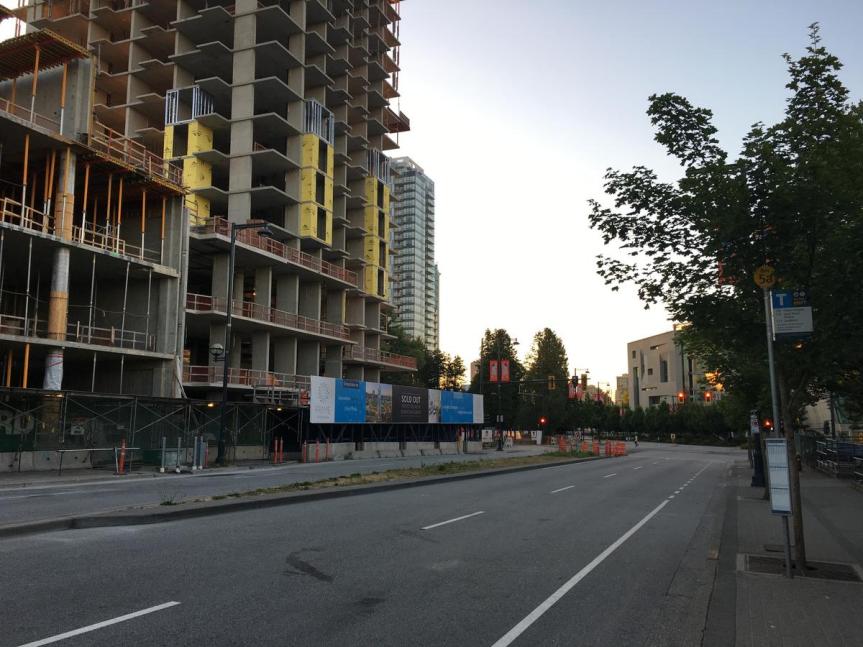
Progress continues on the SFU Sustainable Energy & Environmental Engineering Building and Prime on the Plaza. As of July 5, work is progressing on the 17th floor of Prime on the Plaza and the 4th floor of SFU. Of notable interest is the large atrium taking shape within the new Bing Thom designed SFU building, which is already starting to have a dominating presence over University Dr. It is expected that both buildings will top out by the end of the year and be complete in 2018.

Passages by Rize heads to Council – UrbanSurrey

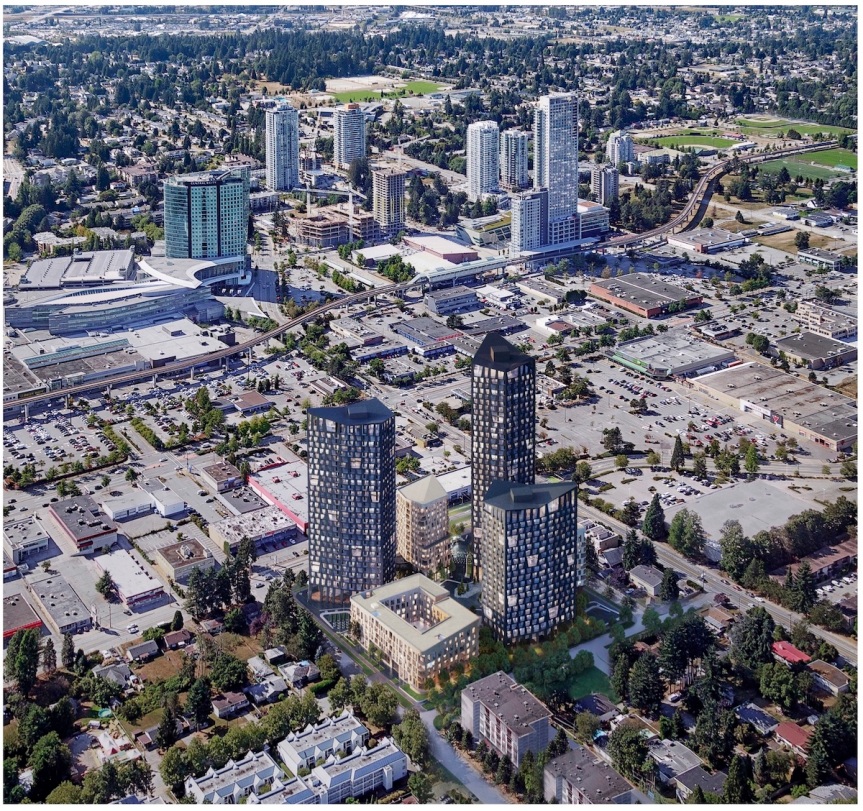
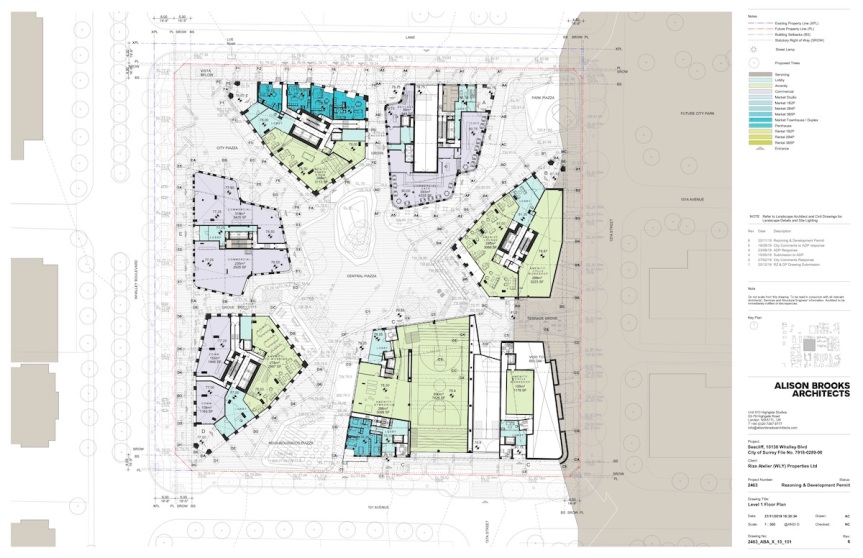
Vancouver developer Rize is set to bring their latest and most ambitious project to date before Surrey Council on Monday for 1st & 2nd Readings, and approval to proceed to Public Hearing. Passages as it’s called, is a proposed master-planned mixed-use development at 10138 Whalley Blvd consisting of market condos, market rental apartments, retail, and daycare space, all situated within a European-style ‘piazza’ public plaza. In total the project is proposing:

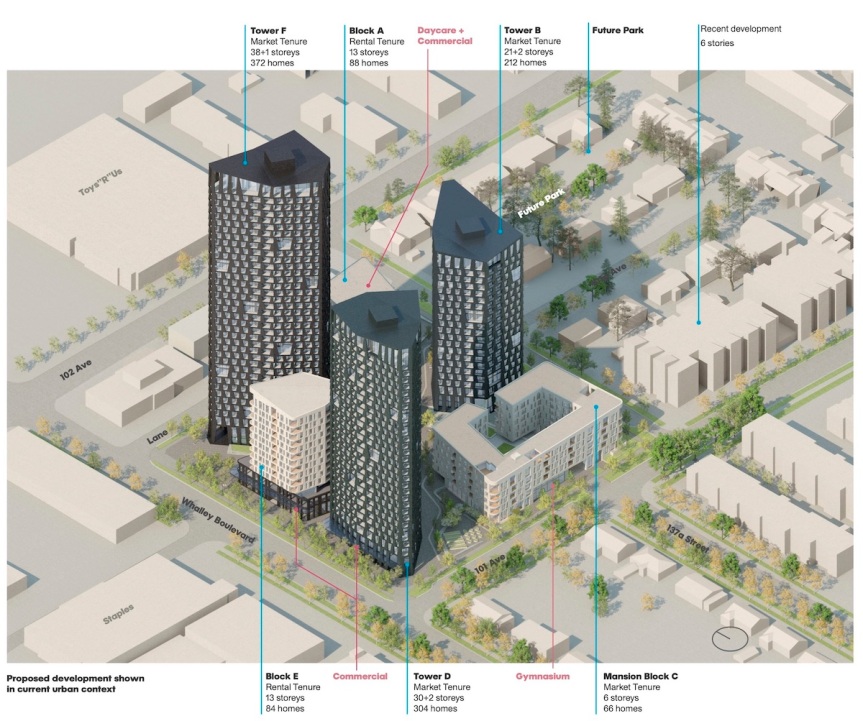
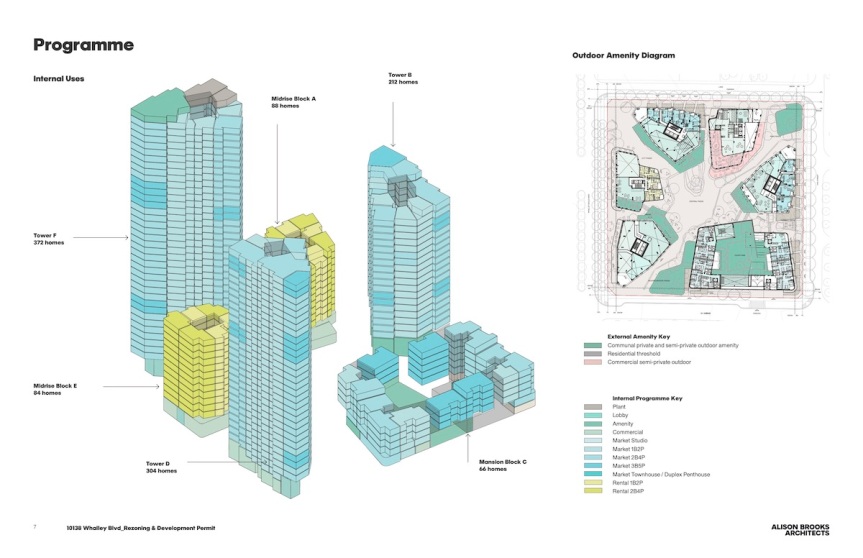
  • 3 High-Rise towers and 1 Low-Rise (6, 23, 32 & 39 Storeys) containing 954 Market Condo Residential Units
  • 2 Mid-Rise towers (13 Storeys each) containing 172 Market Rental Residential Units
  • 18,116 sq.ft. of Ground Level Retail Space
  • 4,252 sq.ft. of Daycare Space
  • A 69,602 sq.ft. Publicly Accessible ‘Piazza’-Style Public Plaza

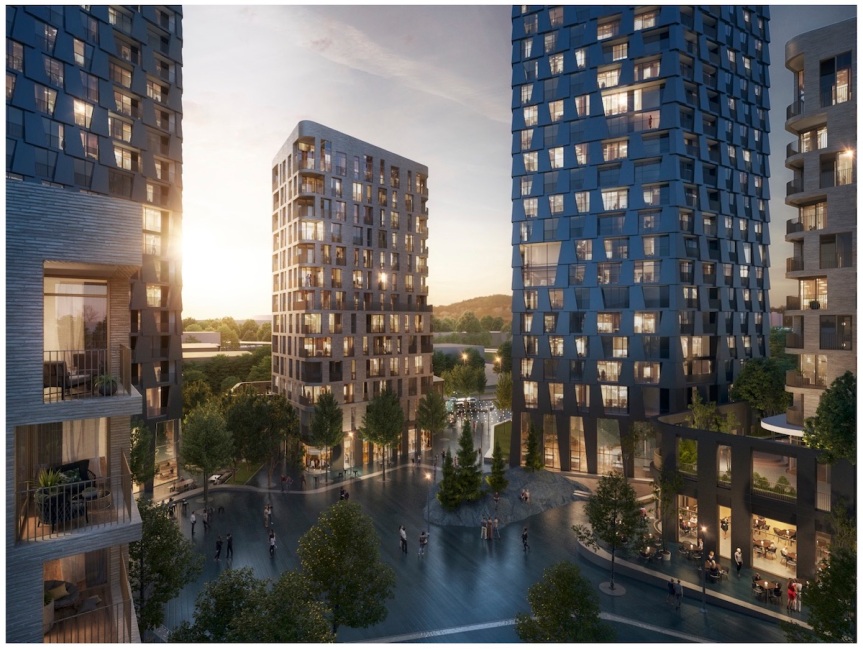
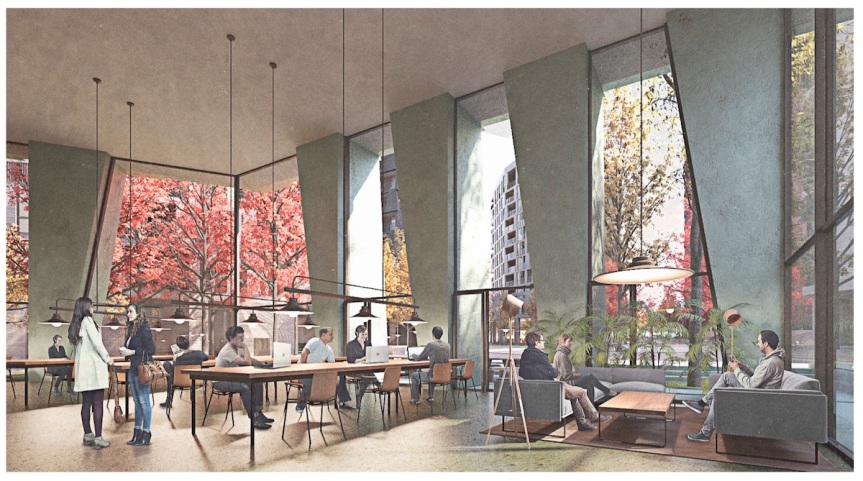
Rendering of central public ‘Piazza’ space within Passages development

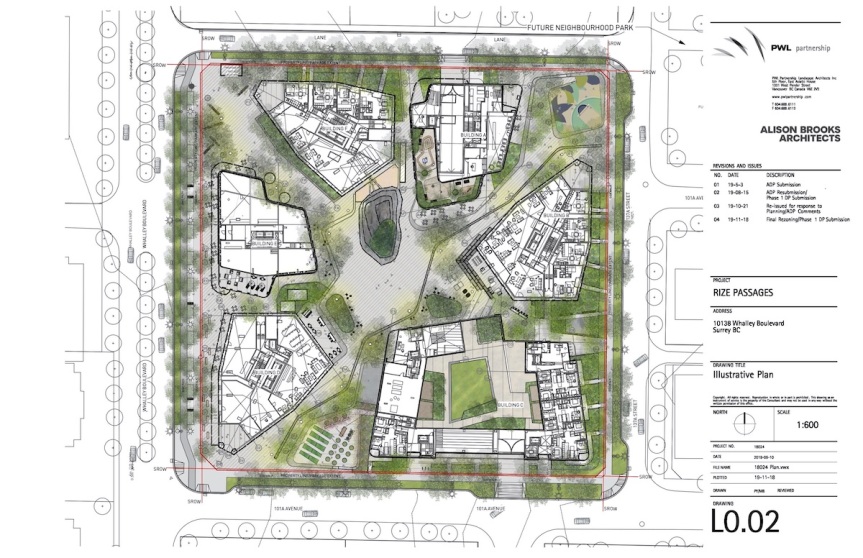
Designed by London, UK based Alison Brooks Architects, Passages brings a fresh departure from the standard point tower above podium form, commonly found throughout Metro Vancouver. Instead, the project consists of 6 irregularly-shaped buildings of varying heights, clustered around a ‘Piazza’-style public plaza.

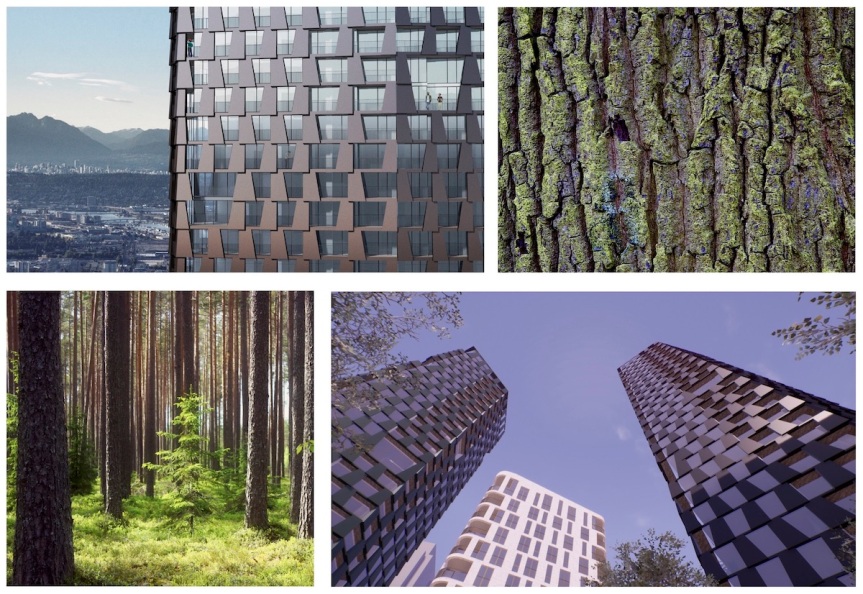
The design takes inspiration from coastal BC forests, incorporating references to ‘textured tree bark’ on building facades, and the use of earth tones and materials. Interspersed single and double-storey units are present throughout the towers, adding variation in form and glazing pattern. The 6-storey building is a modern interpretation of the traditional ‘British mansion block’ merged with ground floor townhouses.

The site’s perimeter and courtyard are structured as open, barrier-free spaces that the public and residents can share and enjoy. A series of four distinct piazzas, City Piazza, Park Piazza, Central Piazza and Neighbourhood Piazza, are linked by narrow urban groves between buildings and enriched streetscape edges.

The Landscape Architect on the project is Vancouver’s PWL Partnership tasked with designing the publicly accessibly open spaces comprised of the four landscaped piazzas. These spaces are animated with community agricultural gardens, an urban square with seating, a children’s play area, a great lawn for event and performance space, a yoga and exercise zone, a community harvest table, and an outdoor barbeque and games table space to encourage the public and residents to interact and socialize.

Passages will replace two existing and aging, wood-frame, 4-storey apartment buildings known as Fraserview Court, built in the 1970’s. Rize is proposing to offset the loss of the 154 existing rental residential units on site by providing 172 new rental residential units in two new 13-Storey concrete mid-rises as part of re-development. These rental units will be secured for a period of 20-years, through a Housing Agreement with the City. Rize is also assisting existing residents facing displacement through a City policy directed Tenant Relocation and Assistance Plan.

The project is proposed to be built in 3 phases, which includes:

Phase 1 (Targeted Completion: May 2023)

  • 13-Storey Mid-Rise with Market Rental Residential (88 Units), Ground Floor Cafe, and Daycare
  • 23-Storey High-Rise with Market Condo Residential (212 Units)

Phase 2 (Targeted Completion: June 2024)

  • 6-Storey Low-Rise with Market Condo Residential (66 Units)
  • 32-Storey High-Rise with Market Condo Residential (304 Units), and Ground Level Retail

Phase 3 (Targeted Completion: August 2024)

  • 13-Storey Mid-Rise with Market Rental Residential (84 Units), and Ground Level Retail
  • 39-Storey High-Rise with Market Condo Residential (372 Units)

In terms of approvals, the development is seeking:

  • City Centre Plan amendment to increase density on the site from 3.5 FAR to 5.5 FAR
  • Official Community Plan amendment to increase density on the site from 3.5 FAR to 5.5 FAR
  • Rezoning from Multiple Residential 45 Zone to Comprehensive Development Zone (Based on RM-135 & C-8)
  • Subdivision from 1 to 3 lots
  • Development Permit to allow for 3 High-Rise Buildings, 2 Mid-Rise Buildings, and 1 Low-Rise Building.

For more information on Passages:

https://www.surrey.ca/bylawsandcouncillibrary/PLR_7918-0289-00.pdf

Guildford Town Centre – UrbanSurrey

The long-awaited first phase of Surrey’s LRT is a go-ahead, following today’s announcement of an agreement between the provincial government and the Mayor’s Council to fund the project. Billed as the largest transit and transportation investment in the history of the Metro Vancouver region, the plan will see:

  • Construction of the Surrey Guildford-Newton Light Rail (LRT)
  • Construction of Millennium Line Broadway Extension
  • Significant upgrade of existing Expo-Millennium Lines to expand capacity to meet and improve the customer experience
  • An 8% increase in bus service to address overcrowding, reduce wait times and bring bus services to communities with limited service
  • Improvements to sidewalks, bikeways, multi-use pathways and roadways

According to the media release, delivery of these projects will be funded by:

  • $1.6 billion in fare revenues expected from higher ridership resulting from service expansion in Phase Two, TransLink resources and efficiencies.
  • A 2% increase to all transit fares over two years beginning in 2020.
  • Parking lot sales tax increase of 15 cents per hour for an average $5 per hour parking.
  • $5.50 increase in property taxes per average household each year or about 46 cents a month, beginning in 2019.
  • About $300 to $600/unit increase to the Development Cost Charge on new residential developments depending on type of dwelling.
  • Revenue from a variety of transit-related commercial opportunities.

Construction by 2019 – Phase 1 Completion by 2024

While federal matching of the provincial funding still needs to be finalized, it is expected that the first phase of the Surrey LRT line between Guildford – City Centre – Newton will likely be under construction by late 2019, with completion by 2024. Not only will the project bring a new a rapid transit line to the South Fraser, it will also be a game-changer in how it will integrate with, and transform the neighbourhoods it passes through. In conjunction with the City Centre Plan and the Guildford-104 Avenue Plan, LRT corridors will be gradually transformed with 4-6-storey density along each route, with higher density mixed-use nodes at key intersections and throughout City Centre, Guildford Town Centre, and Newton Town Centre.

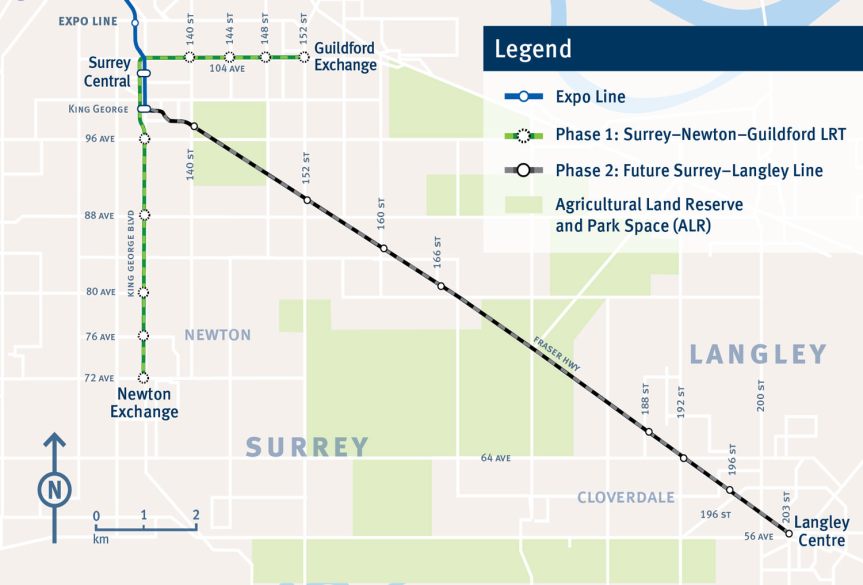
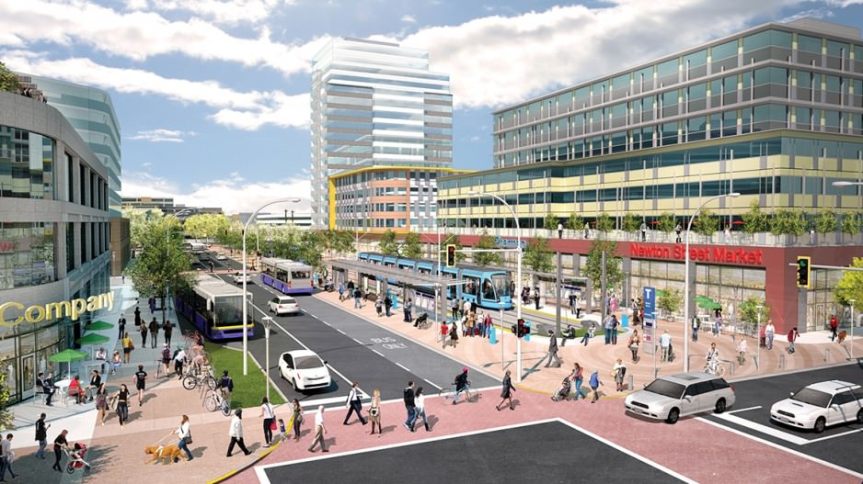
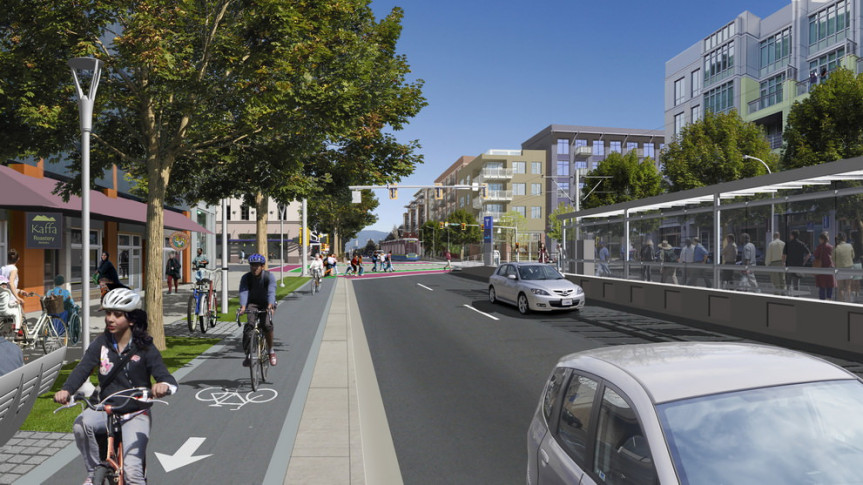
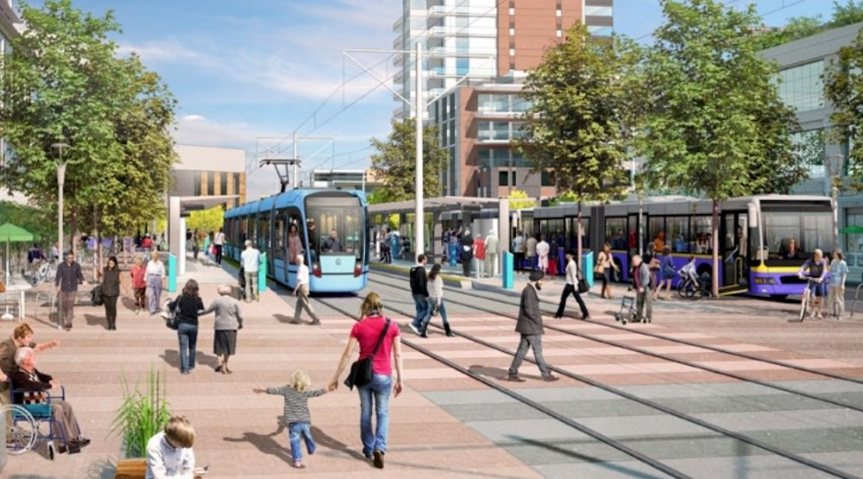
Planned route of Phase 1 & 2 of the Surrey LRT network Conceptual rendering of a revitalized Newton Town Centre with LRT integration Conceptual rendering of King George Blvd in Newton with LRT, bike-lanes, and 4-6-storey urban density Conceptual rendering of LRT plaza integration at Newton Town Centre Conceptual rendering of LRT integration along a repurposed 104 Avenue corridor LRT integration on a pedestrianized City Parkway at Central Ave in City Centre

A new tier of rapid transit for Metro Vancouver

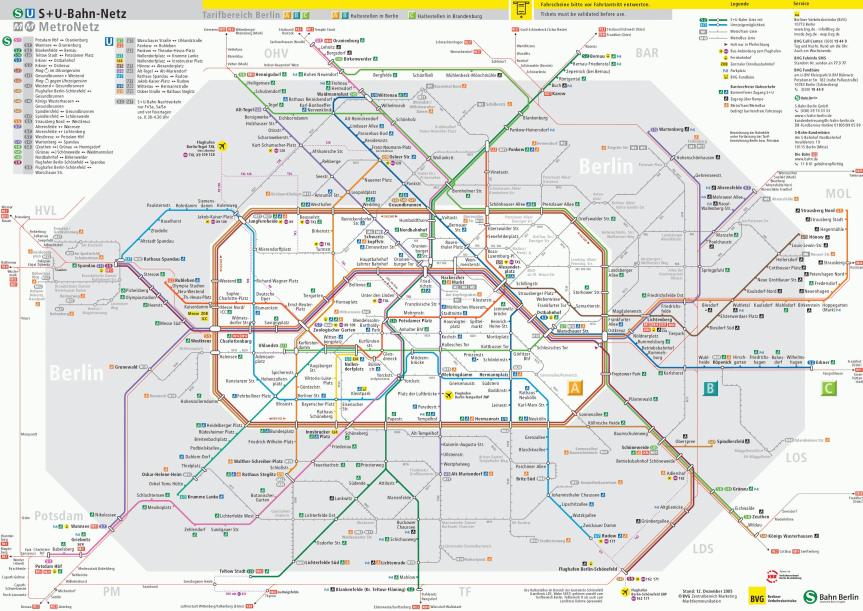
LRT will introduce a new layer of rapid transit service to Metro Vancouver that is complimentary to SkyTrain. It will serve as a more localized, finer-grained service, compared to SkyTrain which can be seen as more of a regional commuter train service. Tiered transit systems are common around the world, with various forms of rail combining to form an intricate and dynamic transit network. A good example of this is Berlin, Germany where there are 4 tiers of rail within its robust transit network. These include:

  • Regional Train (Comparable to WestCoast Express)
  • S-Bahn (Suburban service)
  • U-Bahn (Urban service – Comparable to SkyTrain)
  • MetroTram LRT (Fine-grained urban service)

All of these lines converge at hub stations, with each tier serving a specific purpose.

Berlin rapid transit system featuring 4 tiers of rail – LRT lines shown in light grey

Example – Tiers of Rail Transit in Berlin

Regional Train (Comparable to West Coast Express) S-Bahn – Suburban service (No comparison in Metro Vancouver) U-Bahn – Urban service (Comparable to SkyTrain) MetroTram (LRT) – Fine-grained urban service

Surrey LRT will bring the first fine-grained rail service to Metro Vancouver – appropriate for routes that are more localized, and less regional – such as the Guildford-City Centre-Newton line – but connecting to SkyTrain for regional commuter travel at hub stations. It is likely that we could see LRT build elsewhere in the region following Surrey, given its cost-effectiveness and appropriate scale for many other parts of the region.

The City of Surrey held a public open house last week on the in-progress, Guildford Town Centre – 104 Avenue Plan. The plan, which has been under study since last year, is seeking to define a vision and prepare a long-range land-use plan to guide future growth along the 104 Avenue Corridor and Guildford Town Centre areas.

Presented to the public at the open house last week were 2 land-use concept options, along with a proposed street network, bicycle and pedestrian network, and parks and open space concept.

Land-Use Concept Option 1: Focused Growth

Land-Use Concept Option 1 seeks to focus growth and density in key areas of the plan, such as along 104 Avenue and areas surrounding Guildford Town Centre. The plan envisions:

  • A continuous stretch of 6-storey mixed-use/apartments (Dark orange) along 104 Avenue
  • Mid to high-rise mixed-use (pink) at 104 Ave & 144 St.
  • Mid to high-rise along 104 Ave east of 148 St and to the north and east of Guildford Town Centre – with the tallest tower heights (purple) concentrated on the former Sears site.
  • 4-storey apartment areas (light orange) dispersed throughout the plan area
  • Townhouses (yellow) in a few areas
  • Single Family housing preserved in a number of areas, mostly west of 148 St.

Land-Use Concept Option 1: Focused Growth

Land-Use Concept Option 2: Dispersed Growth

Land-Use Concept Option 2, while very similar, seeks to disperse growth and densities over the plan area, with lower intensities of density, but increased density covering more area. This includes:

  • A wider continuous stretch of 6-storey mixed-use/apartments (Dark orange) along 104 Avenue
  • Mid to high-rise mixed-use (Pink) to the north and east of Guildford Town Centre.
  • 4-storey apartment areas (light orange) more widely dispersed throughout the plan area
  • Townhouses (yellow) more widely dispersed across the plan area
  • Slightly less preserved Single Family housing.

Land-Use Concept Option 2: Dispersed Growth

Proposed Street Network

The proposed street network adds a number of new local and collector streets to improve connectivity through a finer-grained network. One of these new collectors is the currently underway 105A Avenue connector project which will provide an alternate east-west route to 104 Avenue linking City Centre to Guildford. A long-range new street network is shown on the site of Guildford Town Shopping Centre – envisioning the future redevelopment of this mall into an urban district far into the future – similar to the vision for the Metropolis at Metrotown Shopping Centre site in Burnaby under the Metrotown Plan.

Proposed Bike and Pedestrian Network

The proposed bike and pedestrian network creates a number of new multi-use paths and road-separated bike lanes improving connectivity throughout the plan area. Pedestrian and cycling crossings at busy intersections would be enhanced under the plan to improve safety and streetscape integration. Existing bike lanes would be upgraded to be physically separated from the road.

Proposed Parks and Open Space

The proposed parks and open space plan illustrates how parks, habitat areas, and the city’s Green Infrastructure Network will be integrated into the plan area. A key feature of the plan is a ‘Green Loop’ pedestrian and cycling network stretching east-west with north-south connections – improving non-automobile connectivity in the area and connecting the many parks. In addition to existing parks shown in light green, many new parks are shown in dark green, including expansions to Hawthorne Park.

Future Light Rail Transit (LRT)

An integral part of the 104 Avenue – Guildford Town Centre Plan area will be the new LRT line linking City Centre to Guildford along 104 Avenue, and further south to Newton. This urban-style, low floor, LRT system will not just be a rapid transit line passing through the area, but a fully streetscape-integrated, centrepiece of the 104 Avenue corridor. Combined with a continuous 6-storey mixed-use density along 104 Avenue, the corridor will be transformed into a transit/pedestrian-oriented and prioritized streetscape, similar to precedents in Europe and elsewhere around the world. The LRT will support the densities along the the 104 Avenue Corridor, and integrate seamlessly into the community – unlike SkyTrain which bisects and has a negative visual and physical impact on the streetscape.

To find out more about the Guildford Town Centre – 104 Avenue Plan, and participate in the public survey – visit:
http://www.surrey.ca/city-services/24723.aspx

City Centre – Page 2 – UrbanSurrey

A 360 VR rendering has been released by Vancouver-based VR/AR company Stambol Studios, which specializes in creating “hyperrealistic immersive experiences”. According to their website, Stambol also has an office in the very Health & Technology District featured in the 360 VR rendering.

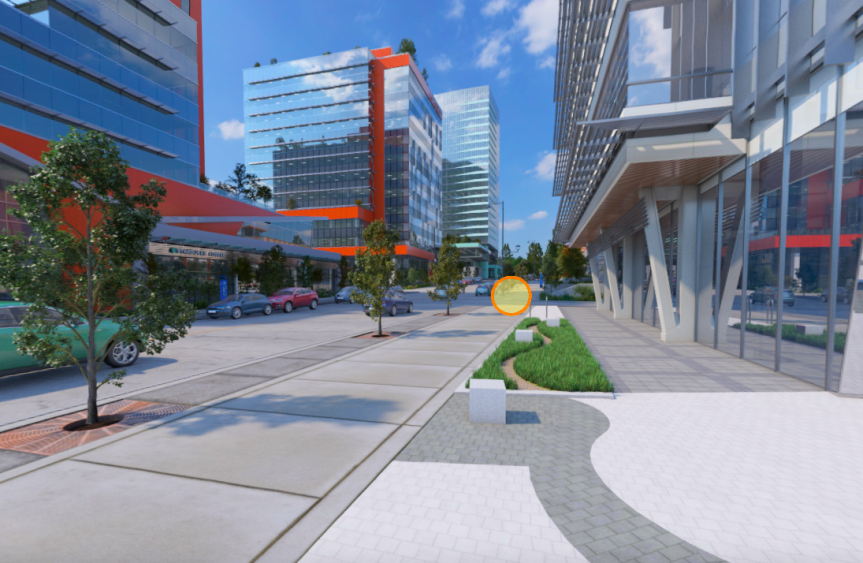
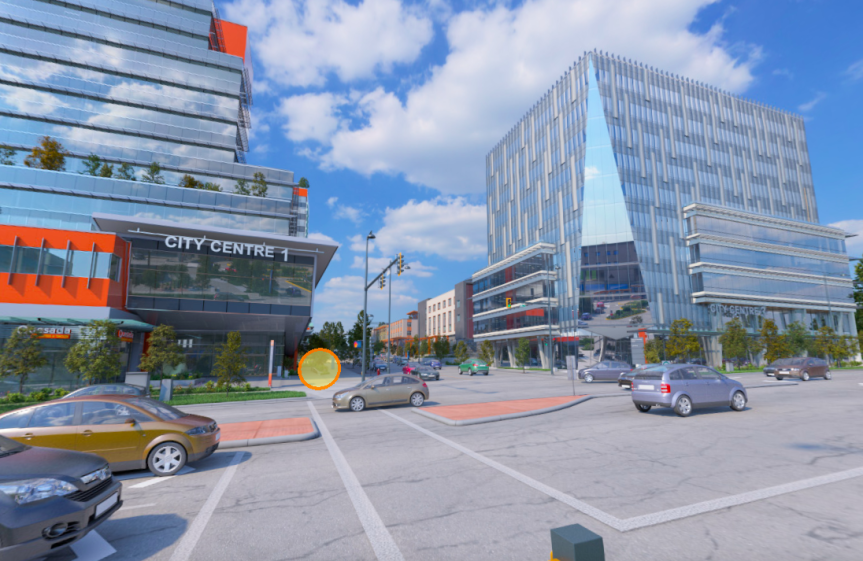
In the 360 VR rendering which can be found here, a glimpse is given into the future of the emerging Health & Technology District at the south end of City Centre near 96th Avenue and 137 St. The hyperrealistic rendering shows the existing City Centre 1, and currently under construction City Centre 2 buildings, along with the recently approved City Centre 3 – all by the developer Lark Group.

The rendering also provides a first glimpse at a future phase of the district, presumably City Centre 4 & 5, shown north of City Centre 2 along 137 St. These towers appear to be taller than their predecessors, and also have a shared podium, suggesting they would be built as a single phase. Lark Group was quoted in a Business in Vancouver article back in March, to have plans for up to 8 towers in the district, which spans from Surrey Memorial Hospital north to Fraser Hwy.

Looking north on 137 St from City Centre 3 towards City Centre 1, 2 and future phase. Future Health & Technology District phase to north of City Centre 2 Future Health & Technology District phase to north of City Centre 2 View looking north from 96th Ave & 137th St towards City Centre 3

Health and Technology District 360

Each year, as part of the Surrey’s Capital Construction Program, approximately 300 capital infrastructure projects related to transportation, drainage, sewer, and water improvements are constructed in the city.  Of these projects this year, the following are set to be completed in City Centre:

Arterial Paving Upgrade

King George Blvd (University Dr to 108 Ave)

Bike Lanes Upgrade

102 Ave (University Dr to 140 St)

New Collector Road 

103A Ave (132 St to 133 St) + 103 Ave (University Dr to City Parkway)

New Signalized Intersection

108 Ave & City Parkway

District Energy Network Expansion

Various Locations

Surrey City Energy is an award-winning City-owned district energy utility that supplies high-density residential, commercial and institutional buildings in City Centre with heat and hot water.

The district energy system produces hot water at centralized facilities and then distributes this hot water by way of a dedicated pipe system to heat buildings throughout various City Centre districts. The system uses low GHG-emission energy sources such as:

  • Organic waste (kitchen scraps, etc.) from residential homes throughout Surrey;
  • Geoexchange from the ground;
  • Solar from the sun;
  • Biomass from clean waste wood;
  • Waste heat from buildings, industry and waste water.

For more on District Energy:
http://www.surrey.ca/community/3475.aspx

For more on City-wide Capital Construction projects in 2017:
http://www.surrey.ca/files/CapitalConstructionBook.pdf

Street Lighting Upgrade to LED

All roads in City Centre

As part of Surrey’s LED Roadway Lighting Upgrade program which began in 2016, the City Centre will continue to have its street lighting upgraded to a modern LED system in 2017. This new lighting system replaces the current orange coloured ‘high pressure sodium (HPS)’ street lights currently in use both in Surrey, and much of the world, with new white coloured LED lighting that provides superior lighting quality, energy, and cost savings.  Surrey will be one of the first cities in Canada to convert its street lighting to LED. The program is to be implemented citywide over the next 5 years.

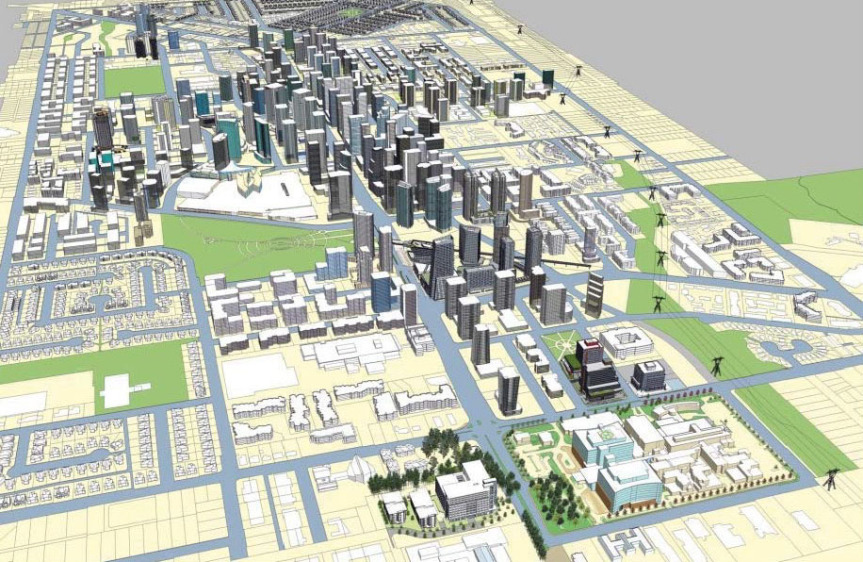
Conceptual Rendering of Surrey City Centre in 2040

A landmark decision was made tonight as Surrey City Council gave final adoption to the new City Centre Plan. The plan, which has been under development for the past 10 years, is a major revision and update to the first City Centre Plan adopted back in 1991. Its aim is to redefine the vision and help better establish and reinforce a desirable development pattern for Surrey’s downtown. The 500-page document is full of visionary guidelines, objectives, and plans for the area, which will guide development over the next 30 years.

Below are some of the highlights:

The goal of the Surrey City Centre Plan is to help develop and support a regional downtown that is the main business, cultural and activity centre for the City of Surrey. It is anticipated that the existing City Centre population of 32,000 will more than double by 2033 to approximately 68,000 people and the number of jobs will increase from 24,000 to 32,000 over the next 10 years.” The population of Surrey as a whole is expected to grow from 550,000 today to over 800,000 within 30 years to become the largest city in BC.

Surrey’s City Centre is undergoing a major transformation from a suburban centre into a walkable high density, transit oriented downtown for South of the Fraser. Surrey City Centre is envisioned to be the Fraser Valley’s metropolitan centre, connected to major regional destinations by rapid transit and an efficient road network designed to support walking, cycling, and transit. It will be a centre for major employment; services; higher density housing; and commercial, cultural, entertainment, and institutional activity. Surrey City Centre is also designated as Metro Vancouver’s second metropolitan centre in the 2040 Regional Growth Strategy.”

Distinct and vibrant neighbourhoods, including a dynamic and innovative business sector, university, hospital, and civic and historic districts, will form the framework of the City Centre. Each of these areas will have its own unique character that together will create a diverse, authentic, and interesting downtown.”


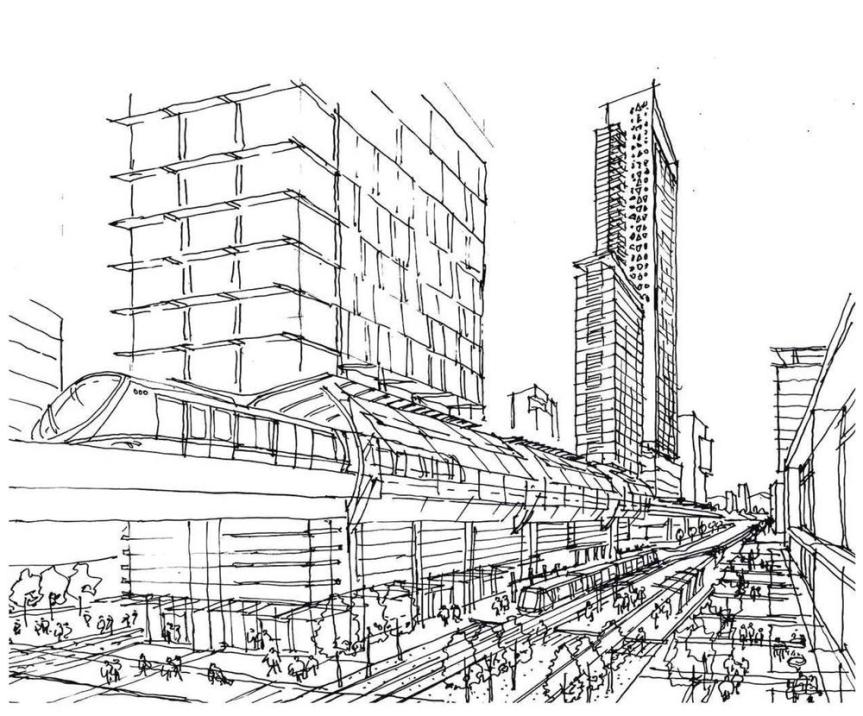
Artistic rendering of Surrey Central Station and a pedestrianized City Parkway with LRT

City Centre Neighbourhoods

  • The City Centre Plan area has been organized into a number of distinct residential neighbourhoods and mixed use districts each with its own emerging identity, function, and scale. These sub areas help to create a focused, vibrant, and more urban downtown by defining and understanding the plan area through a smaller scale and framework.


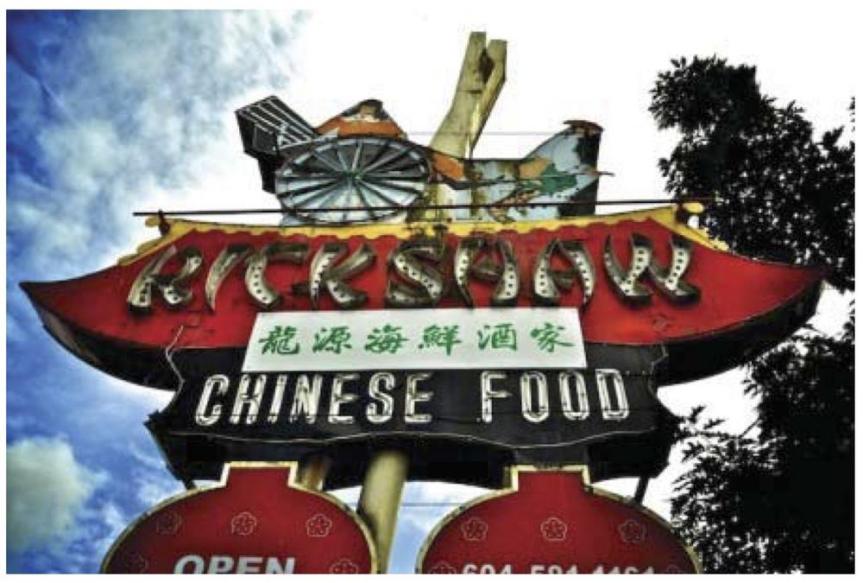
1960’s Rickshaw Restaurant Sign at 10522 King George Blvd – Photo by Rebecca Bollwitt/Miss604

  • A Mid-Century Historic District:
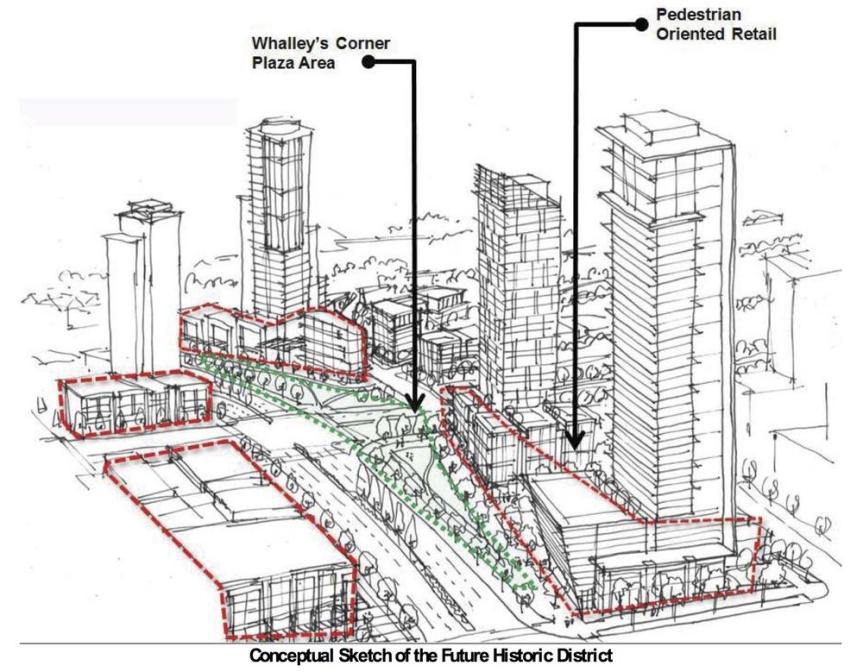
    • Building on the historic roots of the area, the vision for the Historic District is to support a pedestrian-oriented eclectic shopping experience with a continuous commercial and retail edge with pedestrian amenities. The historic, mid-century modern feel will be preserved and reinforced through small storefronts, building façade treatment and materials, public art, and signage.
    • New developments will incorporate the 1950’s character by using elements that reflect a mid-century modern design aesthetic. These elements include flat roof lines, vertically oriented windows, cantilevered overhangs, and clean and contemporary lines.
    • Preservation of mid-century heritage signs. If re-use of the sign is not possible, new developments should integrate the heritage sign into the redevelopment through an adaptive re-use approach.


Conceptual rendering of Surrey Central area – Existing and Future SFU buildings in red.

    • Central Downtown:
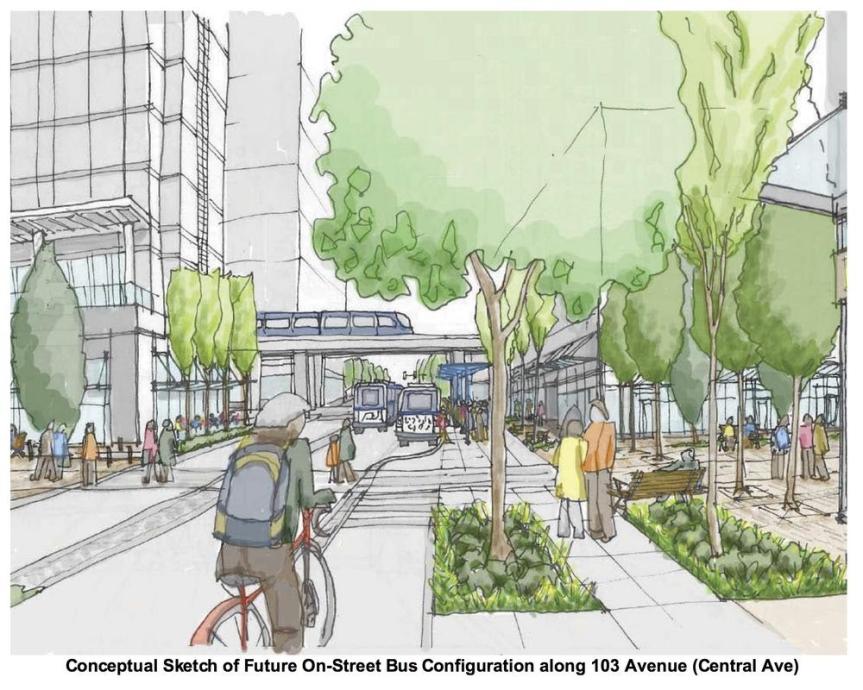
      • A major transit hub will be located at the core of the district, building on the existing Surrey Central Exchange and SkyTrain station with the addition of light rail transit(LRT). The suburban style bus loop will be reconfigured into a new on-street transit exchange, as the bus layover and ice arenas are relocated away from the central core.
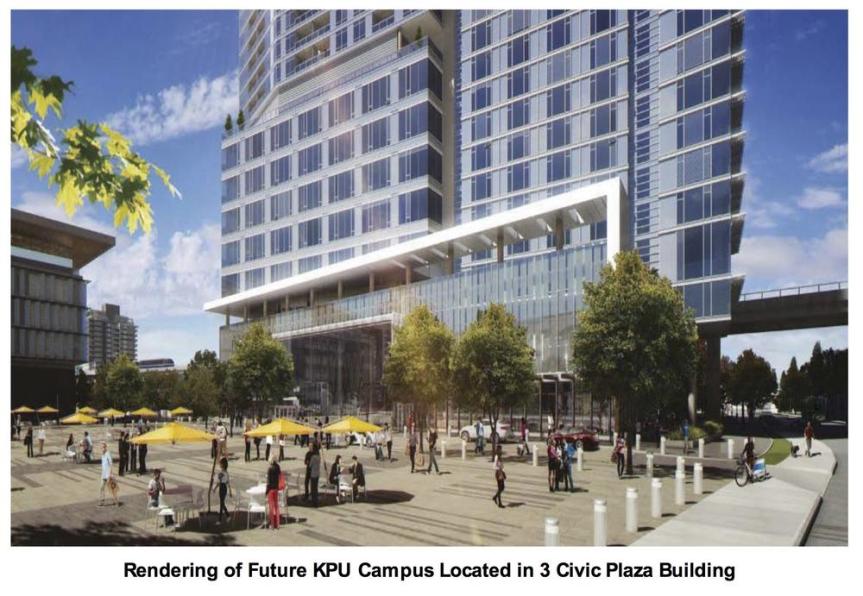
      • The presence of significant new university buildings will expand in the Central Downtown, creating a stronger campus identity and student energy at street level. Research buildings with large floor plates will have active retail street frontages and transparent storefronts to engage the pedestrian with the innovative internal uses.
    • Central City Mall Redevelopment:
      • Over the longer term, the Central City Mall property will redevelop to create a site that has improved interface and connection to Holland Park as well as a broader range of mixed of uses. The retail uses in the parking lot areas along King George Boulevard will intensify and include office and residential components.
      • The interface along Holland Park will also be improved with redevelopment of the parkade structures into high density residential buildings and a redesign that creates direct connection through the mall site to Holland Park.

Greenways and Parks Network

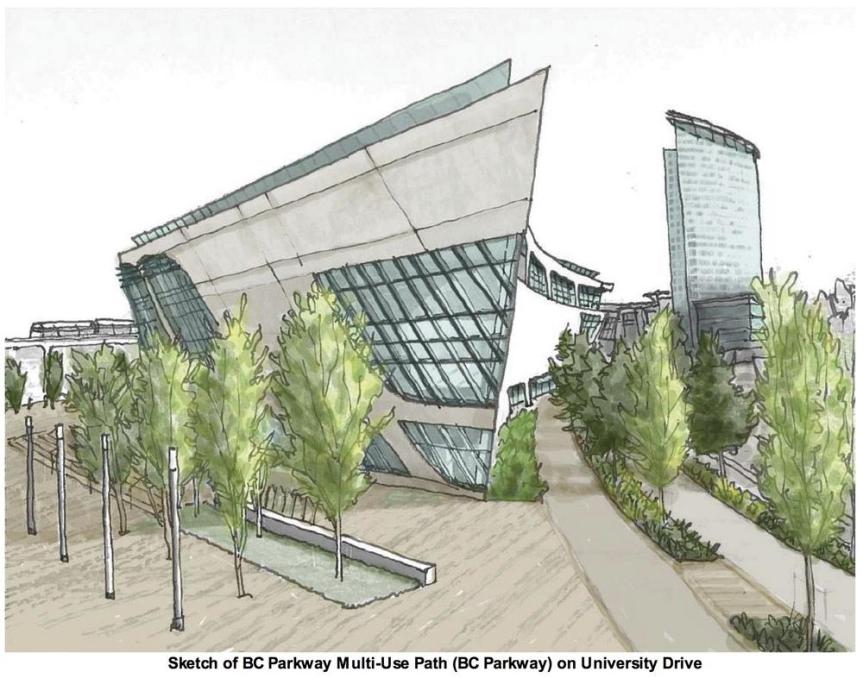
  • The downtown will be known for its green urban infrastructure of parks, plazas, greenways, planted boulevards, and rain gardens, as well as for its existing natural features that include fish bearing creeks, riparian areas, and spectacular views to the North Shore and North Cascade Mountains.

  • Rapid transit is a cornerstone of the City Centre, both for existing conditions as well as future planning. The existing elevated rapid train system (SkyTrain) links the City Centre with the region north of the Fraser River. A new Light Rail Train (LRT) network is planned to expand the rapid transit service. This network consists of two lines: the ‘L-line’, and the ‘Fraser Highway Line’, which is 17 kilometres long.
  • The vision for City Centre’s street network is for a finer-grained, connected framework that facilitates mobility and enhances the safety for all citizens, creating a vibrant, pedestrian-oriented downtown.
  • City Parkway will become a car-free zone from 102A Avenue to Central Avenue (103 Ave) and include an LRT station next to Surrey Central SkyTrain Station. The station area is planned as a signature LRT station with the termination of the Fraser Highway line, and intersection of the L-line along City Parkway.

  • There are three large public plazas in City Centre. The largest is the Civic Plaza, designed as contemporary open space which offers programmable open space for gatherings and large special events. The Civic Plaza will provide a central corridor that connects the institutions of the civic precinct.

  •  The redevelopment of the Recreation Centre and the relocation of the North Surrey Arena’s will enable the extension of the Civic Plaza to the south, ultimately linking with the Central City Plaza to create one of Metro Vancouver’s largest urban plaza systems.

  • Whalley’s Corner Plaza at 108 Avenue and King George Boulevard will provide a contemporary link to the Whalley’s history, with opportunities for public art and interpretation.

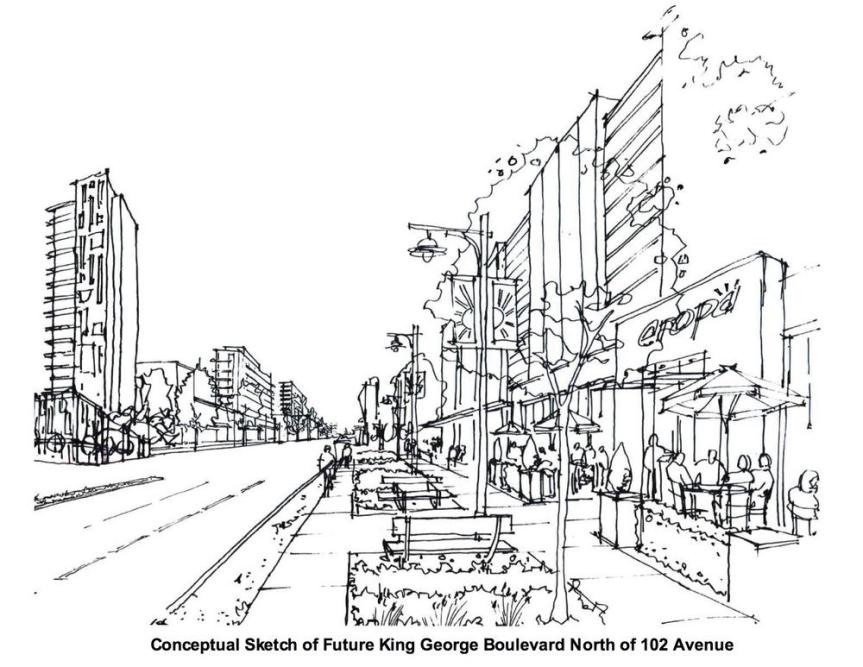
  • King George Boulevard, between 102 Avenue and 104 Avenue, will emerge as a true “ Boulevard” , with the low intensity commercial and parking lot uses redeveloping into a street-facing downtown shopping area.
  • As part of humanizing King George Boulevard, a significant public art installation will be located in the centre of King George Boulevard median, in the residual road right-of-way area created by the narrowing of the street as the LRT turns onto 102 Avenue. As well, segregated cycle tracks will be introduced along King George Boulevard.

  • A public art walking loop linking key public art installations. Along the walk will be new art installations, building façade improvements, artistic street furniture, and banners. Corner plazas, seating areas and architectural featuring, will be realized along the art walk through the development of private property.
  • An iconic public art installation is envisioned as part of a cultural catalyst project within the City Centre Plaza. An art installation at a world-class scale, located within the core of City Centre, will inspire residents and visitors, energize an important public space and stimulate social interaction and discussion.
  • The proposed LRT system should incorporate public art features that promote unique community identities.

While there is too much information in the document to fully cover here, overall, this visionary new plan can be seen as at the forefront of contemporary urban design and planning. As it guides growth over the next few decades, Surrey City Centre is likely to become a world-leading example of how to transform a former suburban centre into a high-quality, mixed-use, mixed-density, environmentally sustaining, culturally rich, and desirable urban centre.

For much more on the new City Centre Plan, click below for the full report:

Blackwood Partners – UrbanSurrey

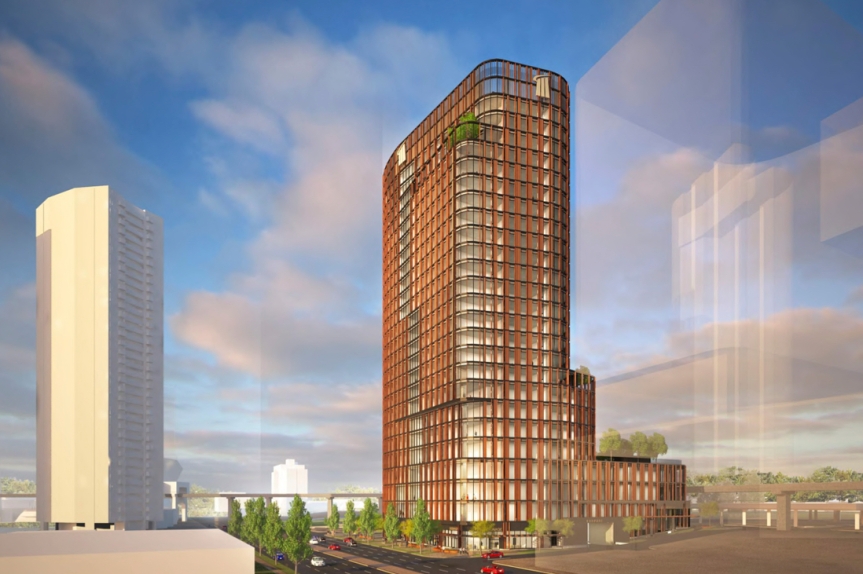
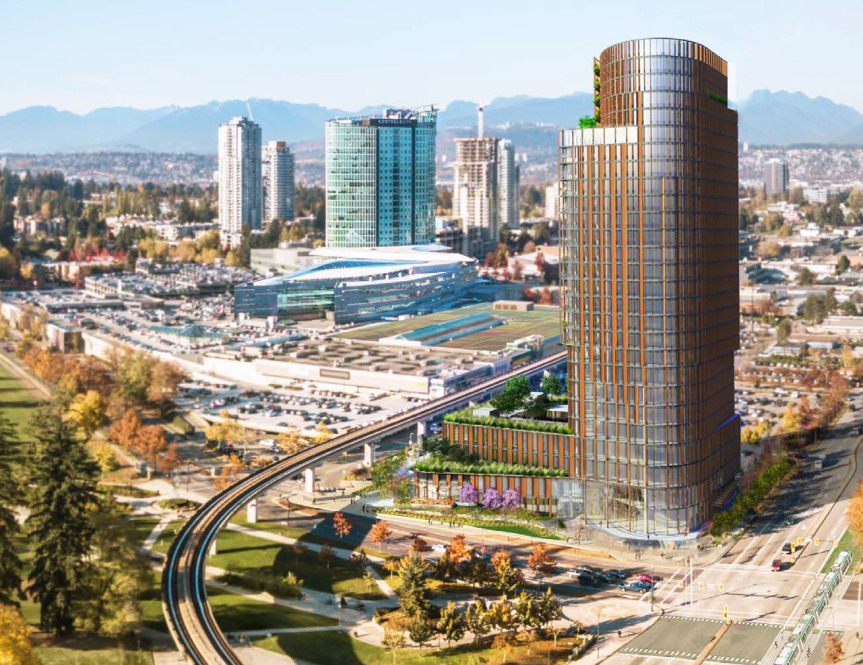
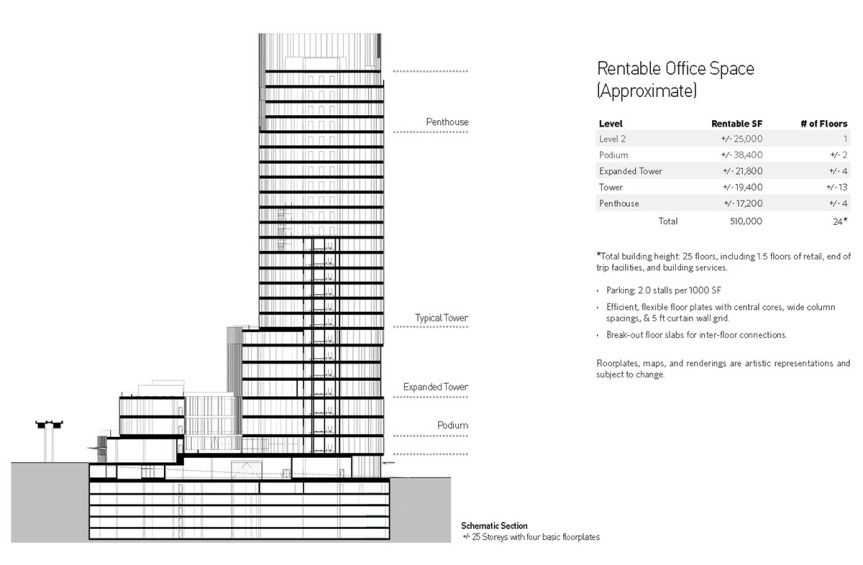
The much anticipated ‘Central City II’ office tower will appear before Surrey Council on Monday for 1st & 2nd readings, as part of the first Council meeting since the summer break. Designed by ZGF Architects, the 25-storey (116.5m / 382 ft.) building will be the successor to the iconic Bing Thom designed ‘Central City I’, built in 2003, and bring much needed new office space to Surrey City Centre. Taking design cues from the original tower, while at the same time having its own distinctive architectural expression, the new building will be located just to the south-east of Central City I at the corner of King George Blvd and Old Yale Rd.

In all, the building is proposed to include:

  • 567,114 sq.ft. of AAA Office Space and Fitness Club on levels 2-25
  • 16,168 sq.ft. of ground-oriented retail, restaurant, and cafe space
  • Landscaped roof terraces on levels 3, 5, 10, 21, and 24
  • A new dedication of City Parkway
  • A new private east-west lane along the north side of the building connecting City Parkway to King George Blvd
  • Plazas and Separated Bike Lanes surrounding the building along King George Blvd, Old Yale Rd, and City Parkway

View looking South along SkyTrain Guideway View Looking South-West along King George Blvd View looking North-West at corner of King George Blvd & Old Yale Rd South and East Elevations West and North Elevations

In terms of design, the building consists of a 25-storey tower with distinctive rust-toned metal panels, above a stepped podium, transitioning to different floor plates at levels 3, 5, 10, 21, and 24. The tower maintains a rounded rectangular form above the podium levels, before transitioning to an elliptical shape – similar to ‘Central City I’ at level 21. Above level 25, the vertical fins extend the curtain wall and frame an additional 2 storeys to conceal the rooftop mechanical equipment, and give the building a 27-storey appearance. The fins also provide space for signage, shown in renderings provided by ZGF, with the Central City logo, similar to the original tower. The bulk of the building’s massing is oriented towards King George Blvd and anchored to Old Yale Rd, creating a strong urban street wall and presence. The building tapers down towards the west, with its 4-storey podium extending to City Parkway, and the SkyTrain guideway.

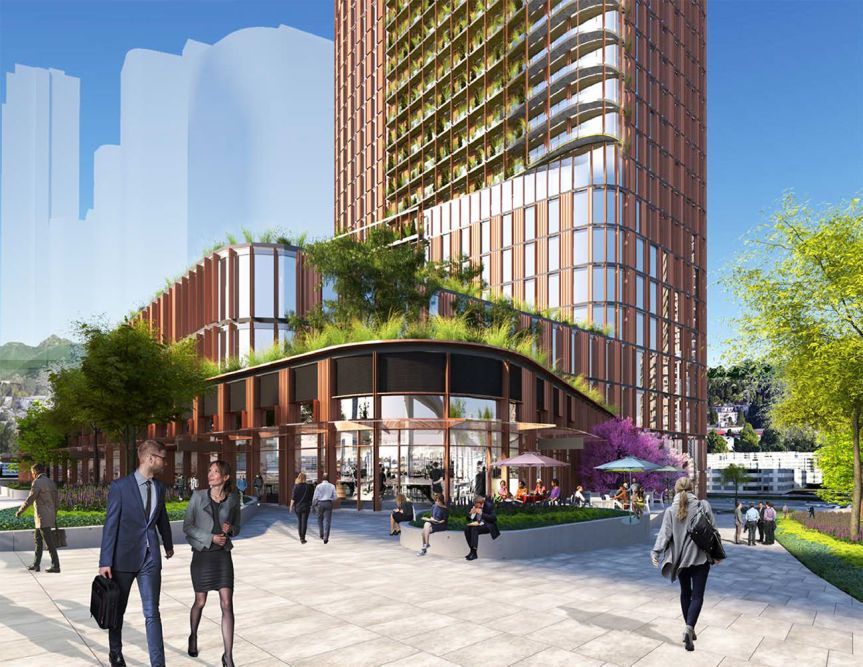
The main entrance to the building will front onto a new public plaza along Old Yale Rd. This plaza will extend around the building on 3 sides, with retail, restaurant, and cafe space spilling out to activate frontages along City Parkway and King George Blvd. The south-west corner of the site at Old Yale Rd and City Parkway has been identified as a location for a future significant public art piece, subject to separate public art plan process.

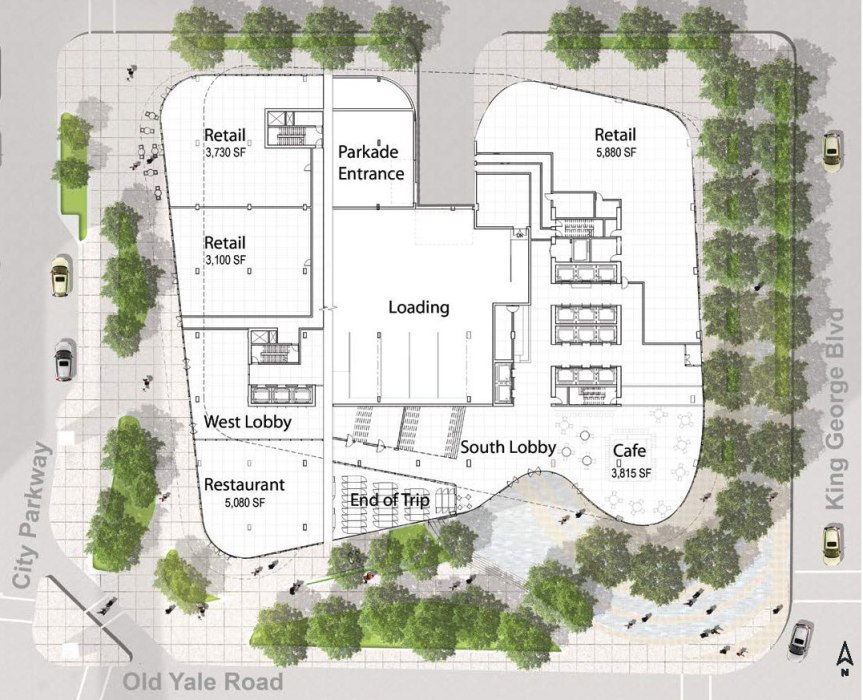
Ground floor Site Plan Landscaped outdoor terrace on Level 3 Landscaped outdoor terrace on Level 5 Landscaped outdoor terrace on Level 10 Landscaped outdoor terrace on Level 21

Replacing the former Best Buy store at the corner of the existing mall parking lot, Central City II represents just phase 1 of a master redevelopment plan for the remainder of the Central City Shopping Centre site. More details of that plan will come through future development applications for subsequent phases. Earlier this year, the mall’s owner Blackwood Partners announced plans for a 1.5 storey addition to the existing parkade along University Drive which is expected to get underway in the coming months. Upon completion, this will allow for the closure of rooftop parking above parts of the existing mall along Old Yale Rd and eventual redevelopment of the site across from Holland Park.

Blackwood Partners has submitted a development application for the much anticipated Central City 2 office tower – proposed for the corner of King George Blvd and Old Yale Road on the site of a former Best Buy. The 25-storey tower designed by ZGF Architects is to be built to Class AAA and LEED Platinum standards and contain over 500,000 SF of office space, and 20,000 SF of ground level retail.

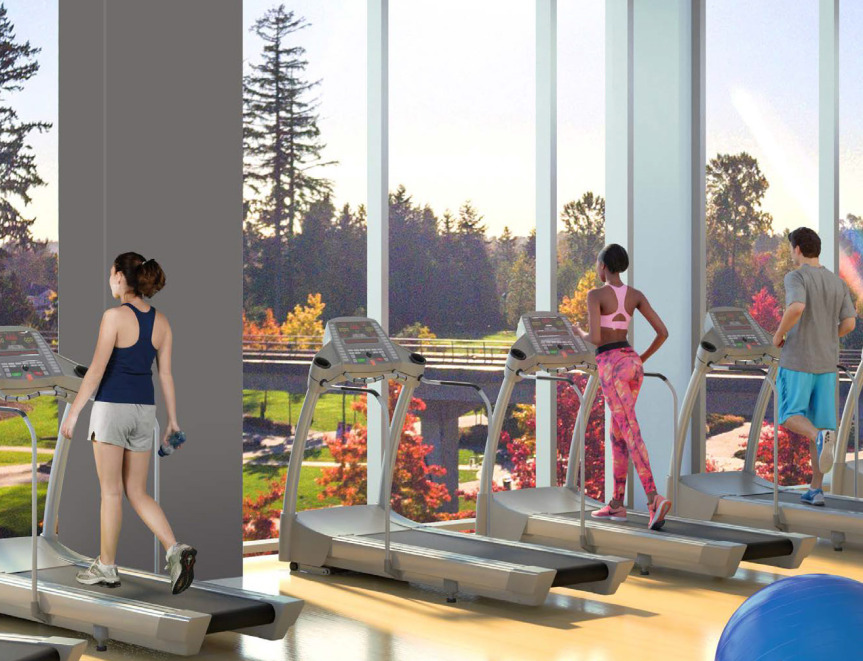
The proposed design of the tower has undergone considerable revision since first announced back in November 2017. The tower now features copper / reddish toned shading fins on its exterior, and a refined, more cohesive massing and podium. The tower also features expansive green roof decks, premium fitness facilities for office tenants, bike lockers, electric vehicle charging, high-speed elevators, and a ground level urban plaza, anchored by a restaurant, café, and retail.

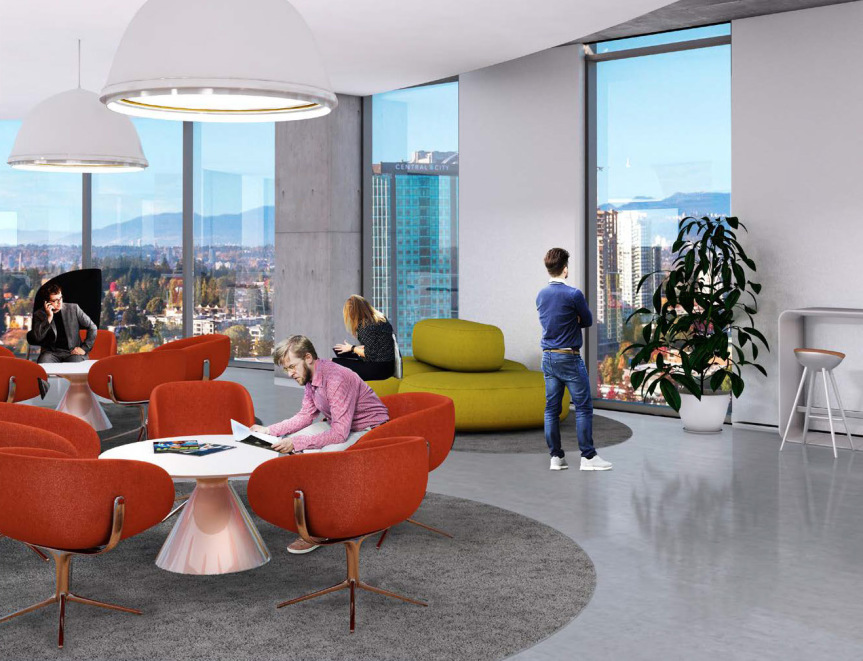
New plaza at corner of Old Yale Road & City Parkway Conceptual ground level floor plan Office tower views Premium fitness facilities for office tower tenants

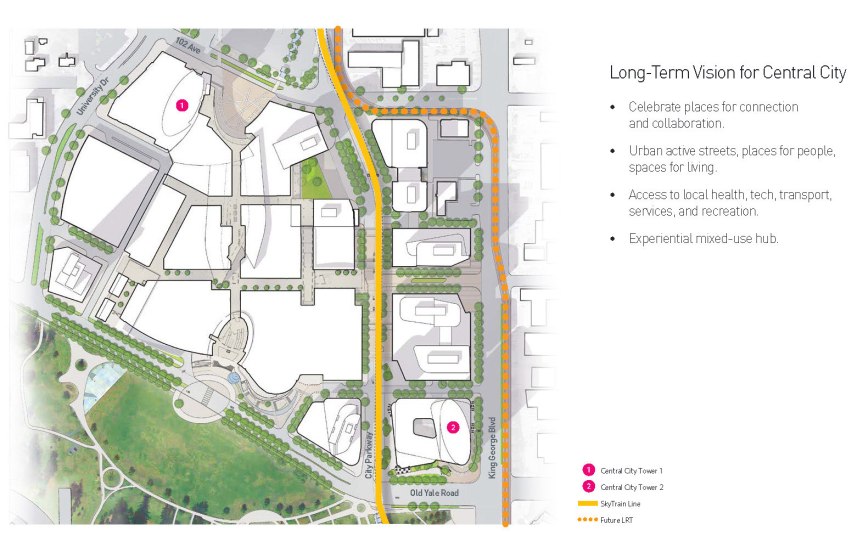
Following the completion of the original Central City office tower and SFU campus back in 2003, Central City 2 will form the next phase of a long-term vision to redevelop the remainder of the Central City Shopping Centre site. While just conceptual at this point, the long-term plan would see the remaining parking lots to the north redeveloped with mixed-use development and new streets. The mall itself is envisioned to be reconfigured to include a number of new tower sites, and a large new plaza entrance fronting Holland Park on Old Yale Road – mirroring the existing Central City Plaza to the north and creating a connection through the mall linking the city’s civic core to Holland Park.

Along with the recently submitted development application, Blackwood Partners has also now begun marketing the tower for lease, and will be opening a presentation centre in the Central City Shopping Centre in early 2019. The current leasing brochure can be found here.

Blackwood Partners, have released new details on their upcoming ‘Central City 2’ office tower project at the corner of Old Yale Rd and King George Blvd. A new leasing brochure, available on the Central City website, provides some updated renderings, floorplans, and marketing information aimed at future tenants looking for office and retail space.

Since first being announced back in November 2017, the new renderings depict a re-designed, more refined tower, from that initially conceptualized. The new design features a stronger podium fronting Old Yale Rd and a more cohesive tower floor-plate and massing compared to the previous design. The rectangular floor plate blends into an elliptical floor plate on higher floors – referencing the existing 25-storey Central City office tower at 102 Ave & University Dr built in 2003.

Conceptual rendering of tower podium and restaurant at corner of City Parkway and Old Yale Rd

Tower Details

Designed by Vancouver’s ZGF Architects, the project will be a 25-storey, Class AAA, mixed- use tower, containing 512,305 SF of commercial space and +/-20,000 SF of retail space contained within the podium. The ground level is conceptualized to contain 6 retail units, a restaurant, cafe, and office tower lobby, anchored to a prominent public plaza at the corner of Old Yale Rd and King George Blvd across from Holland Park and King George Station. The building will be built to LEED GoldDesign (with a pathway to Platinum), and also contain:

  • Premium end-of-trip facilities, with ample bicycle storage, executive bicycle lockers, shower, and change facilities
  • Approximately 900 underground parking stalls
  • High-speed state-of-the-art elevators
  • Electric vehicle charging stations and car share parking spaces.
  • Numerous other advanced technology features

Conceptualized ground-level floor plan Artistic rendering of views from higher-level office floors Artistic rendering of roof-top views overlooking Holland Park Artistic rendering of fitness facilities for office employees

Long-term plan

Also released as part of the leasing brochure is a glimpse at the long-range plan for redevelopment of the entire Central City site following Central City 2. This plan will see much of the existing indoor shopping centre retained but renovated, with the introduction of a new prominent plaza at its south-end along Old Yale Rd, linking the shopping centre directly onto Holland Park. The existing parking lot along King George Blvd is envisioned to be broken up into a series of new city blocks, containing mixed-use high-rise development sites. A re-aligned City Parkway will connect directly through the site from the north, past a new entry plaza where Wal-Mart currently exists.

While no target dates have been given for completion of Central City 2 – it is expected that a development application will be submitted for the project in the near future. The long-range plan for Central City is expected to play out over the next decade or longer. For more on Central City 2:

http://www.centralcity.ca/wp-content/uploads/2018/04/Tower-2-at-Central-City-Brochure-April-2018.pdf

TransLink – UrbanSurrey

A date has finally been set for the official closure of the North Surrey Recreation Centre to make way for the site’s long anticipated redevelopment. In a notice posted on the recreation centre website, the facility is planned to close in 2 phases beginning with a decommissioning of the ice rinks in early September, and finally a closure of the remaining portions of the building on December 22. Ice rink programming will move to the new North Surrey Sport & Ice Complex, set to open on September 3 near Scott Road Station. Following that in January, Aquatics programs will move to Guildford Recreation Centre, fitness and multi-purpose activities to North Surrey Sport & Ice Complex, and preschool programs to Chuck Bailey Recreation Centre.
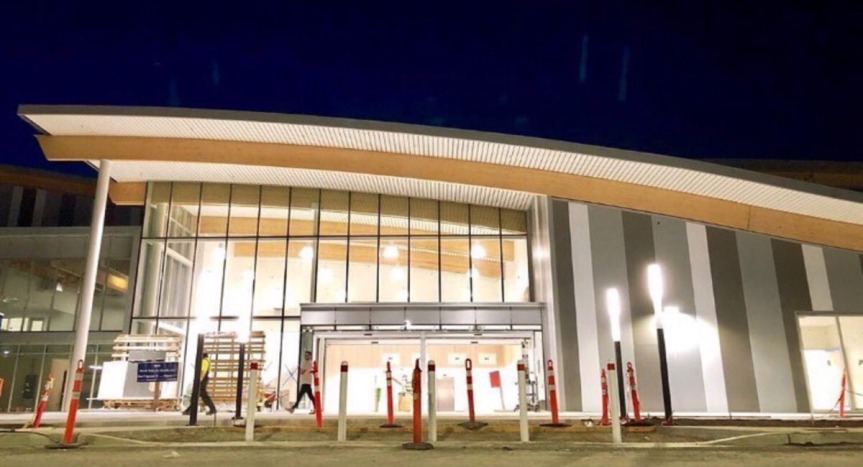
New North Surrey Sport & Ice Complex

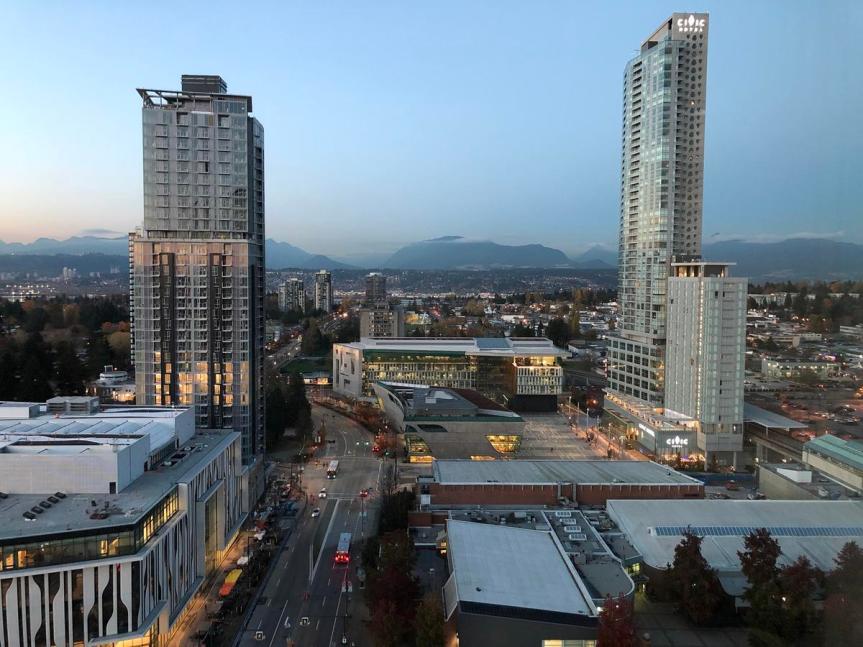
While no timeline has been given for the site’s redevelopment following decommissioning, behind-the-scenes planning work has been underway for years, dating back to 2012. Since then, the City has been working with Simon Fraser University, TransLink, and various architects, planners, and consultants, on a master plan for what is known as the ‘Centre Block’ bounded by Central Avenue to the north, 102 Avenue to the south, University Drive to the west, and City Parkway to the east. Well-positioned adjacent to Surrey Central SkyTrain Station, the site forms a key link between Surrey City Hall / Civic Plaza to the north, and the Central City Complex and beyond to the south.

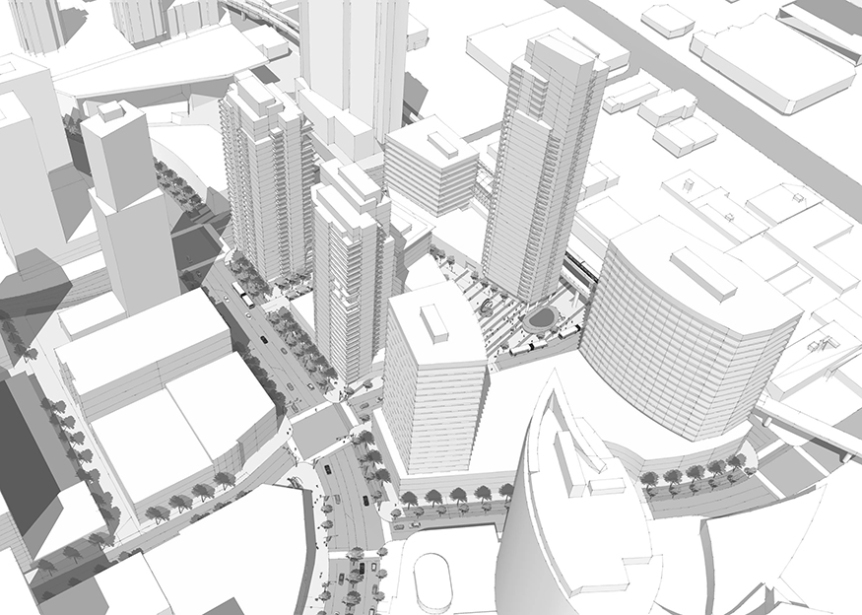
Back in 2013, Via Architecture prepared a ‘vision’ for what redevelopment could look like in the future. The concept envisioned a numerous mixed-use buildings for the site integrated with a transit-oriented plaza linking City Hall to Central City. The buildings would contain office, university, and retail space. The plan also envisioned:

  • A new bus layover facility to be located on 133A St behind the new SFU Engineering building.
  • A removal and re-configuring of the Surrey Central Bus Exchange – replacing the loop with a new street-oriented exchange along a realigned 102A Avenue and Central Avenue. The 2 streets would be integrated with a new Transit Plaza, designed to accommodate high pedestrian and bus passenger volumes.
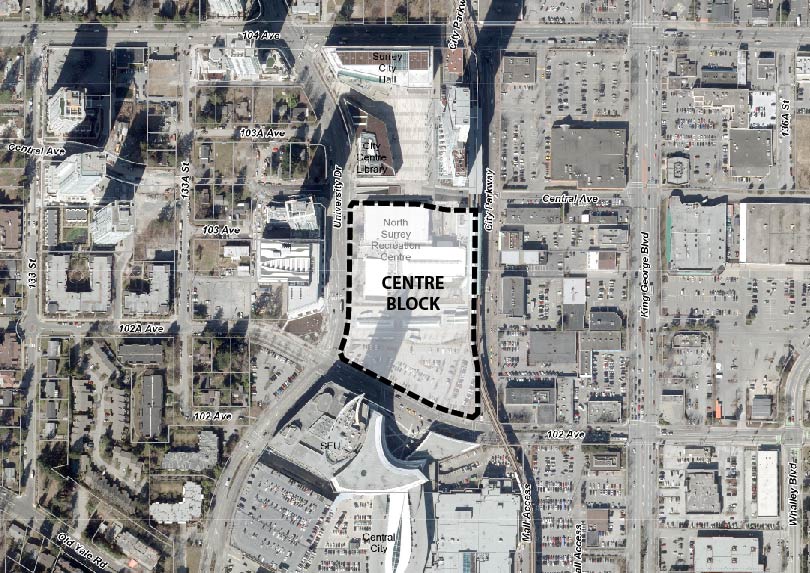
Centre Block location between Civic Plaza and Central City Early vision for the Centre Block prepared by Via Architecture in 2013
Since the early Via Architecture vision, a more recent planning process has been underway following a Surrey City Development Corp (SCDC) RFP was filled seeking a new firm to undertake detailed master planning work for the Centre Block site. While no plans have been publicly released yet, what is expected is a major overhaul of Surrey Central Station linked with a new transit-oriented plaza connecting Civic Plaza to Central City, and integrated with over 2 million square feet of new office, university, and retail space. With such a large scale, the plan is expected to be completed in phases, with various puzzle pieces and phasing needing to take place before other phases can begin. The first of those pieces is the decommissioning and demolition of the North Surrey Recreation Centre. The second will be the construction of the new bus layover facility on 133 Street, allowing for removal of the current Bus Loop, and re-alignment of 102A Avenue through it.

With the North Surrey Rec Centre decommissioning now in sight, the pieces are finally coming together to make the Centre Block redevelopment a reality. While the project is likely to take at least a decade to build-out, we could see the start of application activity related to it in the coming year.

For more on the North Surrey Recreation Centre closing:

https://www.surrey.ca/bylawsandcouncillibrary/CR_2019-R133.pdf
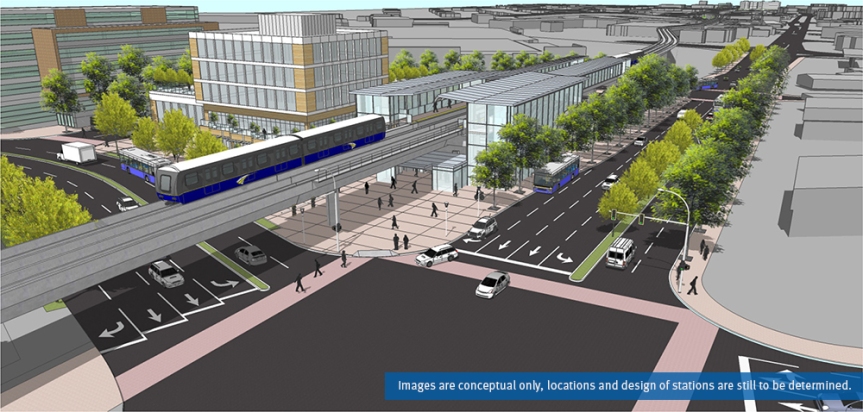
Public consultation is set to get underway this month for the proposed Surrey Langley SkyTrain (SLS) extension, as well as the future of rapid transit along 104 Avenue & King George Blvd.

In 2014, the regional Mayors Council identified Fraser Highway, King George Boulevard, and 104 Avenue as priority corridors for rapid transit South of the Fraser in the 10-Year Vision. Following a study looking at combinations of SkyTrain, LRT, and Bus Rapid Transit for the corridors, the Mayors Council decided on 27-km of urban-style LRT on dedicated track (separate from traffic) on each of the corridors to be built over 2 phases:

  • Phase 1: Surrey-Newton-Guildford Line on 104 Avenue & King George Boulevard
  • Phase 2: Surrey-Langley Line on Fraser Highway

With funding in place to cover the entire first phase, and construction set to begin this year – a last minute request was made in 2018 by Surrey’s new Council to the regional Mayors’ Council to suspend the Phase 1 Surrey-Newton-Guildford LRT line and re-direct funding to the Phase 2 Surrey-Langley line instead, while switching the technology of the Phase 2 line to SkyTrain. The Mayors’ Council voted to move forward with this request, and directed TransLink to begin planning work for SkyTrain on Fraser Highway while at the same time re-visit rapid transit plans for 104 Avenue and King George Boulevard corridors.
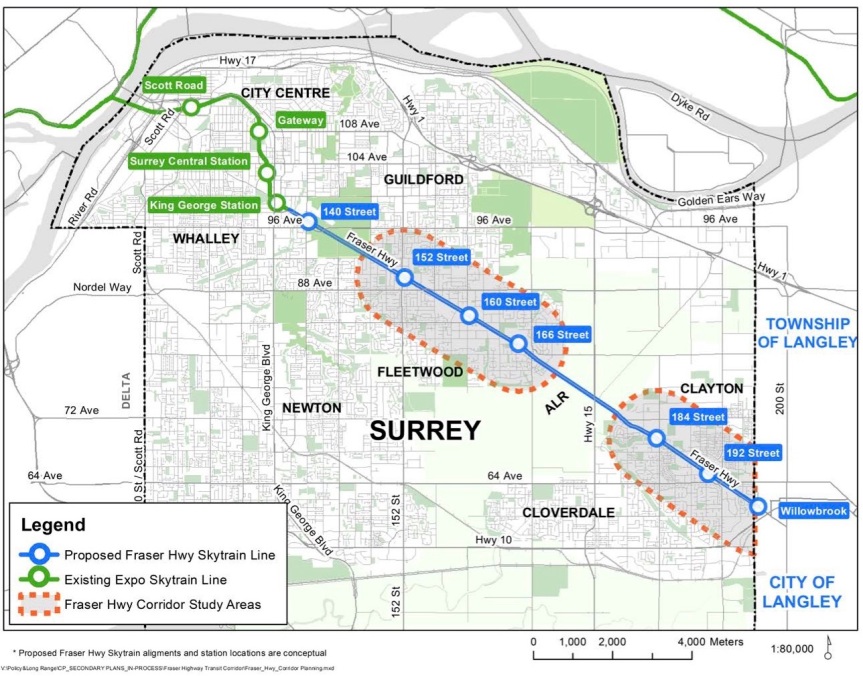
Proposed Surrey Langley SkyTrain route and conceptual stations

The switch of priorities to the Phase 2 Fraser Highway line and changing its technology to SkyTrain has had implications both in budget and timeline. The funding that was allocated for the full Phase 1 Surrey-Newton-Guildford LRT line has been identified as inadequate to fund the entire Fraser Highway SkyTrain extension to Langley. Pending a future round of funding (timeline unclear), the line may have to be phased, with the current funding getting the line potentially only as far as Fleetwood. Start of construction and delivery of new rapid transit South of the Fraser is also now delayed by approximately 2 years as a result of the switch.

Despite the funding and timeline uncertainties, planning work is nonetheless well underway for the new SLS line, which will need to involve a significant re-evaluation of land-use plans along the Fraser Highway corridor to support SkyTrain, completion of a number of supportive studies, and extensive Public Consultation. In a project update report to Surrey Council this week – a preliminary timeline was given for this work by TransLink, with start of service targeted for 2025.
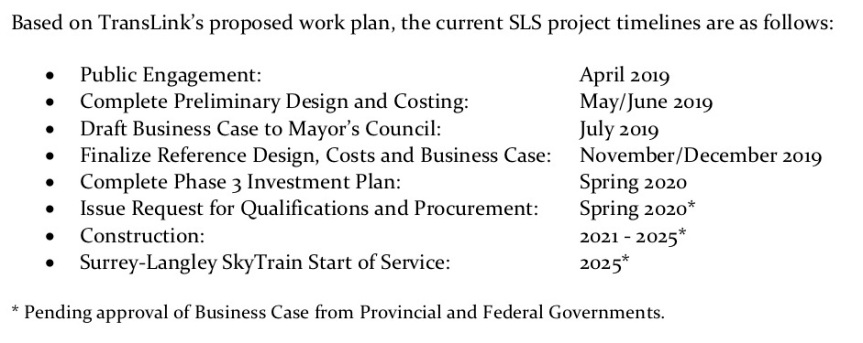
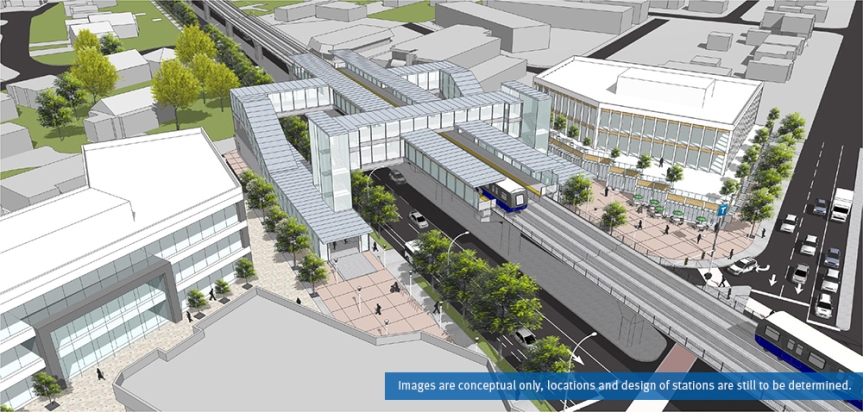
To run concurrently with the SLS planning and consultation work will be a planning process to ‘refresh’ the South Fraser Rapid Transit Strategy for delivering the Mayors’ Council fully envisioned 27km of Rapid Transit along each of the Fraser Hwy, King George Blvd, and 104 Ave corridors. This refresh will look to re-examine and engage the public on what rapid transit along the remaining corridors could look like, now that SkyTrain has been chosen as the technology for Fraser Hwy. The 2013 Rapid Transit Alternatives Study identified Bus Rapid Transit (BRT) for these corridors based on a scenario with SkyTrain on Fraser Hwy. With much LRT planning work having now been completed however, for the 104 Ave and King George Blvd corridors, it’s possible that LRT could still be an option for them rather than BRT, especially given Surrey’s long-term rapid transit vision for an extensive LRT network on major arterials across the City.

The first round of Public Consultation on the SLS line and South Fraser Rapid Transit refresh gets underway on April 11 in Langley, with open houses in Surrey on April 15, 16, and 17. TransLink has also recently launched an online survey where you can voice your feedback on the proposed SLS line. Open House times are set for the following dates and locations between 3-8pm:

  • Thursday, April 11 – Langley City Hall
  • Monday, April 15 – Surrey Sport & Leisure Complex (Fleetwood)
  • Tuesday, April 16 – Surrey City Hall
  • Wednesday, April 17 – Newton Seniors Centre

More info on the land-use planning review process for the Fraser Highway Corridor being undertaken by the City of Surrey can be found here: https://www.surrey.ca/bylawsandcouncillibrary/CR_2019-R059.pdf

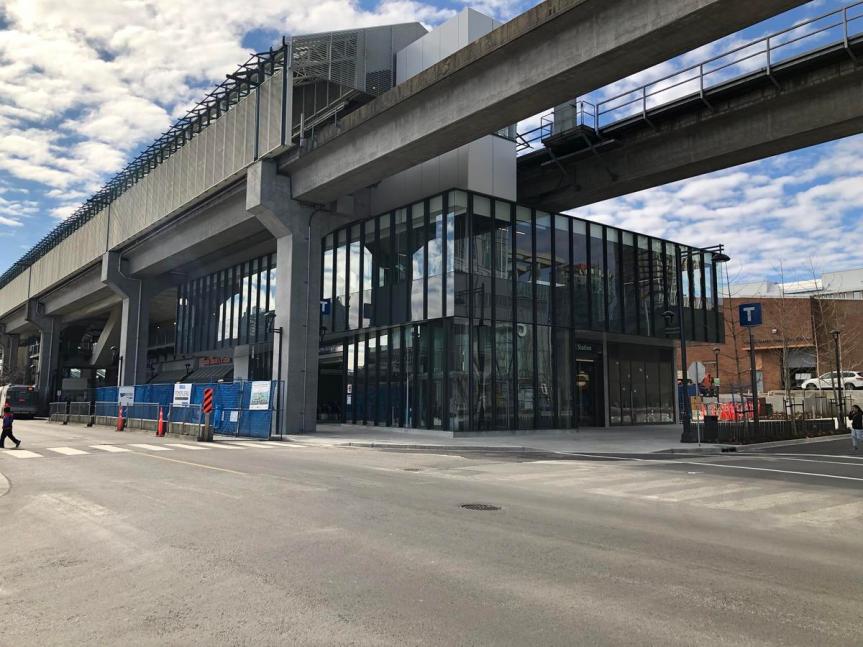
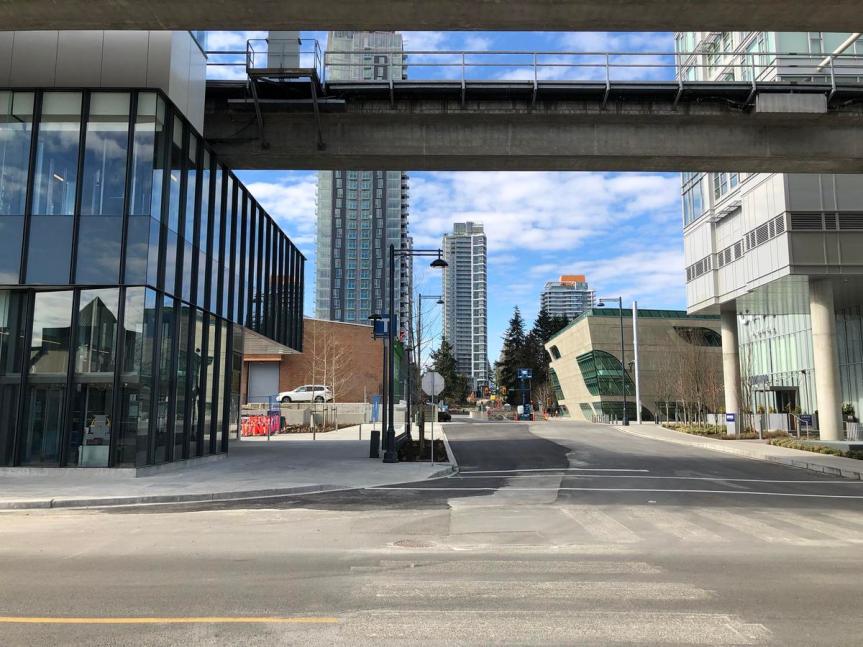
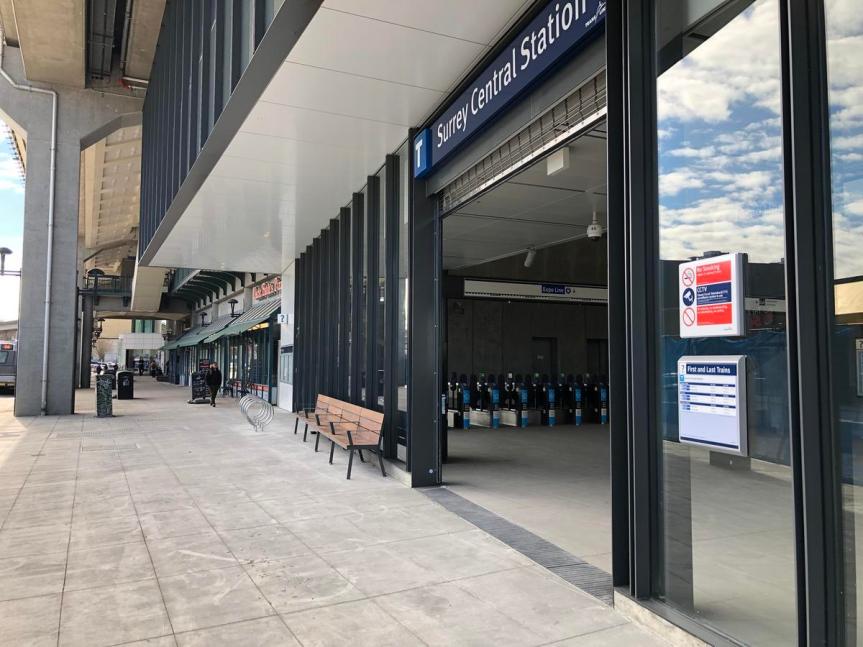
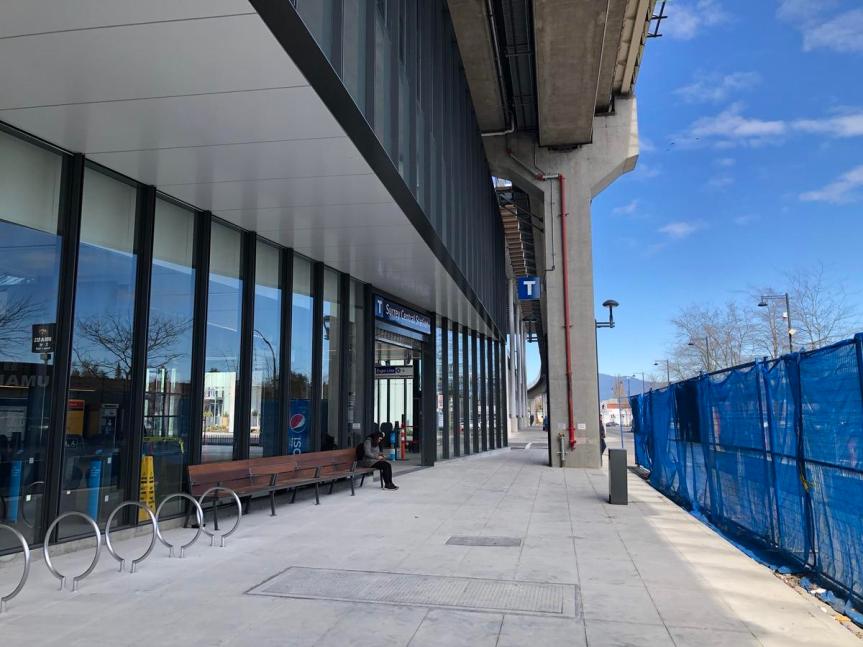
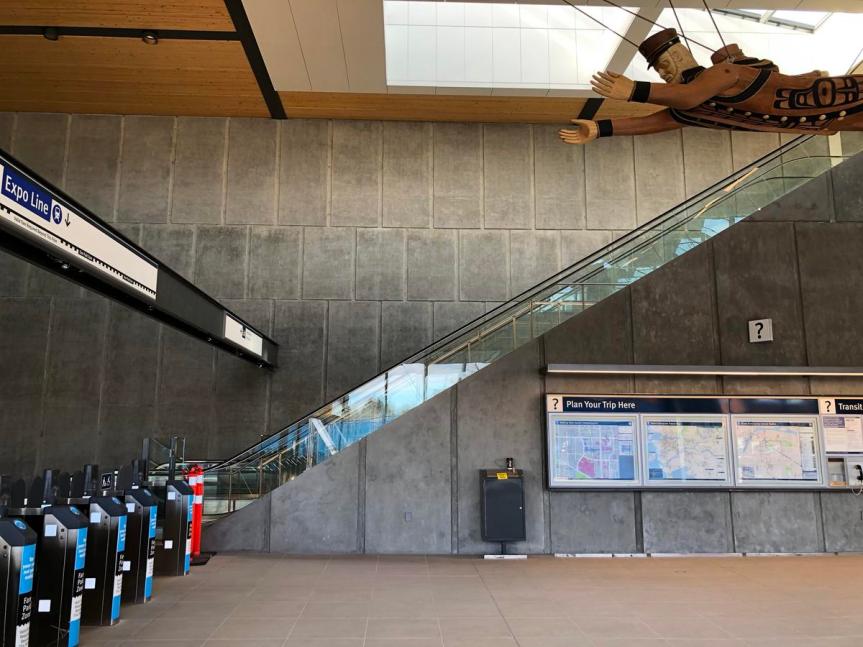
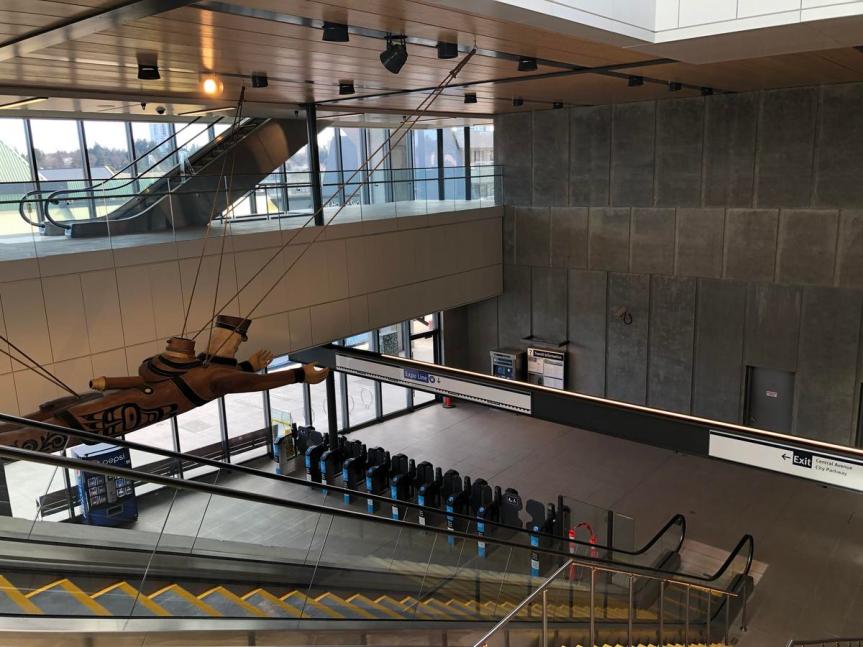
After nearly 2 years of construction, the Surrey Central Station north station house expansion officially opened to the public this weekend. Designed by OMB Architects, the new 2-storey station house is now the largest entrance at the station, fronting directly onto the corner of Central Avenue and City Parkway across from Civic Plaza.

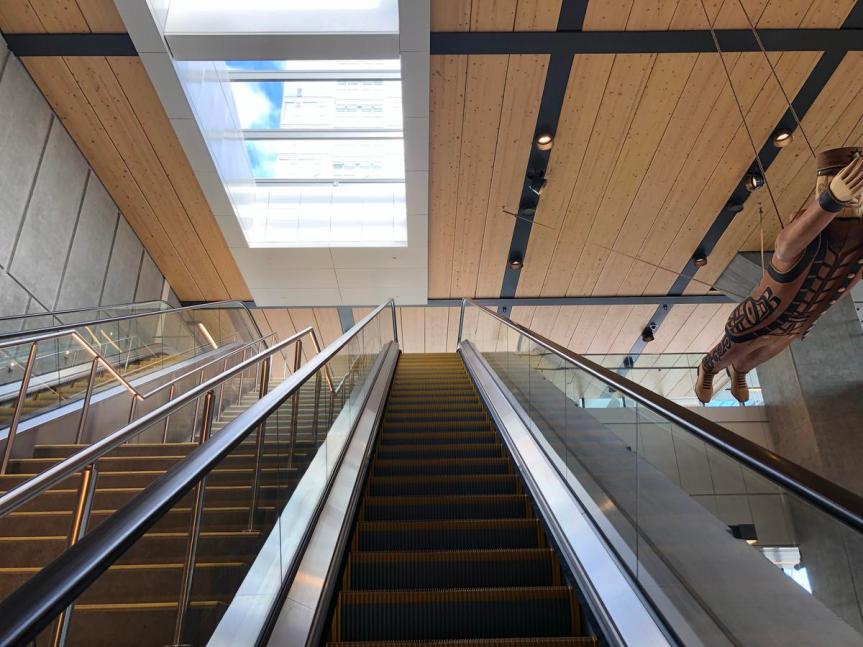
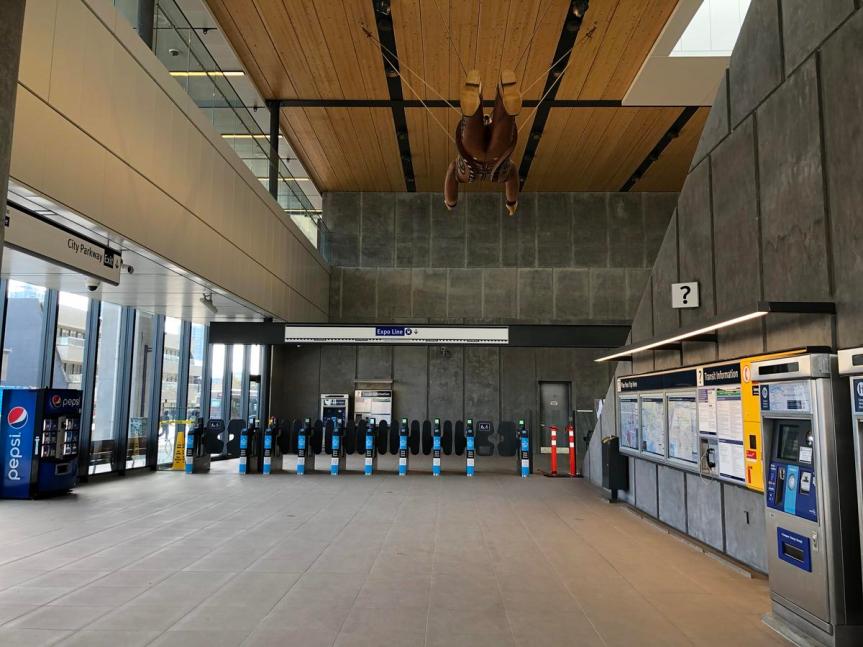
The new station house features a contemporary, open, and airy design consisting of glass, concrete, and wood materials, as well as a prominent new First Nations art installation suspended from the ceiling – ‘The Sea Captain’ by Marianne Nicolson. A new retail unit has also been added to the station next to the entrance fronting Central Avenue, but has yet to be occupied by a tenant.
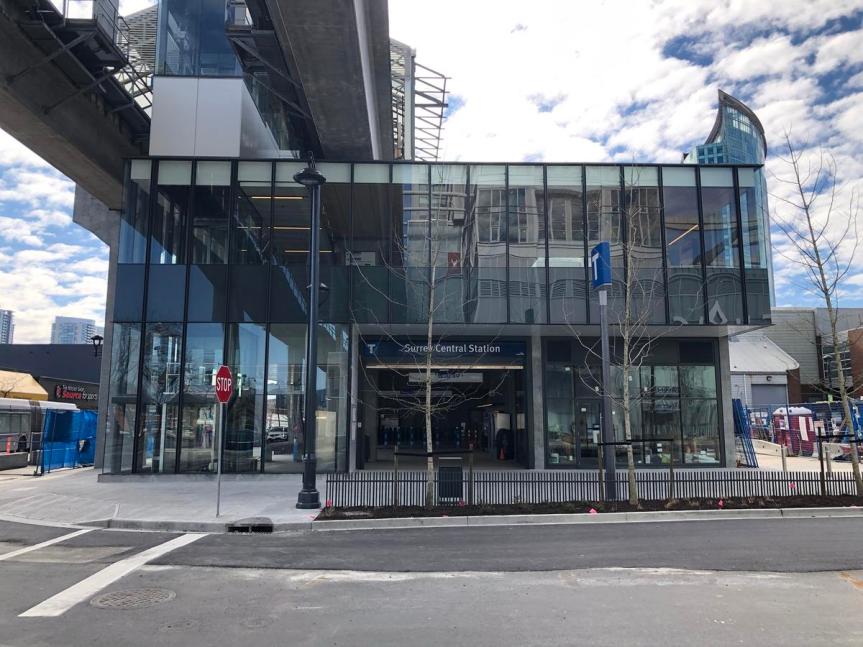
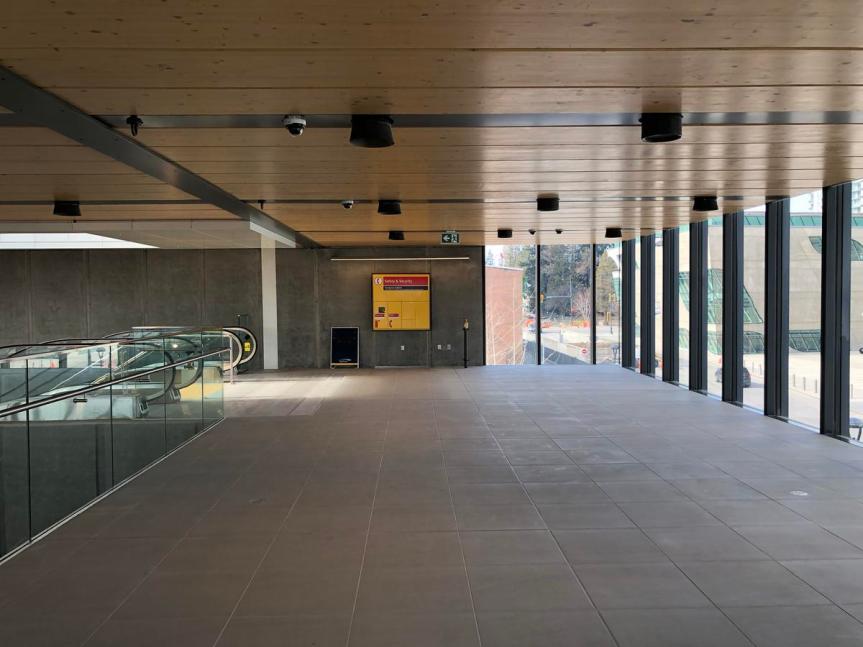
New entrance fronting Central Ave Corner of Central Ave & City Parkway Looking west down Central Avenue New entrance on City Parkway New entrance with bike racks and benches on City Parkway New ticket and fare gate concourse Fare gate concourse and art installation
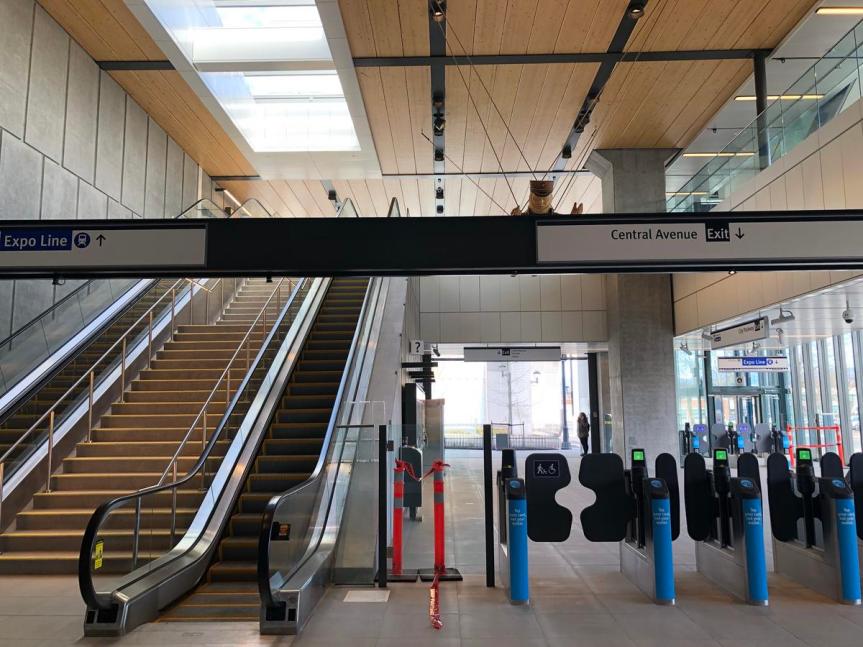
Escalator to second floor concourse

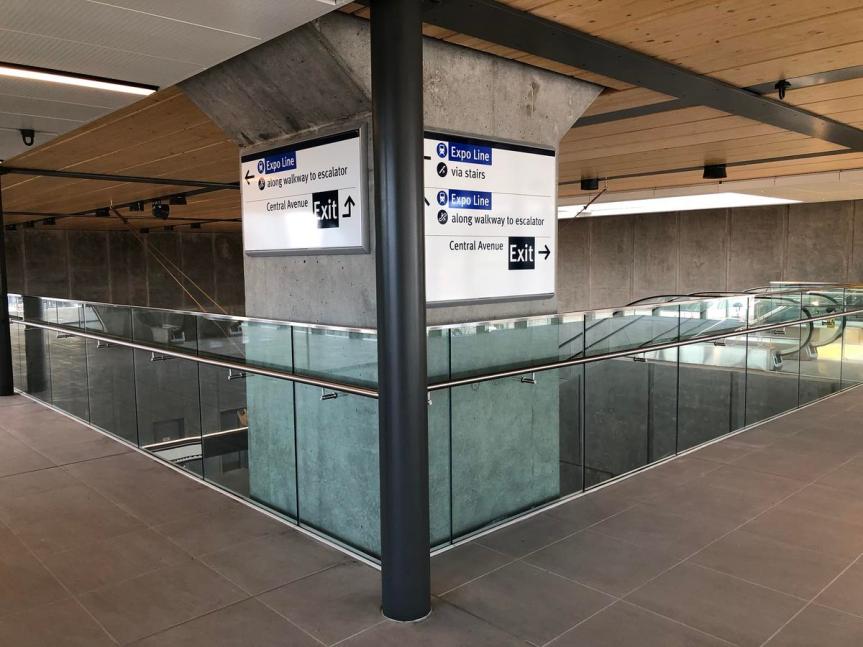
2nd floor concourse Wayfinding signage on second floor concourse
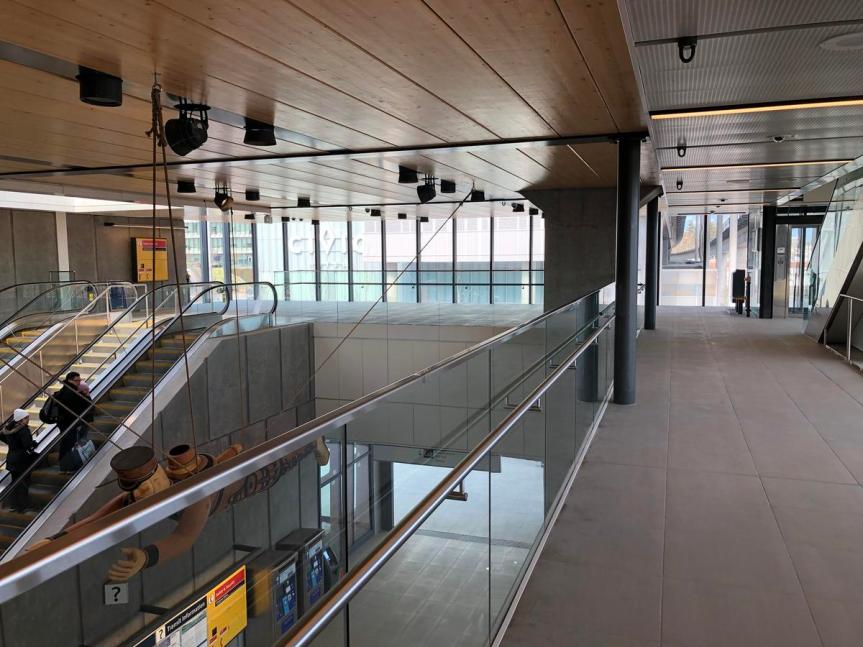
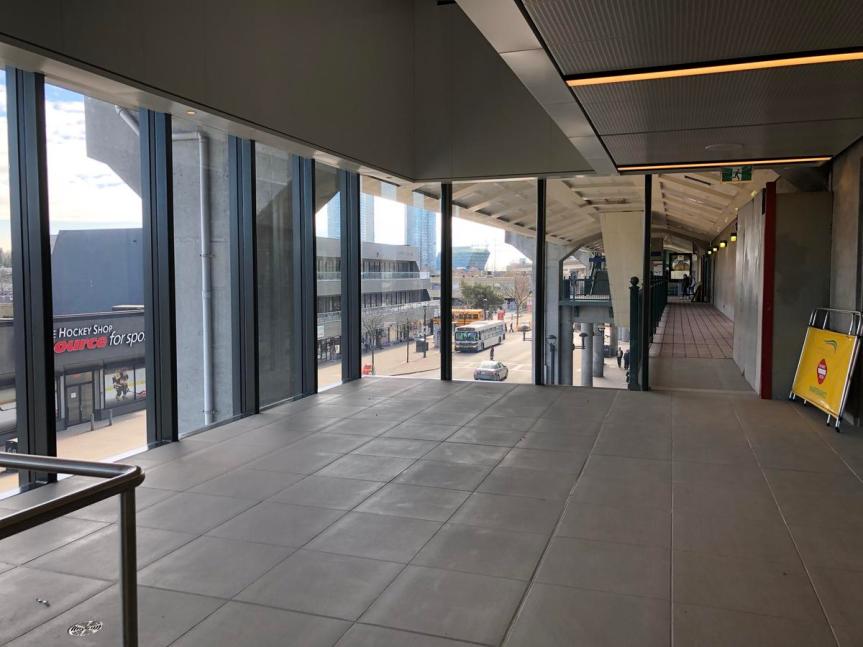
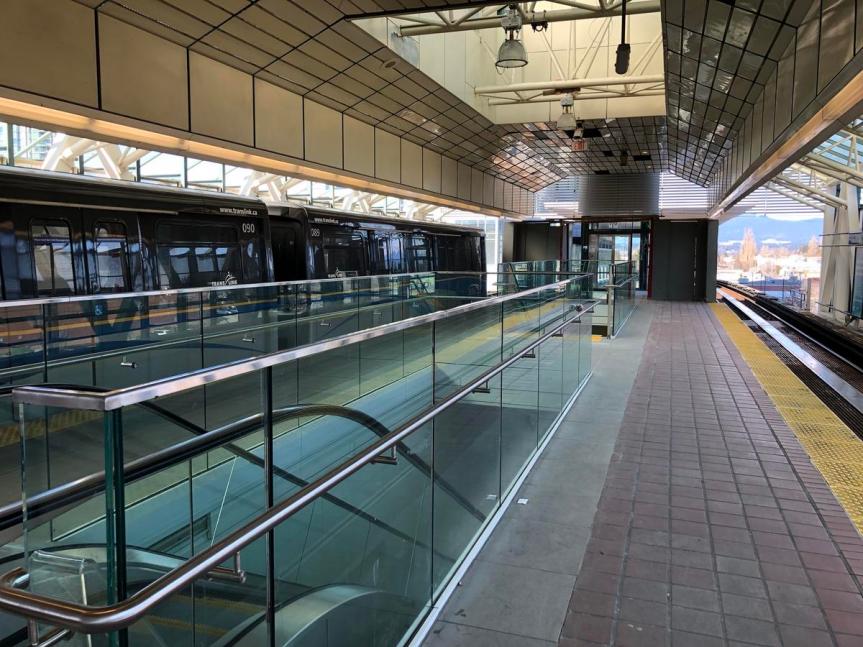
Connection to south station entrance New platform level stairs, escalator and elevator

This latest upgrade to Surrey Central Station is just the beginning of an even larger expansion and re-configuration to come in the future. The lands immediately west of the station, where the current North Surrey Recreation Centre and Bus Loop sit – known as the ‘Centre Block’ are expected to be redeveloped in the coming decade. With that will come the removal of the suburban-style bus loop and re-positioning of bus bays onto streets surrounding the station. A major overhaul of the station is expected at that time to modernize and better integrate it into its evolving urban context.

The City of Surrey began a series of 3 open houses on Thursday for Phase 1 of the upcoming Surrey LRT project. This latest public engagement is the 3rd round of open houses on Phase 1 the project, providing refined plans based on public input from previous consultations. Presented at the open house were preliminary station designs, road designs, information on construction planning, environmental and socio-economic study results, and more. A full set of the Open House Boards can be found here.

Station Designs

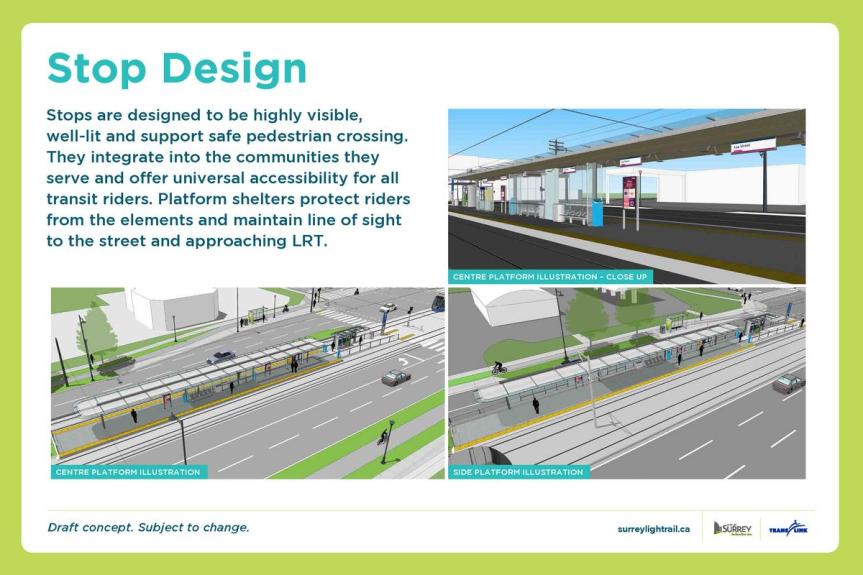
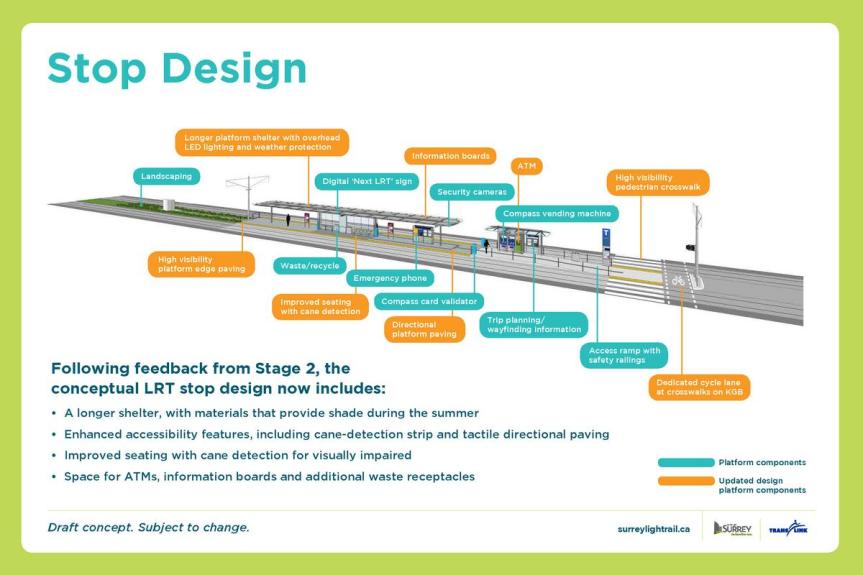
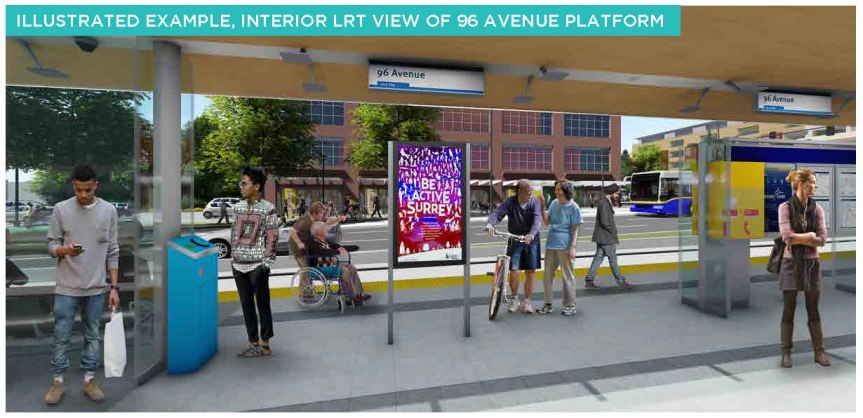
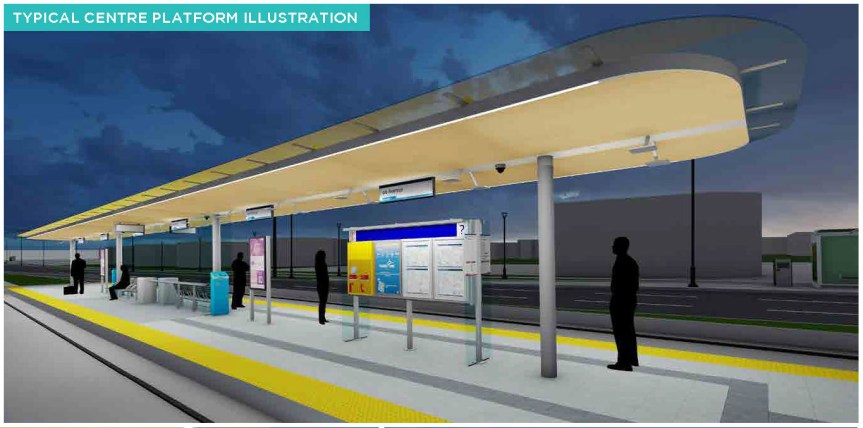
Overall, stations are designed to be highly visible, well-lit, and well integrated into the community – accessible by well-marked pedestrian crossings providing universal accessibility for all riders. Lengthy platform shelters protect riders from weather, and include space for ATM’s, information boards, seating, and more – while maintaining a clear line of sight to the street and approaching trains. Stations will in most cases be located in the centre median of the street, with the exception of King George, Surrey Central and Newton Town Centre – where they will be plaza oriented, or off to the side. Public art will also be integrated into stations along the route.
Roadway Design

LRT will run on its own dedicated track for the entirety of the line, with the exception of City Parkway where it will be integrated into a pedestrian plaza. Placement of the LRT track will vary – typically located in the centre median for most of the route, but off to the side in some sections.

Roadway design for 104 Avenue will consist of LRT in the centre median, and 1 traffic lane in each direction, widening to include an additional turning lane at major intersections. The 104 Avenue design will also provide upgraded and enhanced sidewalks, pedestrian crossings, and connections to stations. Currently 104 Avenue functions as a non-pedestrian friendly, busy arterial for cars. A re-purposed 104 Avenue with LRT will transform the street into a calmed, pedestrianized and transit-oriented corridor, supported by multi-family housing and streetfront shops along the route. The newly widened 100 Avenue and existing 108th Avenue corridors will become the new car-prioritized east-west routes between City Centre and Guildford while 104 Avenue will be the pedestrian/transit prioritized corridor.

Roadway design for King George Blvd will retain 2 traffic lanes in each direction while allowing for LRT in the median for the majority of the route. Sections of King George in City Centre will see LRT routed off to one side. New separated bike lanes, enhanced sidewalks, and pedestrian crossings will also be a key component of the re-designed King George.

Pedestrianized Plazas at Surrey Central & King George Stations

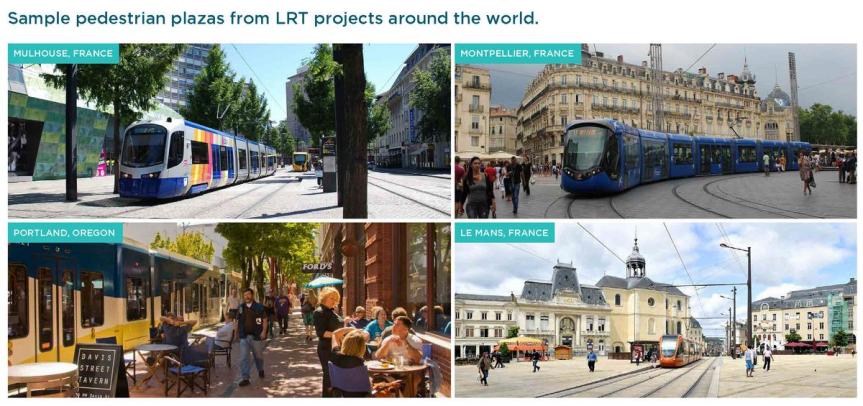
Taking inspiration from leading cities around the world, Surrey Central and King George Stations in City Centre are designed to be integrated into new pedestrianized public plazas. These plazas will help to create vibrant transfer points between LRT and SkyTrain’s expo line, similar to plaza’s found throughout Europe with multi-modal rail connections running through them. 

Socio-Economic Study: Improved Travel Times

A key finding of the socio-economic study released at the open house, was the improvement in travel times that LRT will offer over the existing 96 B-Line bus service, as well as private automobile. Under Section 7.2 of the study it was found that the existing 96 B-Line service between Guilford-Newton currently takes 29 minutes under ideal conditions. During periods of congestion however, this trip can take longer than 50 minutes. Further, this travel time is expected to worsen as population grows. LRT is able to cut this travel time by up to half, taking a consistent 27-minutes every time, on opening day, and a decade later, due to its dedicated track. In addition to this, LRT offers faster service and improved experience due to:

  • More doors for boarding, significantly reducing stop times at stations, and travel times overall.
  • Nearly twice as frequent peak service as the existing 96 B-Line peak bus service.
  • A smoother, more comfortable ride than B-Line bus, with less stop and go.

96 B-Line subject to traffic congestion – travel times between Guildford and Newton up to 50 mins during peak hours.

Integration with the Community

One of the key benefits of LRT is its integration with the community and streetscape compared to SkyTrain. While SkyTrain serves well as a long distance commuter rail service, LRT is better suited to more localized routes in the region – similar to other cities where there are various tiers of rail transit making up the regional transit network.  Not every line in a city needs to be the same type of rail transit – LRT, Subway, and Commuter Rail are often combined to compliment each other and serve different needs. The introduction of LRT to Metro Vancouver represents a maturing of our rail transit network into a multi-modal system, and it is very likely we will see LRT implemented elsewhere in the region following Surrey.

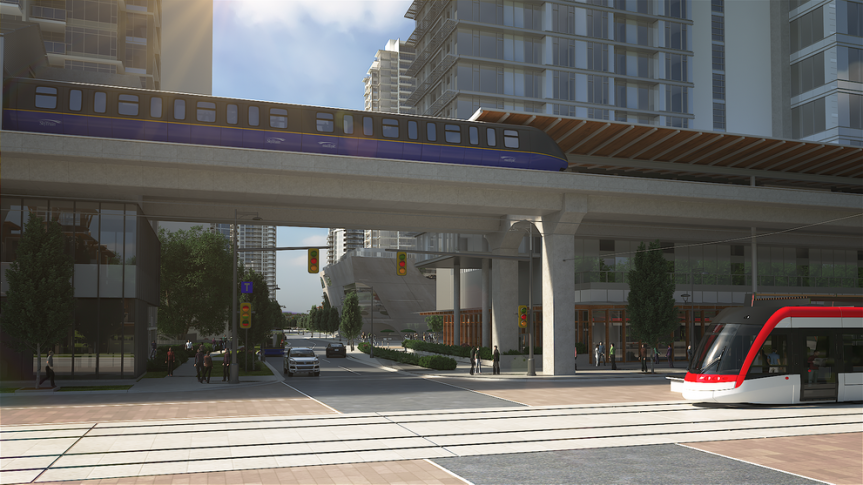
In Surrey, the 104 Avenue and King George Highway corridors that make up the ‘L’ line are much better suited to urban-style LRT than SkyTrain. Not only is this route more localized than regionally serving, but SkyTrain just doesn’t make sense from a cost perspective, and the impacts that such guideways would have on the streetscapes. Looking at a comparison between SkyTrain guideways in Richmond City Centre and Coquitlam City Centre, it is clear to see how much better LRT integrates with the streetscape and community it passes through, rather than bisecting it with an obtrusive, shadowing, and noisy concrete structure. LRT can transform a streetscape into an inviting, pedestrian friendly, vibrant urban environment – whereas SkyTrain does the opposite. 

Impact of SkyTrain guideways on the urban environment/streetscape vs urban-style LRT

For more on Surrey LRT:

https://surreylightrail.ca

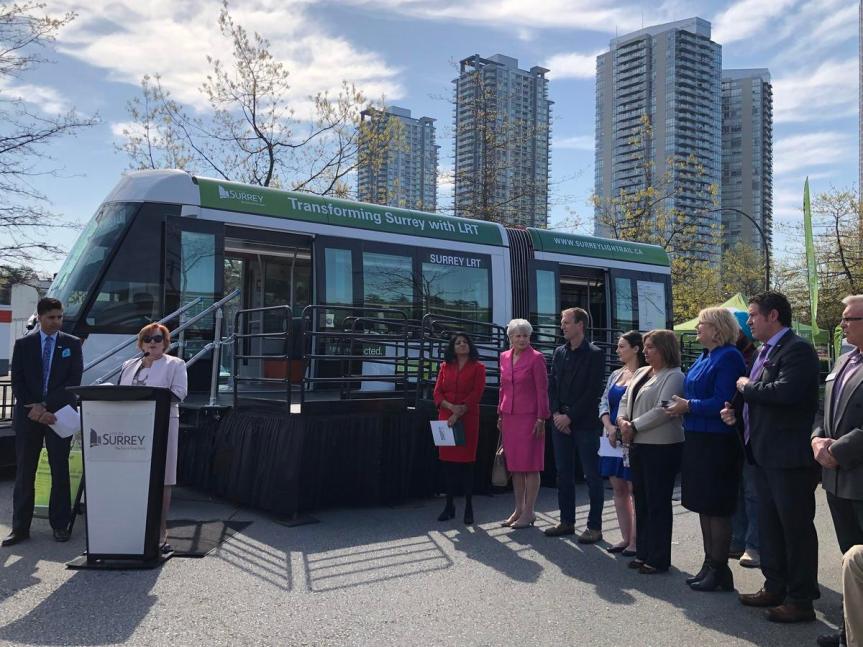
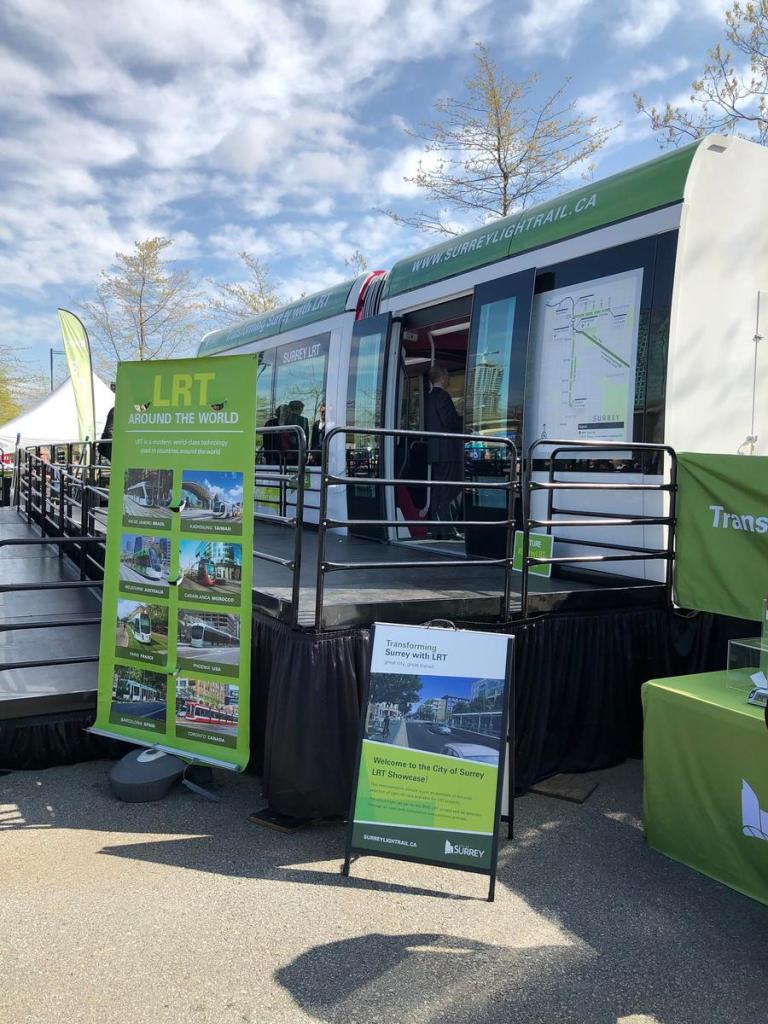
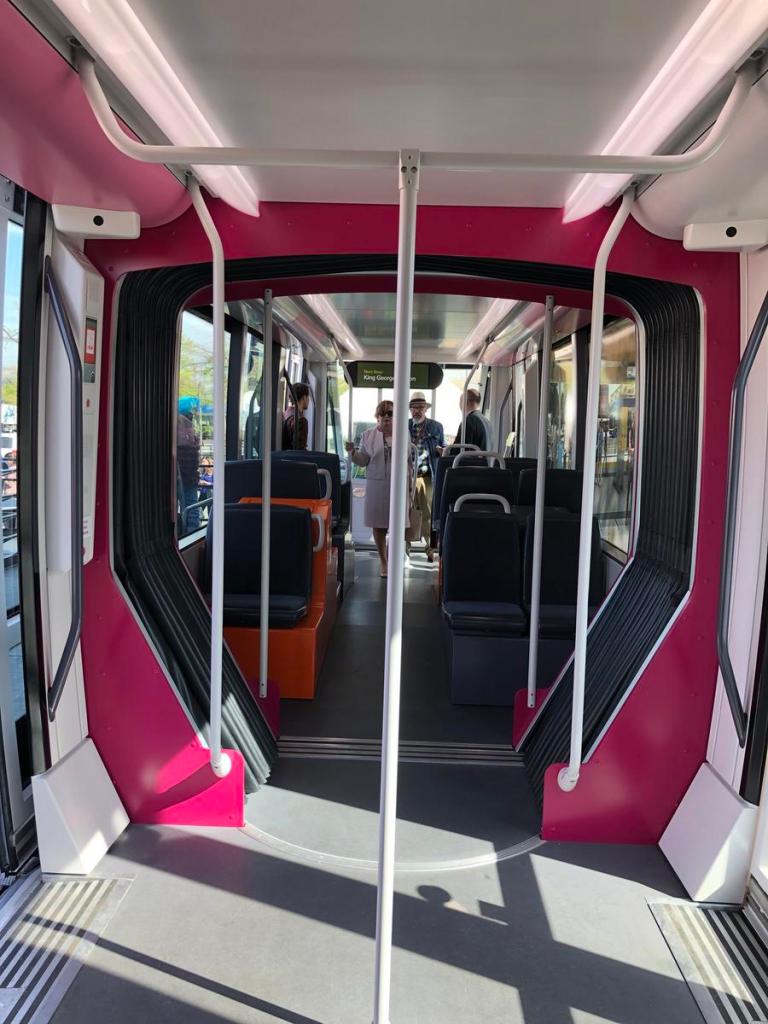
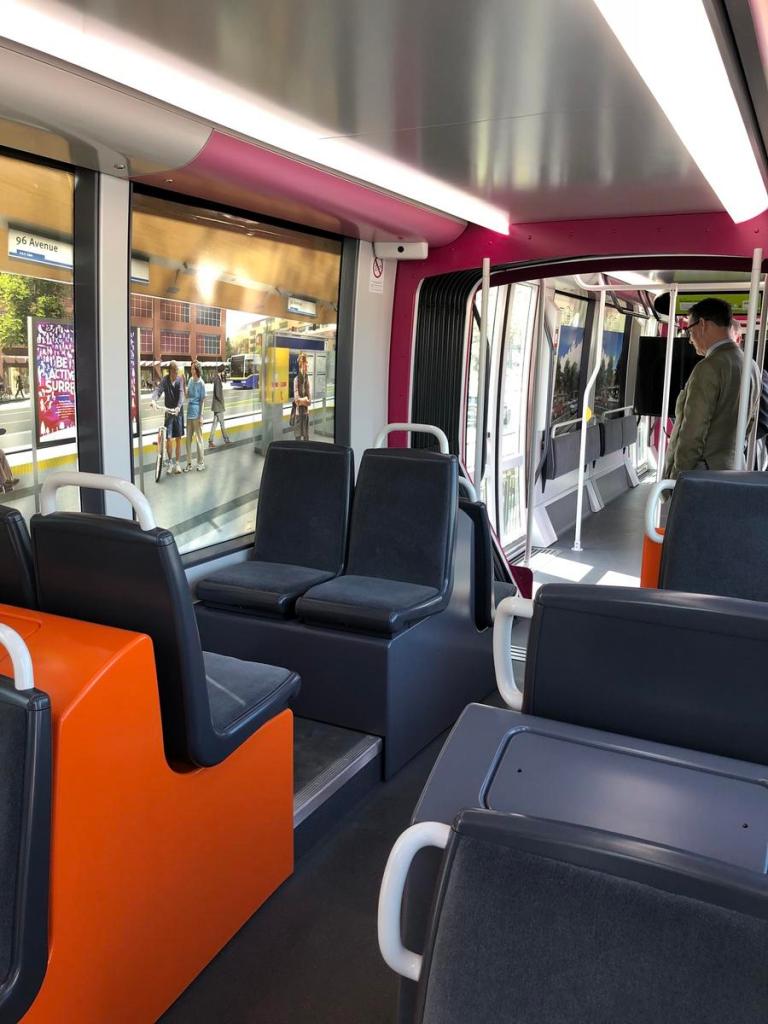
Numerous community and business leaders joined Mayor Linda Hepner today to launch an 8-week LRT showcase, offering residents a first glimpse at Surrey’s future LRT. As part of the showcase, a prototype LRT train car has been brought in from Europe and put on display in the Central City parking lot next to King George Blvd. It will remain there for the next couple of weeks before being relocated to Newton Town Centre, Guildford Town Centre, and finally the Surrey Canada Day celebration in Cloverdale.

The goal of the showcase is to give residents a first-hand look at what the urban-style LRT train will look like. Unlike high-floor commuter-type LRT trains like those in Calgary and Edmonton, Surrey’s LRT will be low-floored, similar to those found in many cities throughout Europe, and even Toronto. Despite being more integrated with the urban environment, the trains will nonetheless run on a dedicated right-of-way, apart from traffic, offering significant improvement over a bus – not only in speed, but also through more consistent/reliable schedules, frequency, capacity, boarding doors, and comfort. It is important to point out that the particular train car brought in for display is just a prototype, and the actual trains chosen for the Surrey line, will likely look a bit different.

LRT was chosen as the mode of choice for rapid transit in Surrey following years of study that began as far back as 2010. Numerous options, and combinations were looked at including LRT, SkyTrain, and Bus Rapid Transit. The results found LRT to be the most cost effective system for Surrey – with 27km of LRT track (2 lines) able to be built for the same $2.2 billion price tag as 16km of SkyTrain (1 line). Surrey gets a more extensive rail transit network, better integrated with the community, creating more pedestrian-orientated streetscapes, with LRT. Further, operating costs for LRT were found to be $6 million cheaper annually, with negligible differences in travel times.

The long-awaited first phase of Surrey’s LRT is a go-ahead, following today’s announcement of an agreement between the provincial government and the Mayor’s Council to fund the project. Billed as the largest transit and transportation investment in the history of the Metro Vancouver region, the plan will see:

  • Construction of the Surrey Guildford-Newton Light Rail (LRT)
  • Construction of Millennium Line Broadway Extension
  • Significant upgrade of existing Expo-Millennium Lines to expand capacity to meet and improve the customer experience
  • An 8% increase in bus service to address overcrowding, reduce wait times and bring bus services to communities with limited service
  • Improvements to sidewalks, bikeways, multi-use pathways and roadways

According to the media release, delivery of these projects will be funded by:

  • $1.6 billion in fare revenues expected from higher ridership resulting from service expansion in Phase Two, TransLink resources and efficiencies.
  • A 2% increase to all transit fares over two years beginning in 2020.
  • Parking lot sales tax increase of 15 cents per hour for an average $5 per hour parking.
  • $5.50 increase in property taxes per average household each year or about 46 cents a month, beginning in 2019.
  • About $300 to $600/unit increase to the Development Cost Charge on new residential developments depending on type of dwelling.
  • Revenue from a variety of transit-related commercial opportunities.

Construction by 2019 – Phase 1 Completion by 2024

While federal matching of the provincial funding still needs to be finalized, it is expected that the first phase of the Surrey LRT line between Guildford – City Centre – Newton will likely be under construction by late 2019, with completion by 2024. Not only will the project bring a new a rapid transit line to the South Fraser, it will also be a game-changer in how it will integrate with, and transform the neighbourhoods it passes through. In conjunction with the City Centre Plan and the Guildford-104 Avenue Plan, LRT corridors will be gradually transformed with 4-6-storey density along each route, with higher density mixed-use nodes at key intersections and throughout City Centre, Guildford Town Centre, and Newton Town Centre.

Planned route of Phase 1 & 2 of the Surrey LRT network Conceptual rendering of a revitalized Newton Town Centre with LRT integration Conceptual rendering of King George Blvd in Newton with LRT, bike-lanes, and 4-6-storey urban density Conceptual rendering of LRT plaza integration at Newton Town Centre Conceptual rendering of LRT integration along a repurposed 104 Avenue corridor LRT integration on a pedestrianized City Parkway at Central Ave in City Centre

A new tier of rapid transit for Metro Vancouver

LRT will introduce a new layer of rapid transit service to Metro Vancouver that is complimentary to SkyTrain. It will serve as a more localized, finer-grained service, compared to SkyTrain which can be seen as more of a regional commuter train service. Tiered transit systems are common around the world, with various forms of rail combining to form an intricate and dynamic transit network. A good example of this is Berlin, Germany where there are 4 tiers of rail within its robust transit network. These include:

  • Regional Train (Comparable to WestCoast Express)
  • S-Bahn (Suburban service)
  • U-Bahn (Urban service – Comparable to SkyTrain)
  • MetroTram LRT (Fine-grained urban service)

All of these lines converge at hub stations, with each tier serving a specific purpose.

Berlin rapid transit system featuring 4 tiers of rail – LRT lines shown in light grey

Example – Tiers of Rail Transit in Berlin

Regional Train (Comparable to West Coast Express) S-Bahn – Suburban service (No comparison in Metro Vancouver) U-Bahn – Urban service (Comparable to SkyTrain) MetroTram (LRT) – Fine-grained urban service

Surrey LRT will bring the first fine-grained rail service to Metro Vancouver – appropriate for routes that are more localized, and less regional – such as the Guildford-City Centre-Newton line – but connecting to SkyTrain for regional commuter travel at hub stations. It is likely that we could see LRT build elsewhere in the region following Surrey, given its cost-effectiveness and appropriate scale for many other parts of the region.

King George – UrbanSurrey

The City of Surrey began a series of 3 open houses on Thursday for Phase 1 of the upcoming Surrey LRT project. This latest public engagement is the 3rd round of open houses on Phase 1 the project, providing refined plans based on public input from previous consultations. Presented at the open house were preliminary station designs, road designs, information on construction planning, environmental and socio-economic study results, and more. A full set of the Open House Boards can be found here.

Station Designs

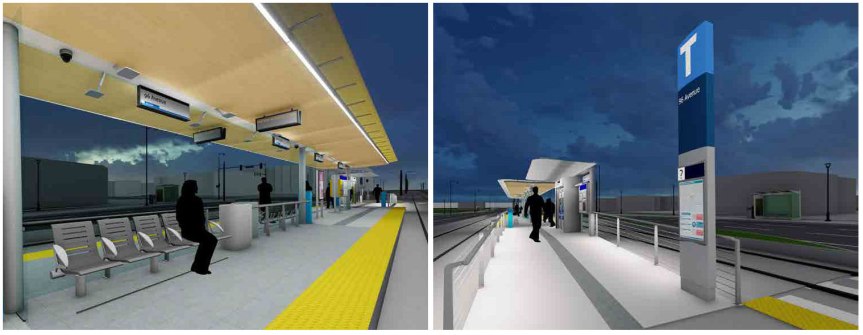
Overall, stations are designed to be highly visible, well-lit, and well integrated into the community – accessible by well-marked pedestrian crossings providing universal accessibility for all riders. Lengthy platform shelters protect riders from weather, and include space for ATM’s, information boards, seating, and more – while maintaining a clear line of sight to the street and approaching trains. Stations will in most cases be located in the centre median of the street, with the exception of King George, Surrey Central and Newton Town Centre – where they will be plaza oriented, or off to the side. Public art will also be integrated into stations along the route.
Roadway Design

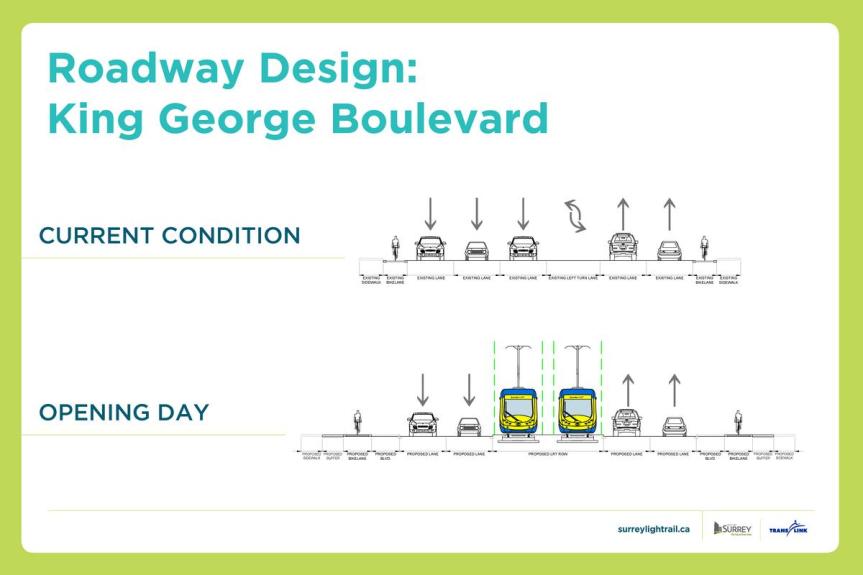
LRT will run on its own dedicated track for the entirety of the line, with the exception of City Parkway where it will be integrated into a pedestrian plaza. Placement of the LRT track will vary – typically located in the centre median for most of the route, but off to the side in some sections.

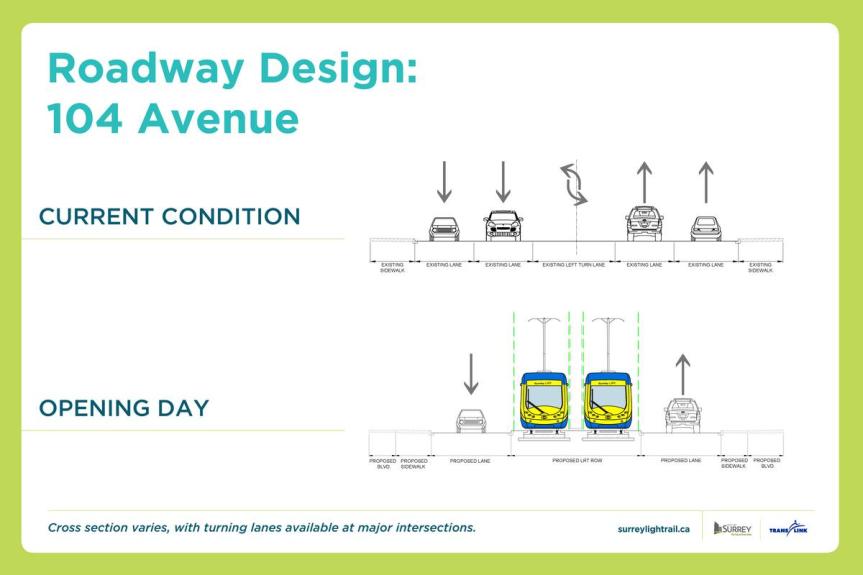
Roadway design for 104 Avenue will consist of LRT in the centre median, and 1 traffic lane in each direction, widening to include an additional turning lane at major intersections. The 104 Avenue design will also provide upgraded and enhanced sidewalks, pedestrian crossings, and connections to stations. Currently 104 Avenue functions as a non-pedestrian friendly, busy arterial for cars. A re-purposed 104 Avenue with LRT will transform the street into a calmed, pedestrianized and transit-oriented corridor, supported by multi-family housing and streetfront shops along the route. The newly widened 100 Avenue and existing 108th Avenue corridors will become the new car-prioritized east-west routes between City Centre and Guildford while 104 Avenue will be the pedestrian/transit prioritized corridor.
Roadway design for King George Blvd will retain 2 traffic lanes in each direction while allowing for LRT in the median for the majority of the route. Sections of King George in City Centre will see LRT routed off to one side. New separated bike lanes, enhanced sidewalks, and pedestrian crossings will also be a key component of the re-designed King George.
Pedestrianized Plazas at Surrey Central & King George Stations

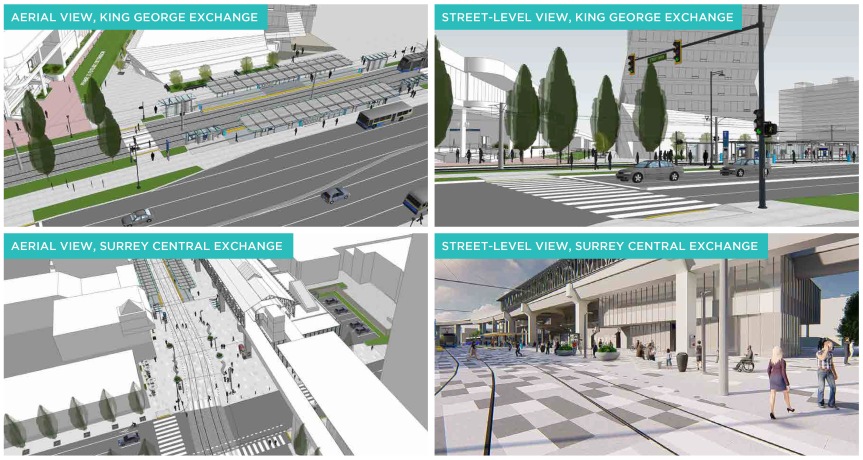
Taking inspiration from leading cities around the world, Surrey Central and King George Stations in City Centre are designed to be integrated into new pedestrianized public plazas. These plazas will help to create vibrant transfer points between LRT and SkyTrain’s expo line, similar to plaza’s found throughout Europe with multi-modal rail connections running through them. 
Socio-Economic Study: Improved Travel Times

A key finding of the socio-economic study released at the open house, was the improvement in travel times that LRT will offer over the existing 96 B-Line bus service, as well as private automobile. Under Section 7.2 of the study it was found that the existing 96 B-Line service between Guilford-Newton currently takes 29 minutes under ideal conditions. During periods of congestion however, this trip can take longer than 50 minutes. Further, this travel time is expected to worsen as population grows. LRT is able to cut this travel time by up to half, taking a consistent 27-minutes every time, on opening day, and a decade later, due to its dedicated track. In addition to this, LRT offers faster service and improved experience due to:

  • More doors for boarding, significantly reducing stop times at stations, and travel times overall.
  • Nearly twice as frequent peak service as the existing 96 B-Line peak bus service.
  • A smoother, more comfortable ride than B-Line bus, with less stop and go.
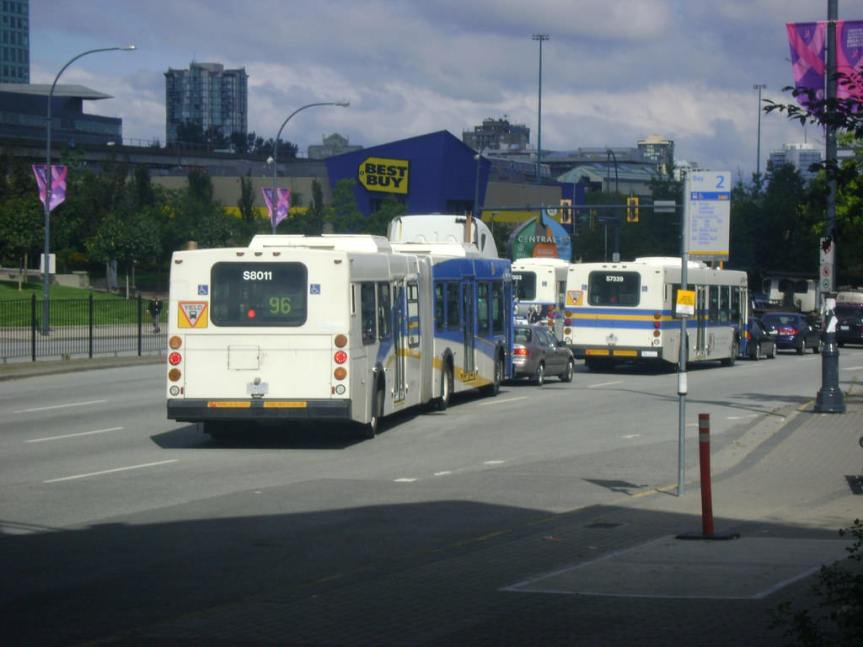
96 B-Line subject to traffic congestion – travel times between Guildford and Newton up to 50 mins during peak hours.

Integration with the Community

One of the key benefits of LRT is its integration with the community and streetscape compared to SkyTrain. While SkyTrain serves well as a long distance commuter rail service, LRT is better suited to more localized routes in the region – similar to other cities where there are various tiers of rail transit making up the regional transit network.  Not every line in a city needs to be the same type of rail transit – LRT, Subway, and Commuter Rail are often combined to compliment each other and serve different needs. The introduction of LRT to Metro Vancouver represents a maturing of our rail transit network into a multi-modal system, and it is very likely we will see LRT implemented elsewhere in the region following Surrey.

In Surrey, the 104 Avenue and King George Highway corridors that make up the ‘L’ line are much better suited to urban-style LRT than SkyTrain. Not only is this route more localized than regionally serving, but SkyTrain just doesn’t make sense from a cost perspective, and the impacts that such guideways would have on the streetscapes. Looking at a comparison between SkyTrain guideways in Richmond City Centre and Coquitlam City Centre, it is clear to see how much better LRT integrates with the streetscape and community it passes through, rather than bisecting it with an obtrusive, shadowing, and noisy concrete structure. LRT can transform a streetscape into an inviting, pedestrian friendly, vibrant urban environment – whereas SkyTrain does the opposite. 
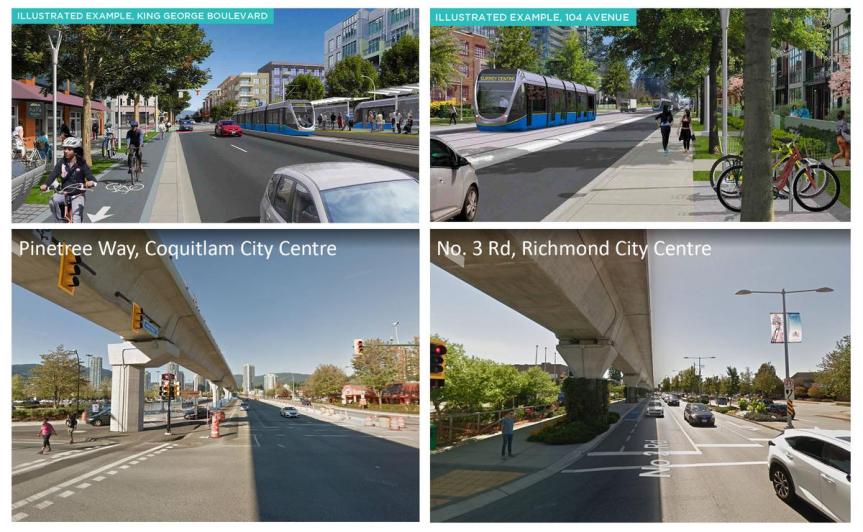
Impact of SkyTrain guideways on the urban environment/streetscape vs urban-style LRT

For more on Surrey LRT:

https://surreylightrail.ca